-

Written By Rohan Wiese
-
Updated on January 2nd, 2026
Best Ways to Restore SQL Server Database Without Backup Files
Many administrators often face questions like, “I have all the SQL database files, but no backup—can I reinstall SQL Server and rebuild the database?” Generally, this situation arises after server failure, accidental deletion, or improper backup configuration. So they want to restore SQL Server database without backup. This guide explains all practical recovery possibilities, risks, and safe alternatives with Aryson SQL Database Recovery Software. It helps administrators make the right decision during critical downtime. Download Now Purchase Now
Anonymous Asked Question on Reddit: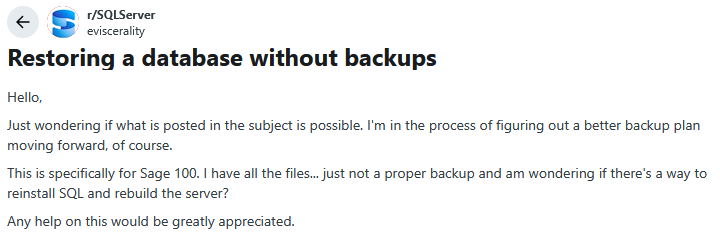
In real-world environments, in ERP-based applications such as Sage 100, losing a proper SQL backup is not uncommon. Although Microsoft strongly recommends regular backups, practical scenarios do not always follow best practices. As a result, administrators must look for reliable ways to restore a SQL Server database without a backup while ensuring minimal data loss.
Is It Possible to Restore a SQL Server Database without Backup?
Yes, it is possible to restore a SQL Server database without a backup, but only under specific conditions. The success of recovery mainly depends on the current state of the database and the availability of database files. Basically, you can recover SQL Server database without backup when:
- MDF and LDF files still exist on the server.
- Database corruption is logical, not physical.
- The database enters SUSPECT, OFFLINE, or EMERGENCY mode.
However, recovery is not guaranteed in every scenario. If the database files are overwritten, severely corrupted, or physically damaged, manual recovery methods may fail. Therefore, administrators must first assess the situation carefully before applying any recovery approach.
Major Reasons Why SQL Server Backup Is Not Available
Before starting the recovery process, administrators should clearly understand why the SQL Server backup is missing. This understanding helps in selecting the most effective recovery method. Some of the most common reasons include:
- Accidental deletion of backup files during cleanup.
- Corrupted or incomplete backup sets caused by failed jobs.
- Disk or RAID failure, leading to data loss.
- Ransomware or virus attacks that encrypt or delete backups.
- SQL Server Agent job failure due to misconfiguration.
- Improper backup configuration or disabled maintenance plans.
In many situations, administrators only realize the problem when the database becomes inaccessible or stops responding. As a result, recovery becomes urgent and time-sensitive.
Essential Pre-Recovery Checks for SQL Server Databases
These checks help prevent further damage and improve recovery success.
- Database state in SQL Server Management Studio (ONLINE, SUSPECT, or OFFLINE).
- Availability of MDF and LDF files on the server.
- SQL Server error logs to identify the root cause.
- Disk health and free space to avoid additional corruption.
If the MDF file is available and readable, the chances of successful recovery increase significantly. Therefore, administrators should never skip this evaluation stage before moving forward to restore SQL Server database without .bak file.
Methods to Restore SQL Server Database without Backup
When a SQL Server backup is missing, administrators can still try a few recovery methods. The success of these methods depends on the database condition, available files, and level of corruption. Each method works in a different situation and has certain limits. Because of this, it is important to understand the options before using any SQL Server database restore methods:
Method 01: Restore SQL Server Database Using Existing MDF and LDF Files
Here is how to restore SQL Server without backup with the manual steps:
- First, stop the SQL Server service to prevent any active connections.
- Then, copy the MDF and LDF files to a safe location.
- Next, open SQL Server Management Studio.
- Now, right-click on Databases and select Attach.
- After that, browse and select the required MDF file.
- Click OK to attach the database and restore SQL Server.
If the LDF file is missing, SQL Server may automatically recreate it during the attach process.
Method 02: Recover SQL Server Database from SUSPECT Mode
When SQL Server cannot complete database recovery during startup, it marks the database as SUSPECT. Usually, it indicates internal consistency issues.
- Set the database to EMERGENCY mode.
- Switch the database to SINGLE_USER mode.
- Run the DBCC CHECKDB command.
- Change the database back to MULTI_USER mode.
Important Note: Although this method can bring the database online, it may remove corrupted data. Therefore, administrators should proceed carefully.
Method 03: Repair SQL Database Using DBCC CHECKDB
DBCC CHECKDB is a built-in SQL Server utility designed to identify and repair database corruption. Administrators often use it when no backup is available.
- Set the database to SINGLE_USER mode.
- Execute DBCC CHECKDB with the repair option.
- Now, allow SQL Server to fix detected issues.
- Switch the database back to MULTI_USER mode.
Point To Remember: Although manual recovery methods can sometimes help restore a SQL Server database without a backup, they often carry high risks, including possible data loss, complexity, and limited success in severe corruption scenarios.
Also Read: Repair Index Corruption in SQL Server Database
Method 04: Best Alternative Solution When No Backup Exists
For administrators who want a safe and reliable solution, Aryson SQL Database Recovery Software serves as an excellent alternative. It can handle corrupted, damaged, or inaccessible SQL Server databases when traditional backups are unavailable. This software provides a fully automated recovery process with a user-friendly interface. Hence, it is suitable for administrators at all skill levels.
- Safe & Non-Destructive: Recovers database objects without modifying original files.
- Automated Repair: Scans and fixes corruption automatically with minimal effort.
- Severe Corruption Support: Recovers data from SUSPECT, OFFLINE, or damaged databases.
- Preview Option: Lets you preview recoverable items before saving.
- Wide SQL Compatibility: Supports multiple SQL Server versions, from old to the latest.
- No Backup Required: Restores data directly from MDF, NDF, and LDF files.
Simple Steps to Restore SQL Server Database without Backup
- Download and launch the SQL Database Recovery Software on your system.
- Click the Browse option to locate and select the required MDF file.
- Choose the appropriate recovery mode to analyze the selected database file.
- After the scan completes, select the MDF file and preview the recoverable database objects.
- Enter the SQL Server login credentials and verify database connectivity.
- Finally, click OK and save the recovered SQL database to the desired destination path.
Conclusion
The above blog guided you through all the available solutions to restore SQL Server database without backup. However, manual recovery methods may help when database files are available. However, these approaches often involve risks and require deep technical knowledge. Because of this, administrators must act carefully to avoid further data loss. In more complex cases, a safer recovery approach helps regain access to critical database objects with better control.
Frequently Asked Questions (FAQs)
Q1. Can SQL Server recover data automatically without a backup?
Ans: No, SQL Server does not automatically recover data without a backup. However, recovery is possible using MDF files or repair techniques.
Q2. Is DBCC CHECKDB safe to use without backup?
Ans: DBCC CHECKDB can fix corruption, but it may cause data loss. Therefore, administrators should use it cautiously.
Q3. Can I restore SQL database without backup after ransomware attack?
Ans: Yes, recovery is possible if MDF files are not encrypted or overwritten.
Q4. What is the safest way to restore SQL database without backup?
Ans: Using a reliable Aryson SQL database recovery solution is the safest approach for administrators.
About The Author:

Rohan Wiese is a Technical Content Writer at Aryson Technologies, specializing in databases, e-mail recovery, and e-mail migration solutions. He enjoys conducting research and generating information that assists database administrators, businesses, and novices in resolving issues with MS SQL Server, MySQL databases, Cloud Computing, and Microsoft Exchange.
Realted Post