Table of Contents
Complete Step-by-Step Guide for the Aryson Google Workspace Backup Tool
Easily back up Google Workspace Mailboxes to PST, PDF, MBOX, CSV, EML, and MSG, and migrate mailbox data to Microsoft 365 and Google Workspace (DWD). The software also backs up Google Drive data to a local drive or migrates it to Microsoft 365, Google Workspace (DWD/Admin), or SharePoint Online. Additionally, it migrates Google Chat DMs, group chats, and Spaces to Microsoft 365 or Google Workspace. The software securely backs up emails, contacts, calendars, attachments, Drive files, and chat data while preserving folder hierarchy, conversation details, and metadata.
Migrate Google Mailbox Data
Step 1: Download and install the Aryson Google Workspace Backup Tool.
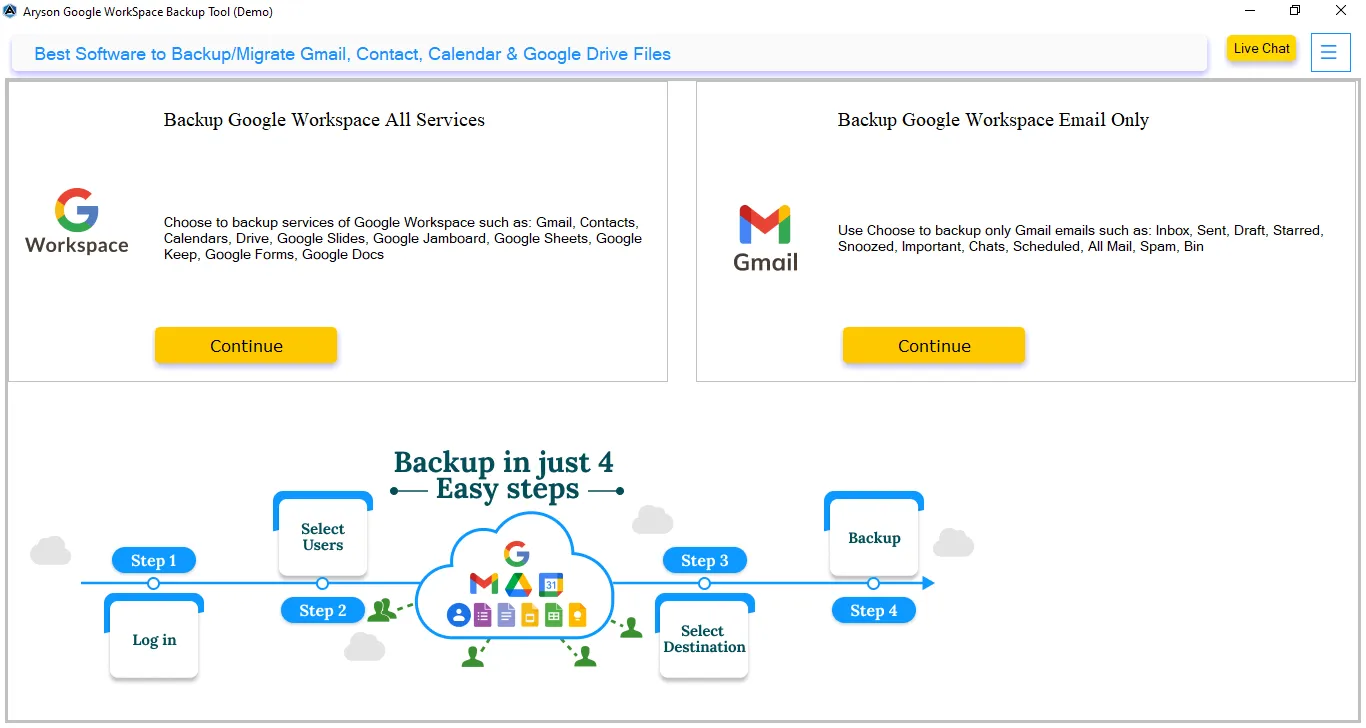
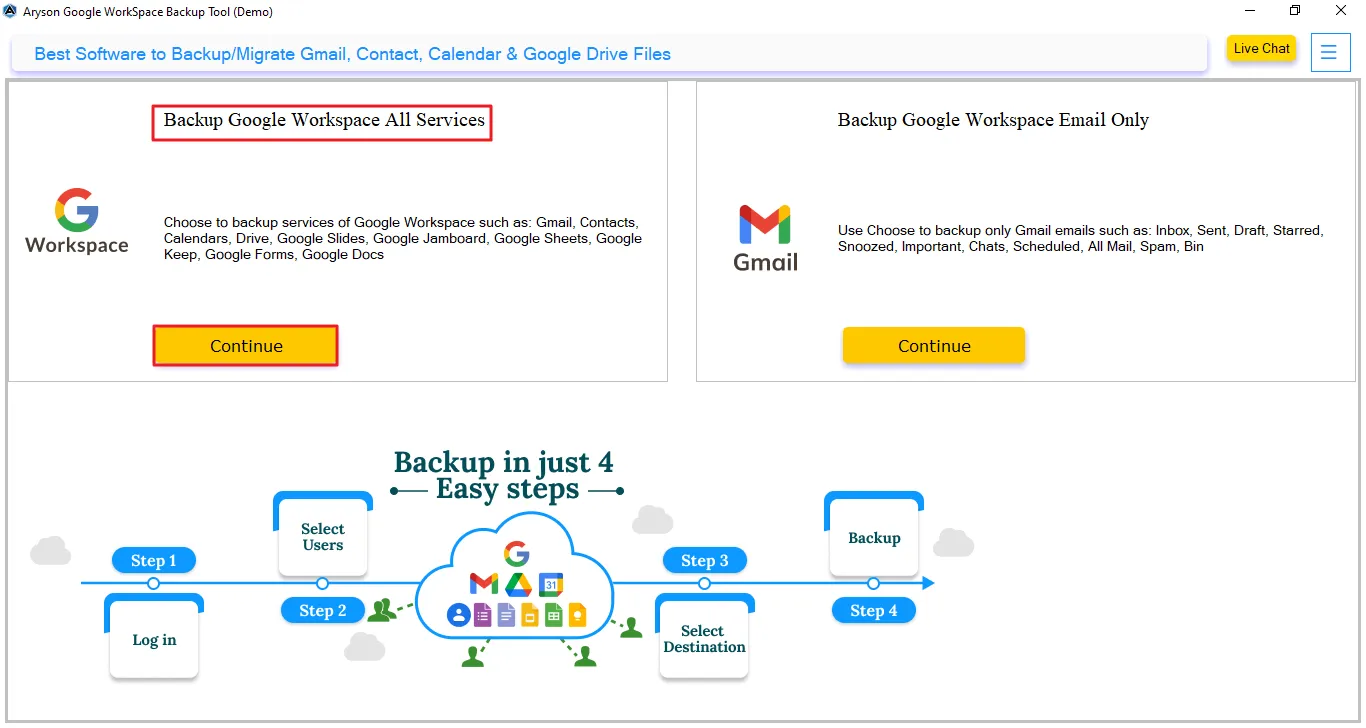
Step 2: Select Mailbox Migration under Choose Migration Mode.
Step 3: Connect Your Gmail Account
The software provides three authentication methods to connect to your Gmail or Google Workspace account. Choose among the A, B, and C migration methods.
Step 3(A): Log in via OAuth 2.0 / Modern Authentication
- Select OAuth 2.0 / Modern Auth.
- Enter the Gmail email address.
- Provide the Client ID and Client Secret generated from the Google Cloud Console (optional).
- If you do not have your own OAuth credentials, enable "I don't have a Client ID & Client Secret."
- (Optional) Enable Remember this account for future logins.
- Click Continue with Google.
- Sign in to your Google account and grant the required permissions.
- The mailbox will be authenticated and added to the software.
Step 3(B): Login via IMAP + App Password
- Select IMAP + App Password.
- Enter the Gmail email address.
- Enter the 16-character Google App Password
- (Optional) Enable Remember this account for future logins.
- Click Continue with IMAP.
- The software verifies the credentials and connects to the mailbox.
- You can have quick access to the saved IMAP accounts.
- You can also use Batch Mode to authenticate multiple Gmail accounts using a CSV file.
Note: Via this method, you can’t fetch contacts, calendars, tasks, and notes. Only emails are migrated.
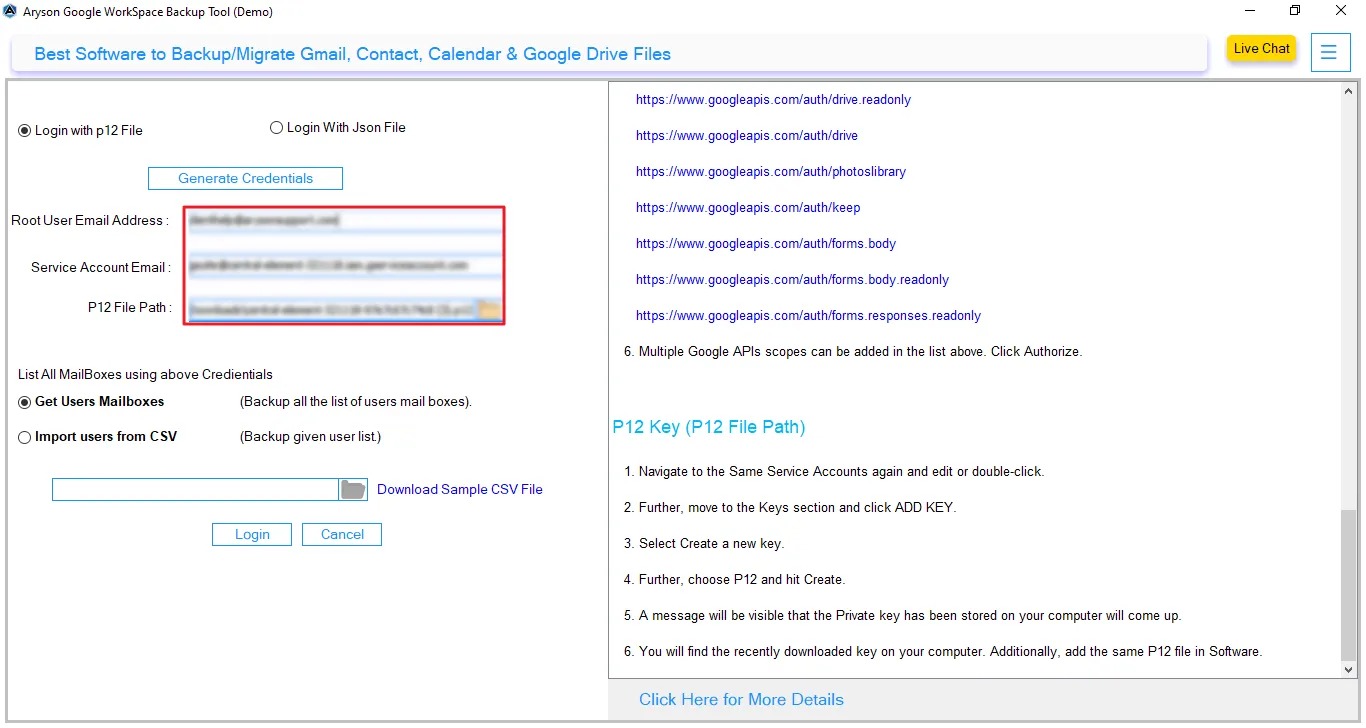
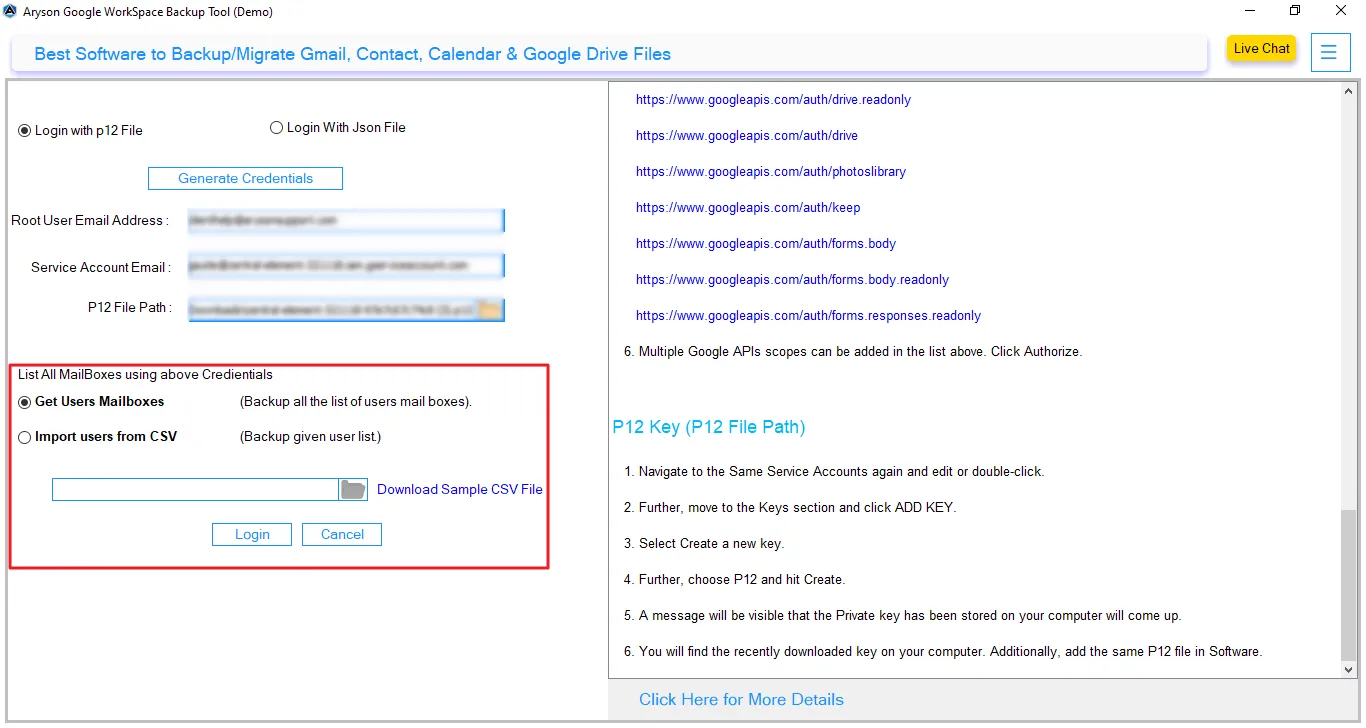
Step 3(C): Log in via Google Workspace Admin (DWD)
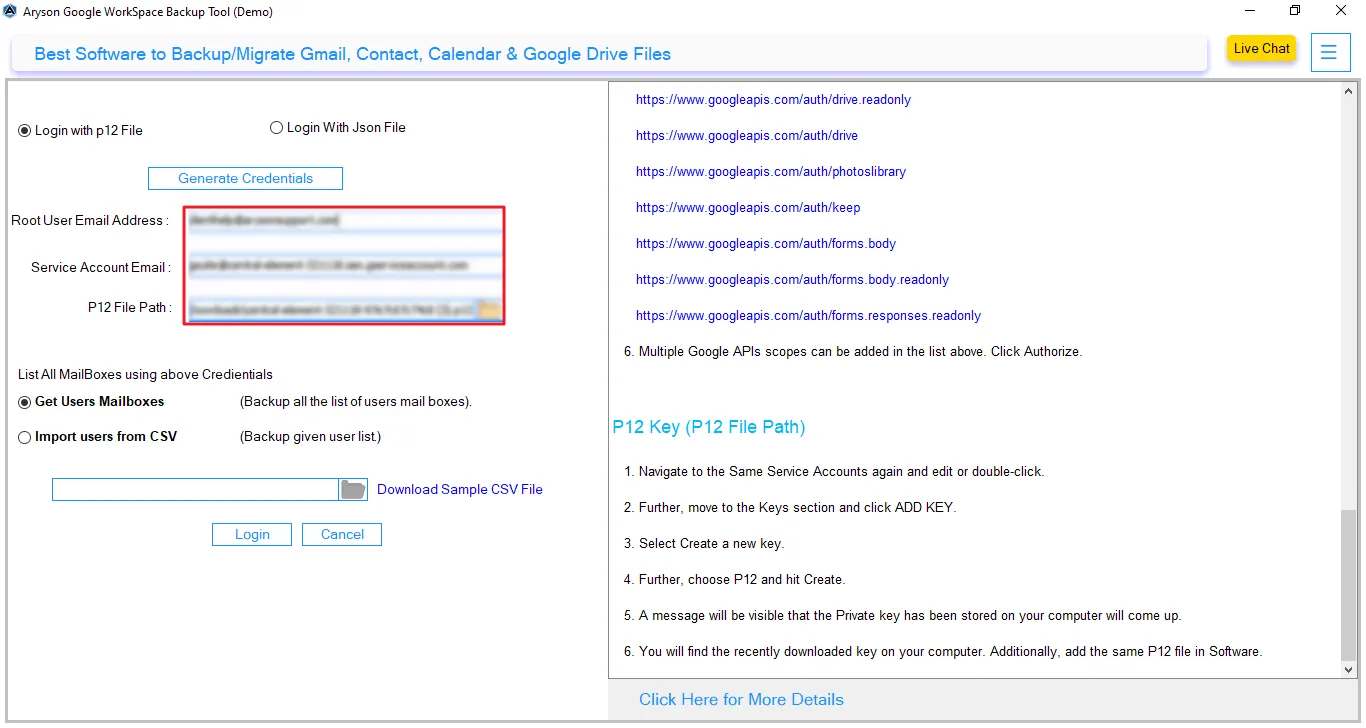
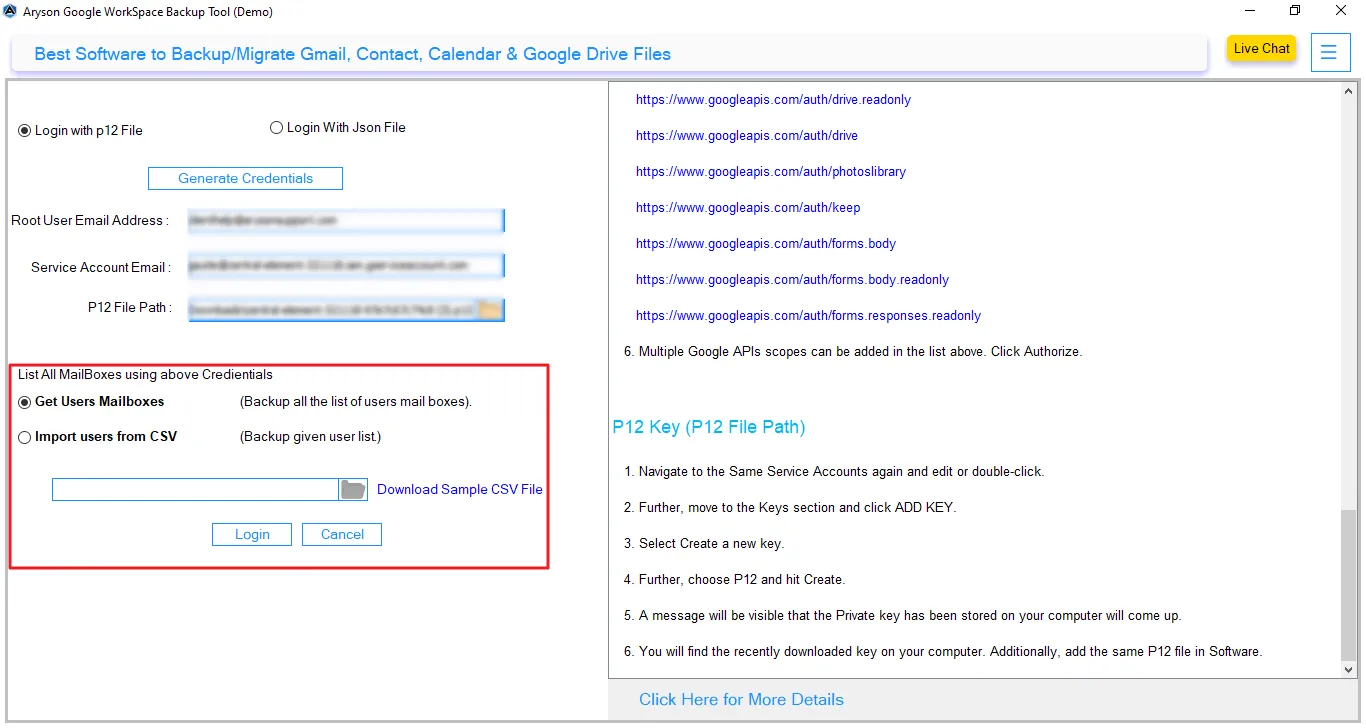
- Select Workspace Admin (DWD).
- Enter the Google Workspace Admin email address.
- Choose the credential type:
- JSON Key File
- P12 Key File
- Click Browse and upload the service account key file.
- (Optional) Enable Remember this account for future logins.
- Click Connect Workspace.
- Alternatively, you can have quick access to the saved Google Workspace account.
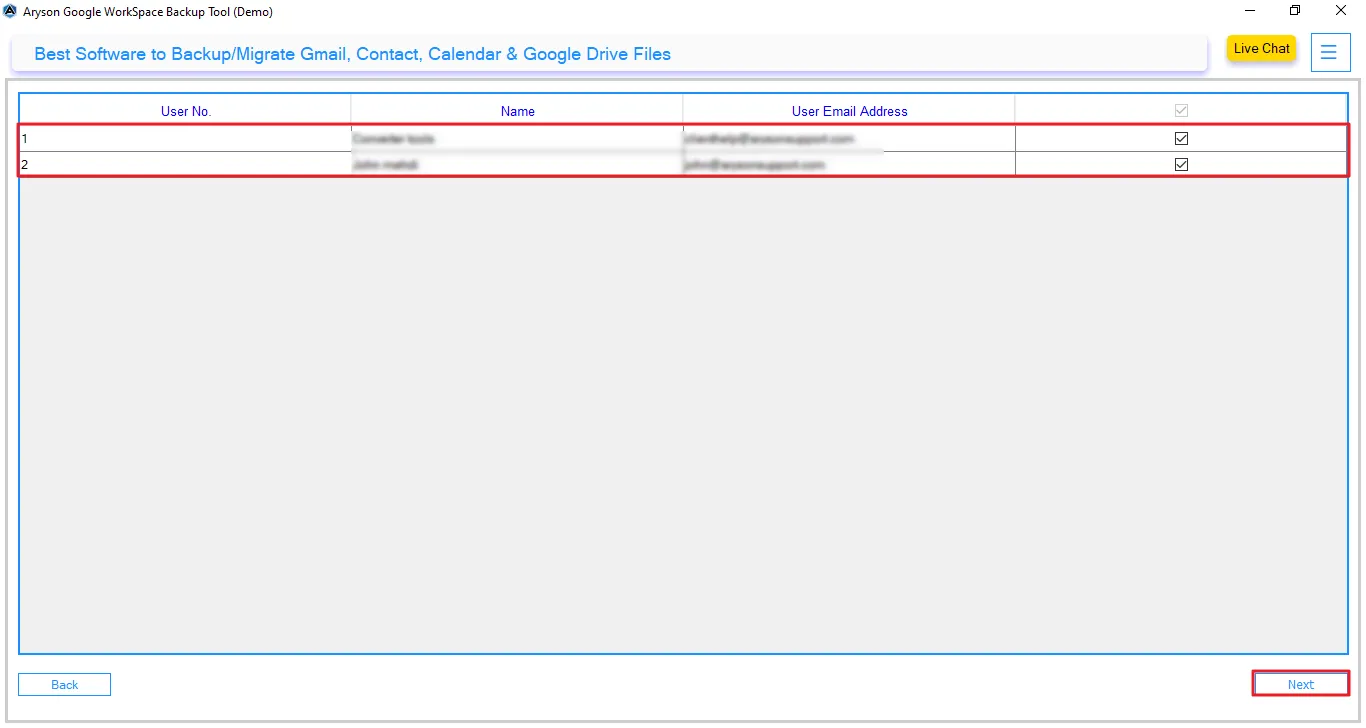
- The software authenticates the Google Workspace domain and loads available user mailboxes.
This method is recommended for bulk mailbox backup and migration.
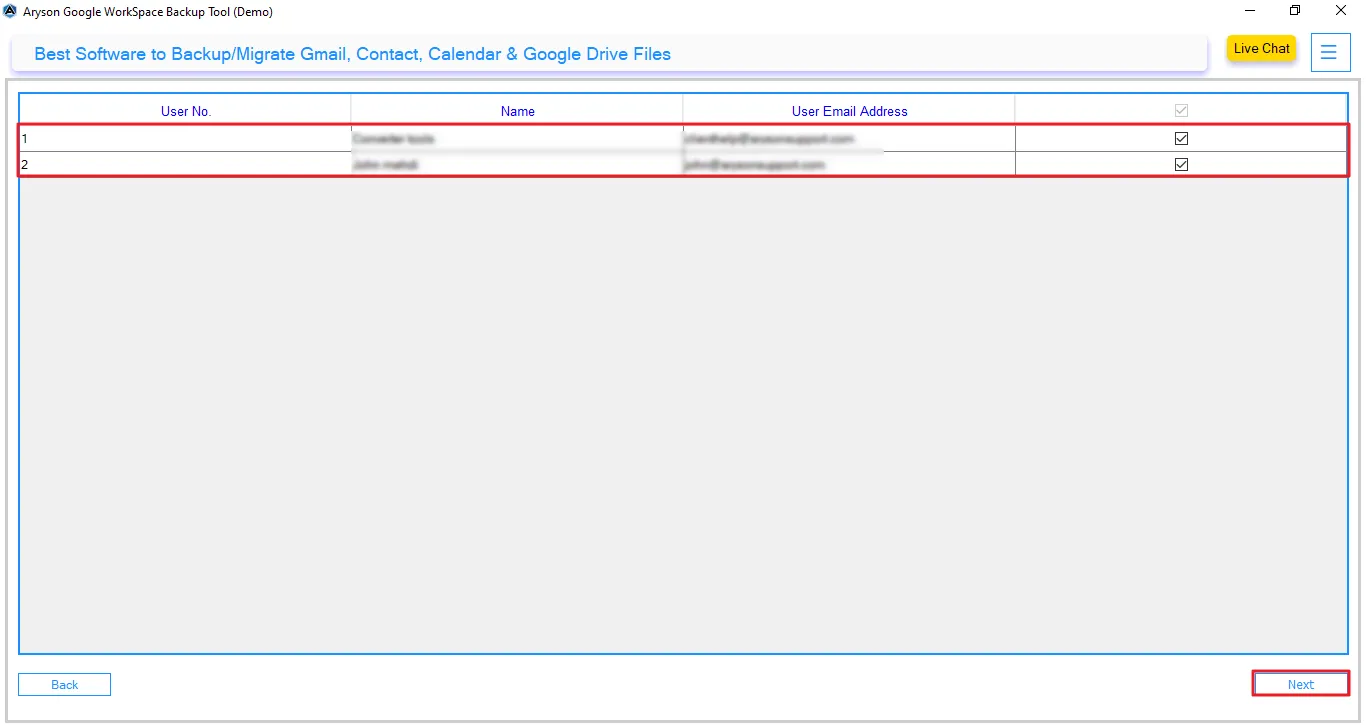
Step 4: Select Google Mailbox for Backup
The software displays all available Gmail mailboxes retrieved from the connected account.
- Select the required mailbox using the checkbox.
- Use Search by Email to quickly find a specific mailbox.
- Review selected mailboxes in the Selected Mailboxes panel.
- Click the Remove (X) icon to remove any mailbox from the selection.
- Verify the licence status of the selected mailbox.
- Check the total number of selected mailboxes at the bottom-right corner.
- Click Continue to proceed to the Folder Hierarchy section.
Step 5: Select Gmail Folders for Backup
The software displays all available Gmail folders and labels from the selected mailbox.
- Select the required folders using the checkbox beside each folder.
- Select All Mail to back up the entire mailbox.
- Use the Search Folders box to quickly locate a specific folder or label.
- Click Show Count to view the number of emails available in a folder.
- Select default Gmail folders such as Inbox, Sent, Drafts, Spam, Trash, and custom labels, and others as needed.
- Use the navigation controls (Prev and Next) to browse additional folders and labels.
- Click Continue to proceed to the Export Format and Filters section.
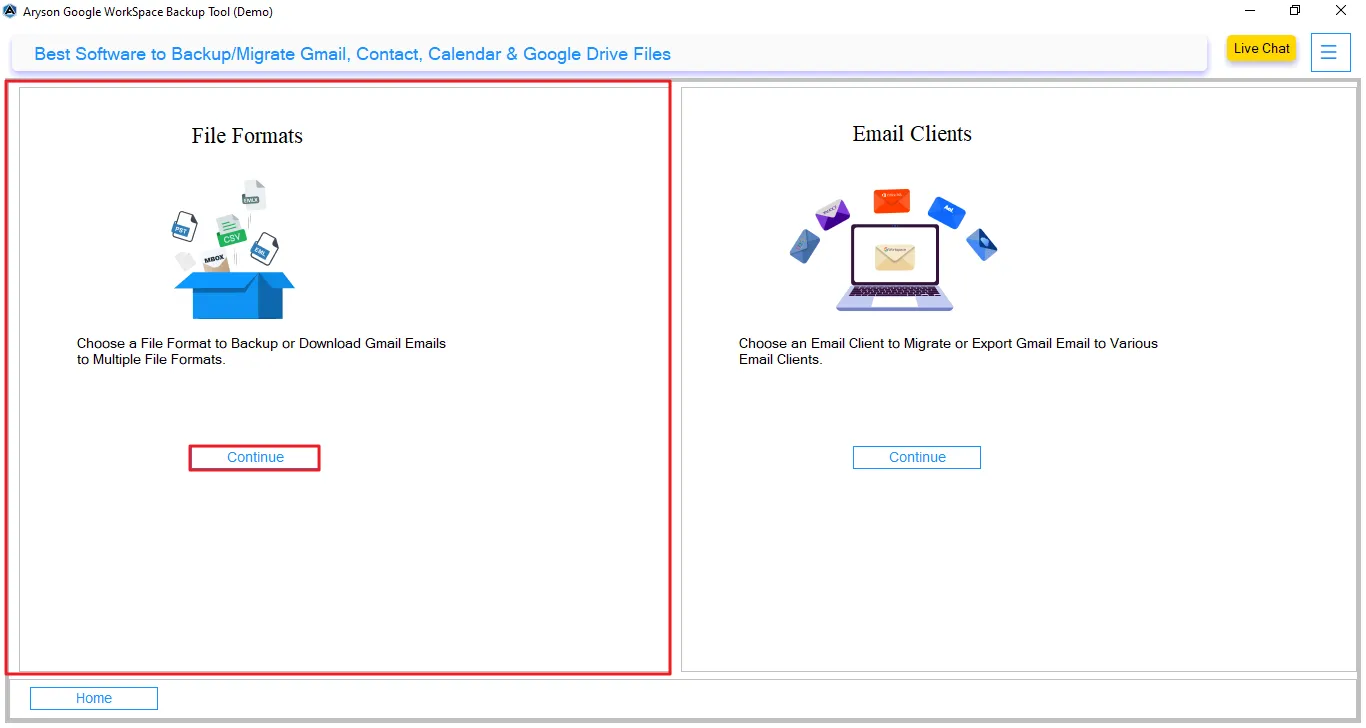
Migrate Gmail/Google Workspace to File Formats
Step 6: Select the Required File Format
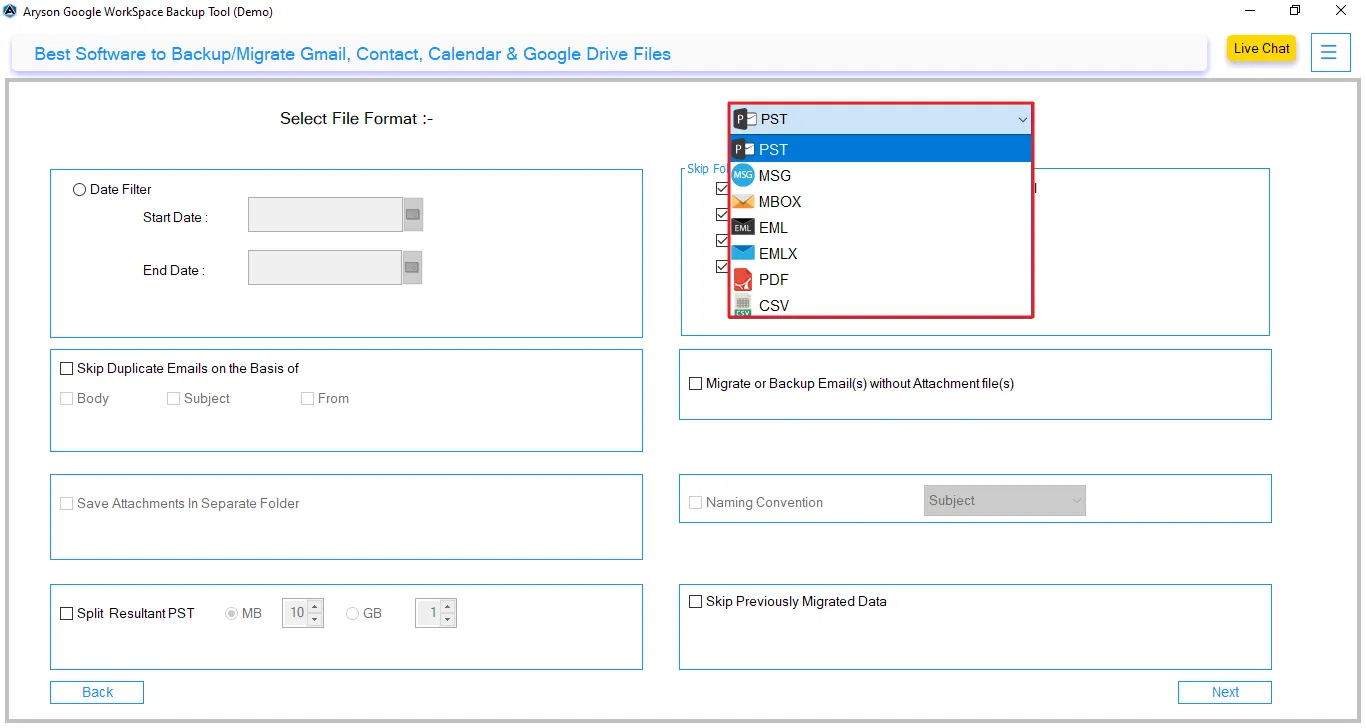
Go to the File Format tab and select the required format from the Export File Format drop-down menu. The Aryson Google Workspace Backup Tool supports PST, PDF, MBOX, CSV, EML, and MSG formats for Google Workspace mailbox data.
Note: Follow the same steps for each available file format. Simply select the desired format from the drop-down menu before starting the migration.
Step 7: Select the Destination Path
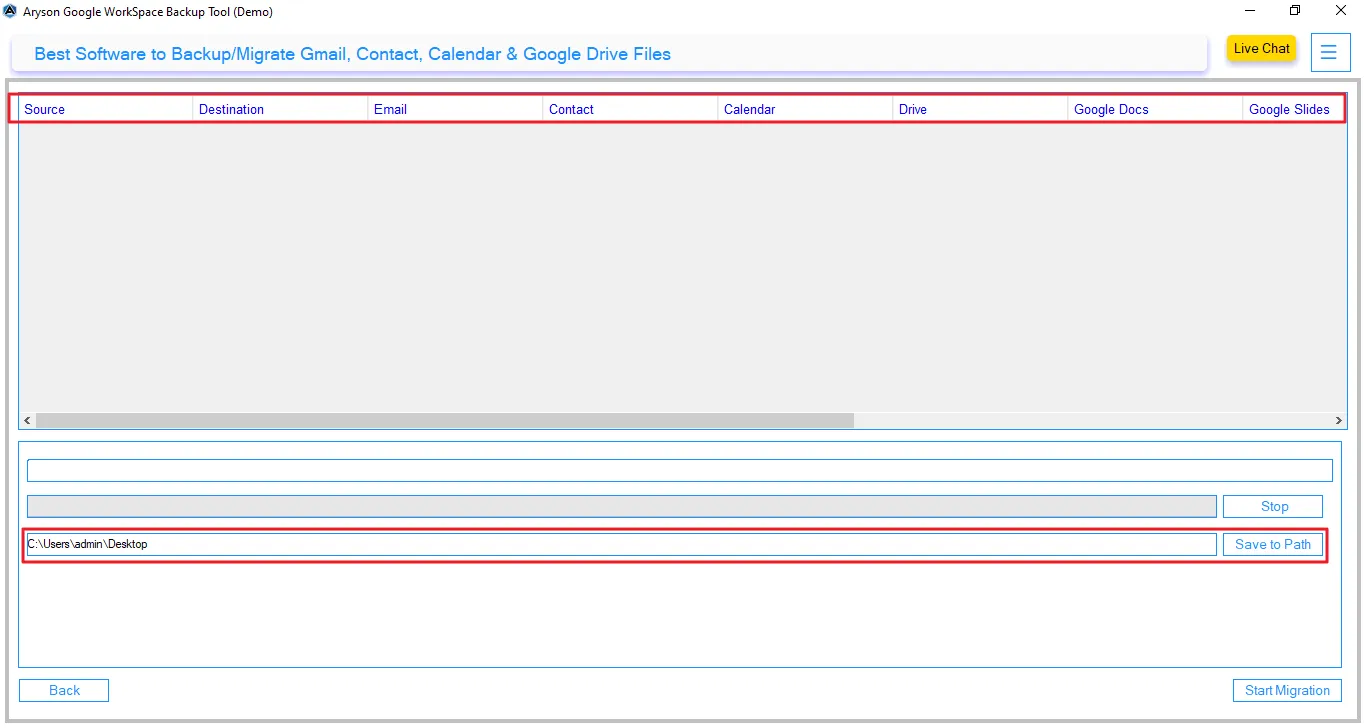
- Click Browse to select the location where the PST file will be saved.
- Choose the desired folder on your local system or external drive.
- Verify the selected destination path before starting the backup.
Step 8: Configure Migration Filters (Optional)
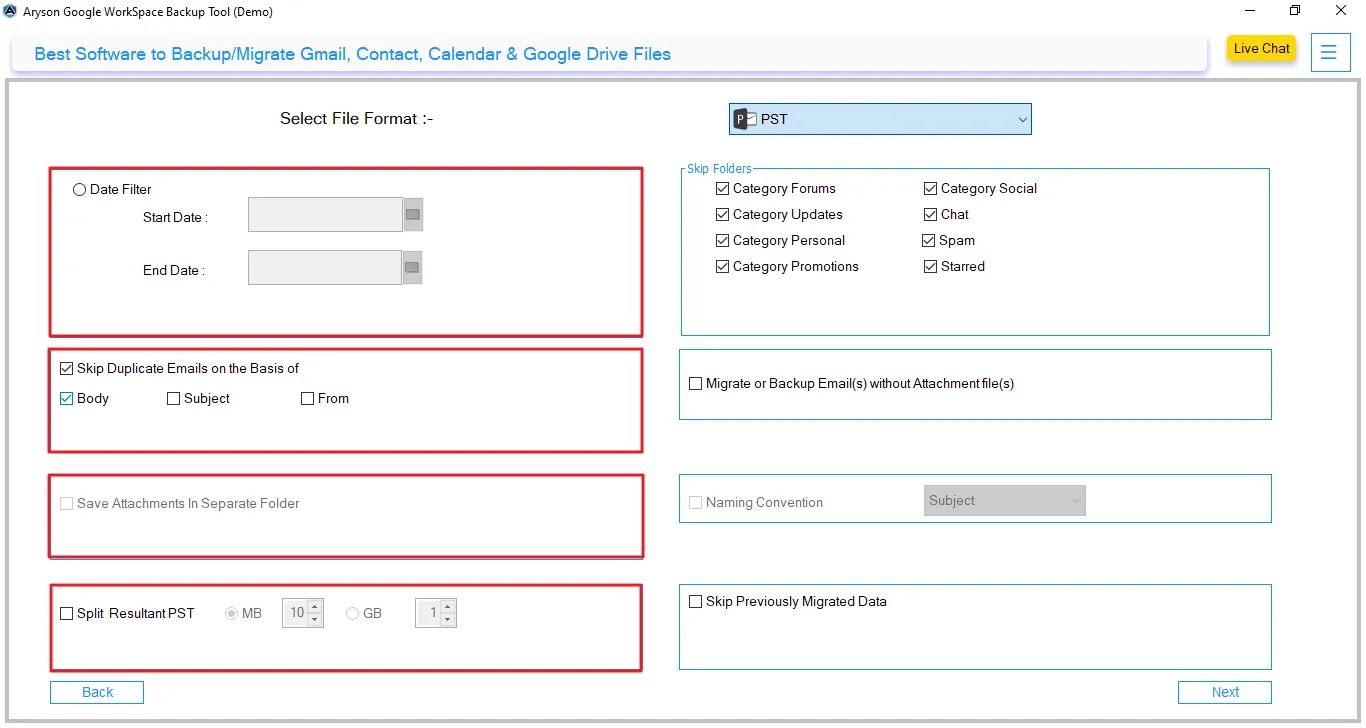
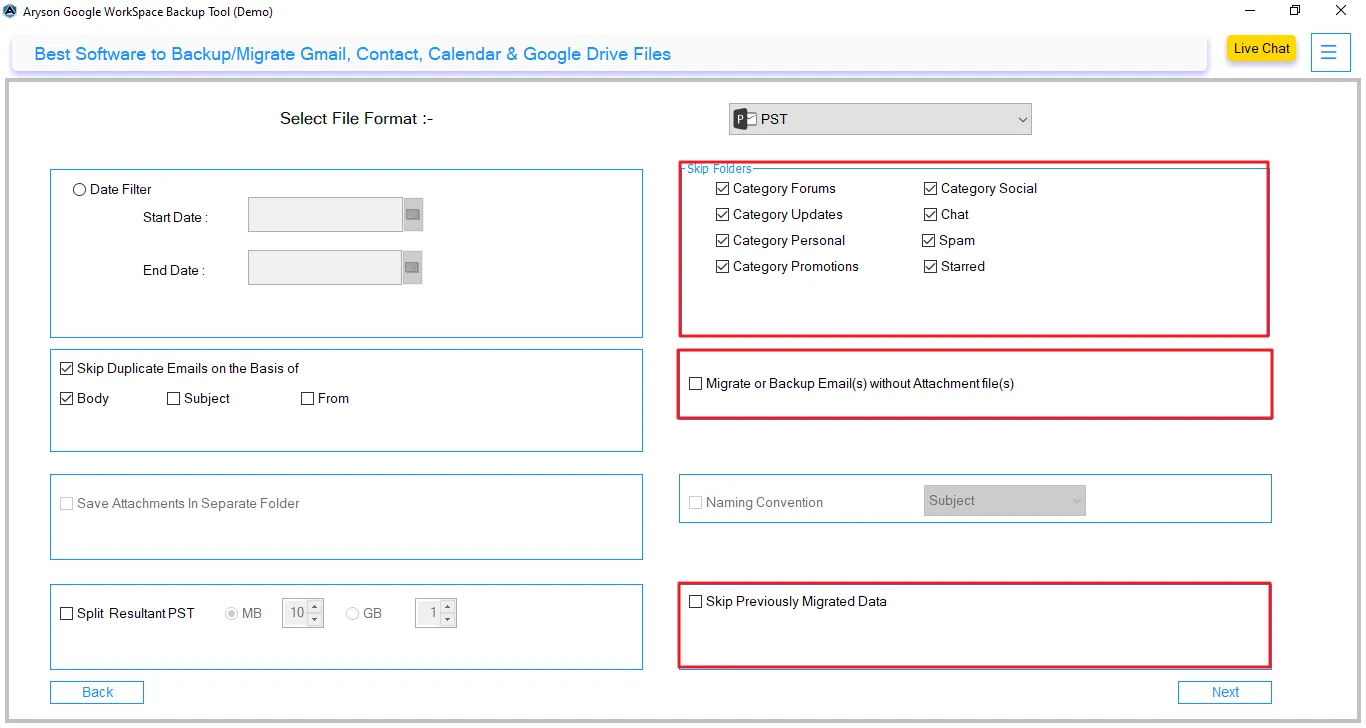
Before starting the Gmail to file format backup, configure the required filters and settings as needed.
- Item Types: Select the mailbox items to export, including emails, contacts, calendars, and tasks. For MBOX, only the email checkbox is available.
- Resume Migration: Enable Skip Previously Migrated Items to avoid re-exporting data that has already been backed up.
- Date Range Filter: Export only emails within a specific date range by selecting the Start Date and End Date.
- Advanced Email Filter: Export specific emails based on criteria such as From, To, Subject, CC, BCC, or Message Content.
- Skip Folders: Exclude Gmail categories such as Promotions, Social, Forums, Updates, Personal, and Unread from the backup.
- Duplicate Handling: Remove duplicate emails based on selected fields such as Subject, From, To, CC, and Body.
- Split PST File: Divide large PST files into smaller parts by specifying a maximum PST size limit (MB/GB).
- Attachment Options: Choose whether to export emails with attachments, skip attachments, or save attachments separately.
- Custom Folder Name: Define a custom name for the destination backup folder.
- Exclude Empty Folders: Skip folders that do not contain any mailbox items.
- Exclude Deleted/Spam Folders: Prevent deleted or junk email folders from being included in the PST backup.
- Free Up Server Space: Move to bin or permanently delete emails from the source mailbox after successful backup (optional).
- Save Contacts as VCF: Export contacts separately in VCF format.
- Save Calendar as ICS: Export calendar items separately in ICS format.
For other formats:
PDF: The "Enable merged PDF size limit" option consolidates exported emails into a single PDF file and automatically splits it into multiple parts once the file exceeds a specified size threshold, with a maximum limit of 500 MB per output file.
Step 9: Start the Migration Process
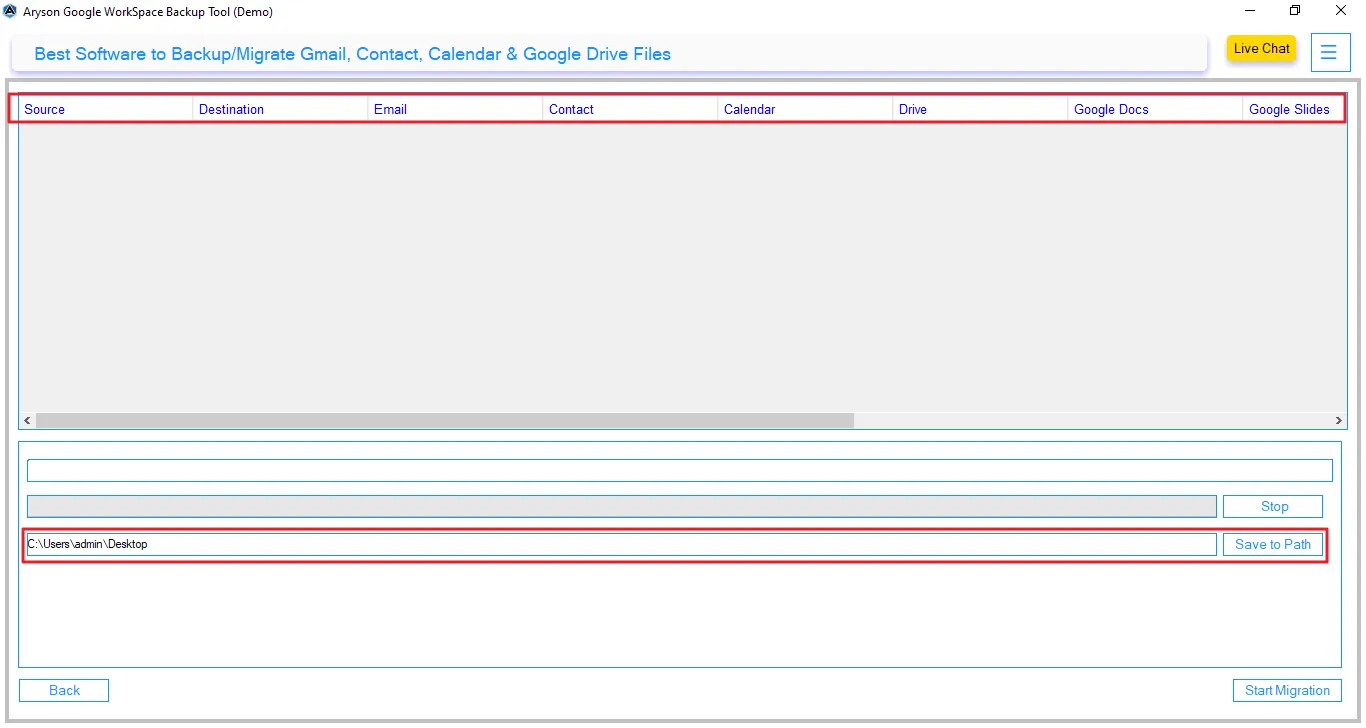
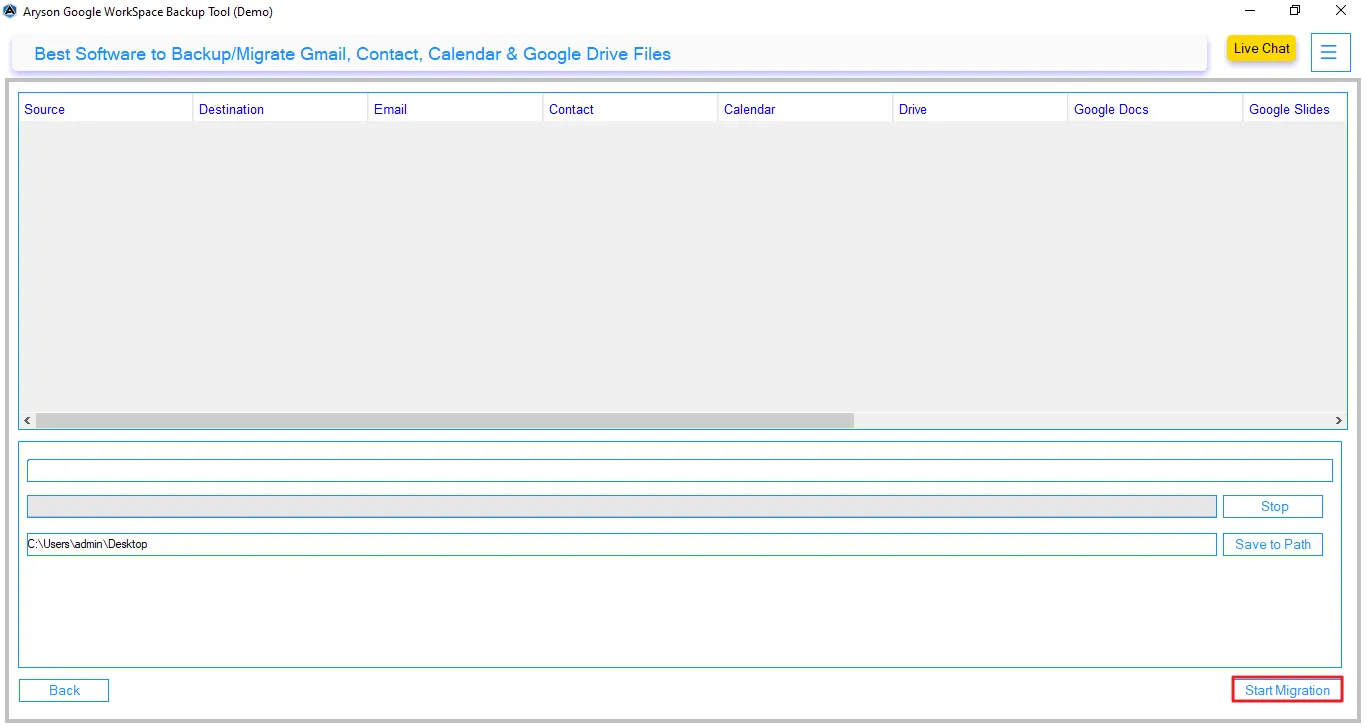
After configuring the required filters, click Start Migration to begin the Gmail/Google Workspace-to-file-formats backup process.
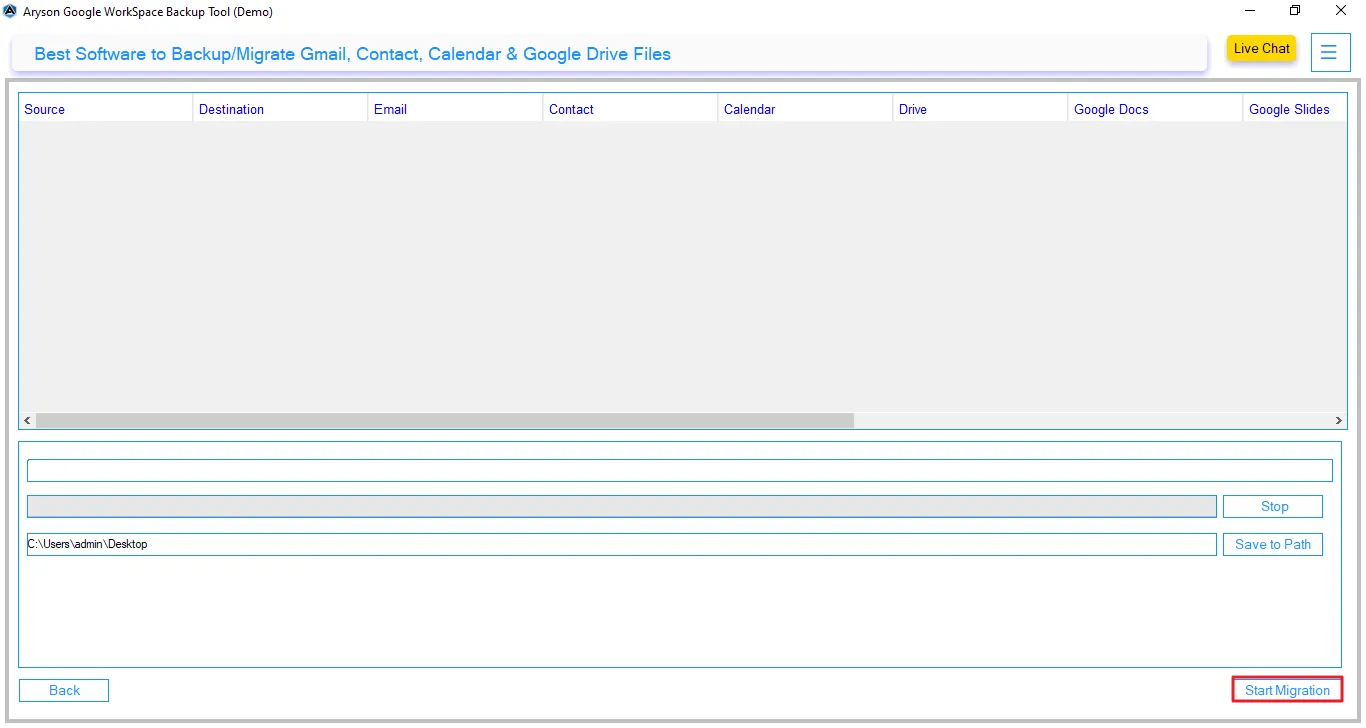
Step 10: Monitor Backup Progress
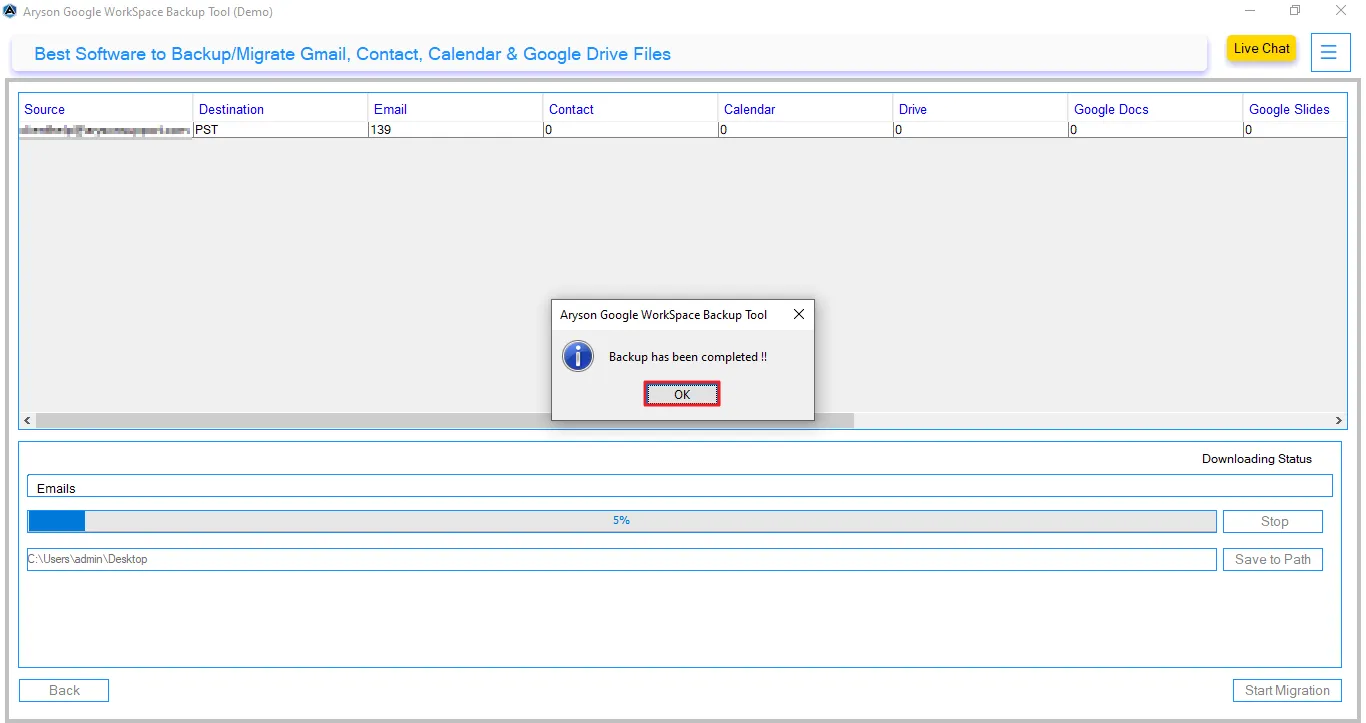
Track the real-time Gmail/Google Workspace-to-file-format backup progress, including exported emails, contacts, calendars, tasks, skipped items, failed items, and the destination location until the process completes successfully. You can use the Stop Migration button to halt the backup process and even pause or resume it whenever needed via the Resume Migration and Pause Migration buttons.
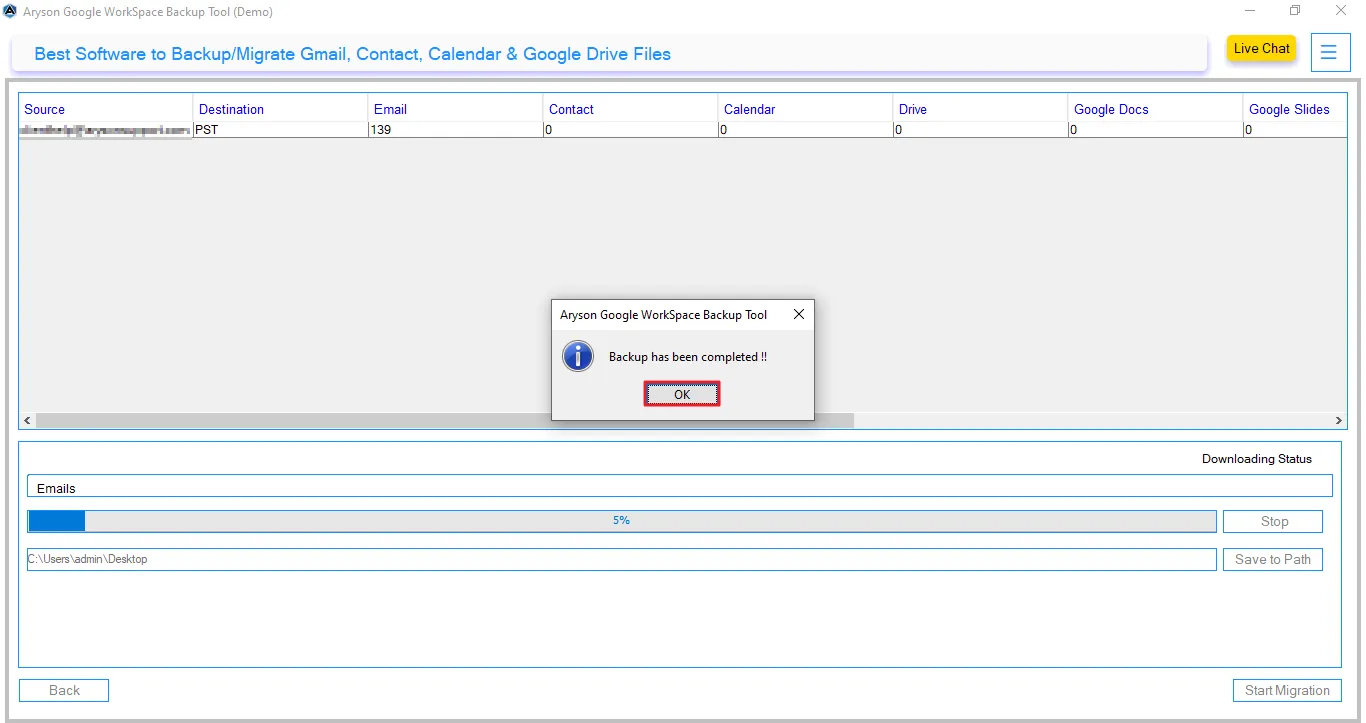
Step 11: Active Tasks / Migration Tasks Panel
- Migration Status: Shows the current export task and indicates whether it is running.
- Progress: Displays the overall export percentage through a progress bar.
- Files Migrated: Shows the number of files successfully exported.
- Skipped Files: Displays the count of files skipped during the export process.
- Elapsed Time: Shows how long the export task has been running.
- View Details: Opens detailed information about the ongoing export task.
*Redirects the user to the Migration Progress Panel, where they can monitor detailed migration activity and progress*
- Active Tasks: Lets users monitor currently running export tasks from one place.
- Help and Feedback: Provides access to help resources and feedback options.
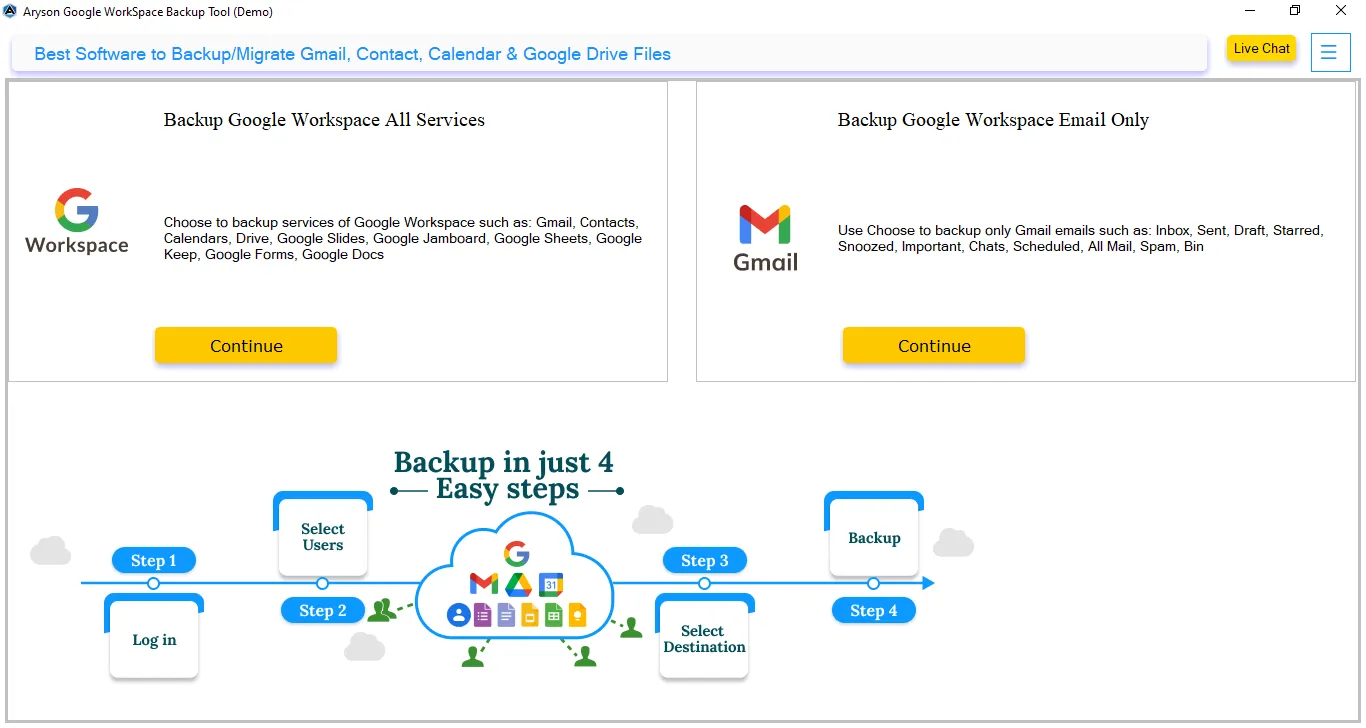
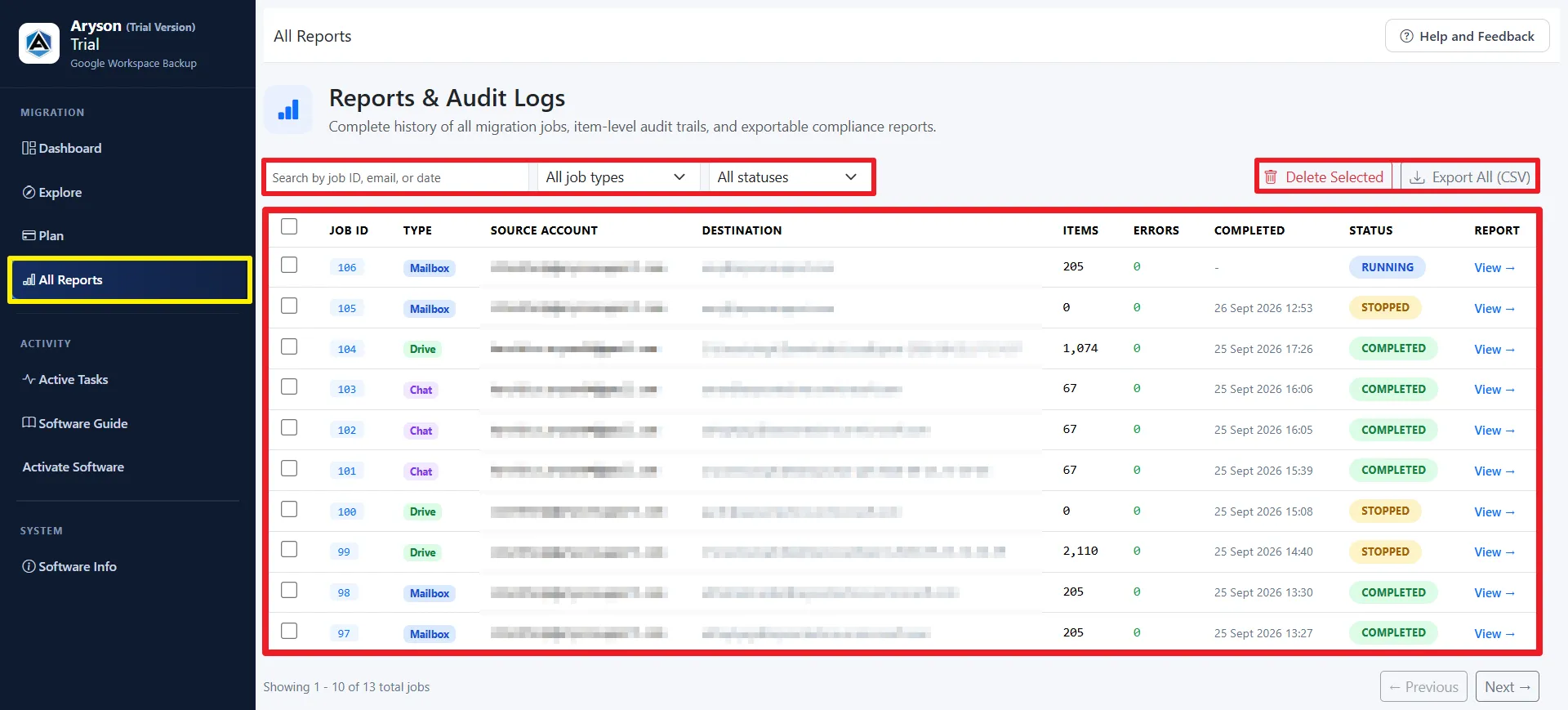
Step 12: The Reports & Audit Logs panel provides a complete record of migration jobs, including job ID, migration type, source account, destination, number of items, errors, completion time, and current status. Users can search and filter reports by job ID, email, date, job type, or status. The panel also allows users to select and delete reports, export all reports in CSV format, view individual reports, and navigate through multiple pages of migration records.
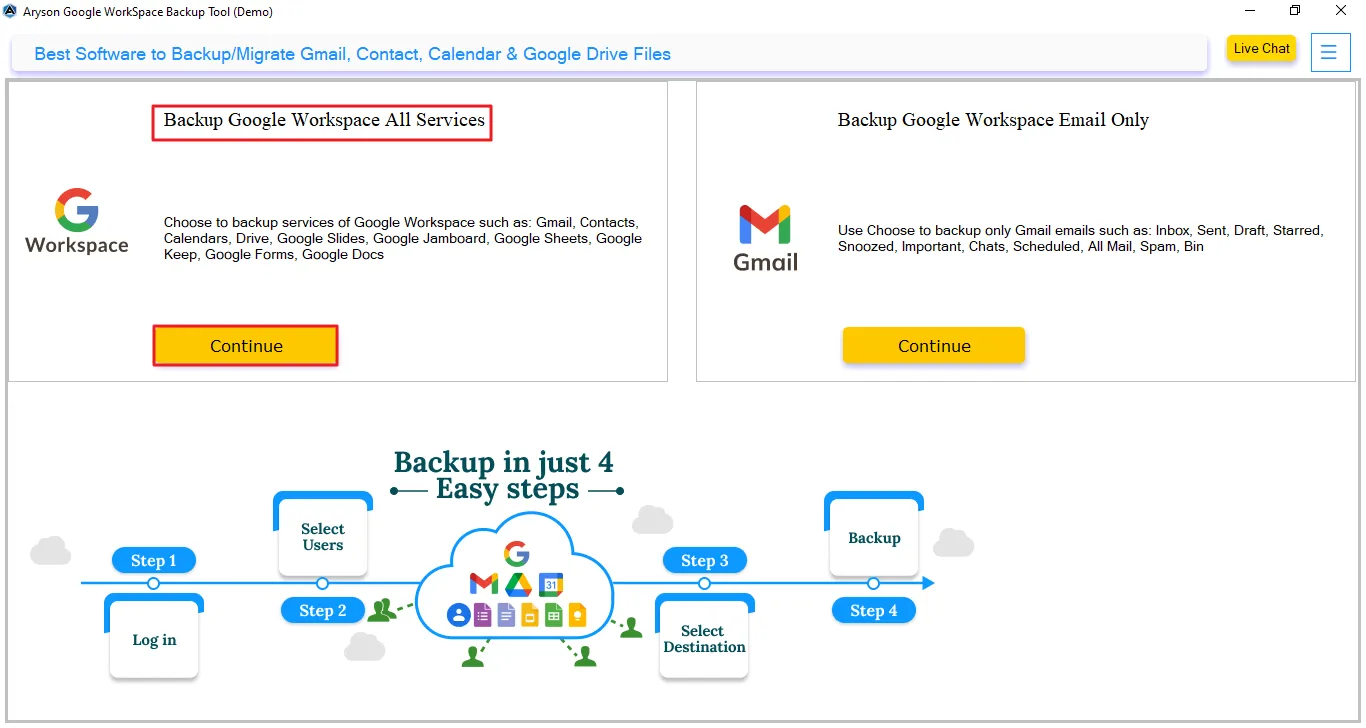
Migrate Gmail/Google Workspace to Office 365
Step 6: Select Microsoft 365 as the destination
- Go to the Email Client section and select Microsoft 365 as the destination platform.
- You can choose the single-user or admin-user login method.
Step 7: Connect the Microsoft 365 Account
- If you selected Single User:
- Click on Single User to initiate login for an individual account.
- Check the 'Remember this account for future logins’ checkbox to save credentials for subsequent sessions.
- Click the Select a tenant connection... dropdown menu to pick a saved Microsoft 365 connection.
- Click + Add connection to establish a new tenant login link.
- Select your Microsoft account under Pick an account on the login prompt.
- Enter your account credentials and click Sign in to authenticate.
- The successful migration message appears in the software interface.
- Click Logout if you need to disconnect or switch the active Microsoft 365 account.
- If you selected Admin User:
Click on Admin User to switch to the administrative account authentication mode.
- B.1 Modern Authentication:
- Select the Modern Authentication radio button to use Microsoft's standard OAuth sign-in workflow.
- Check ‘Remember this account for future logins’ to store session details securely.
- Click Select a tenant connection... to choose an existing Microsoft 365 tenant profile.
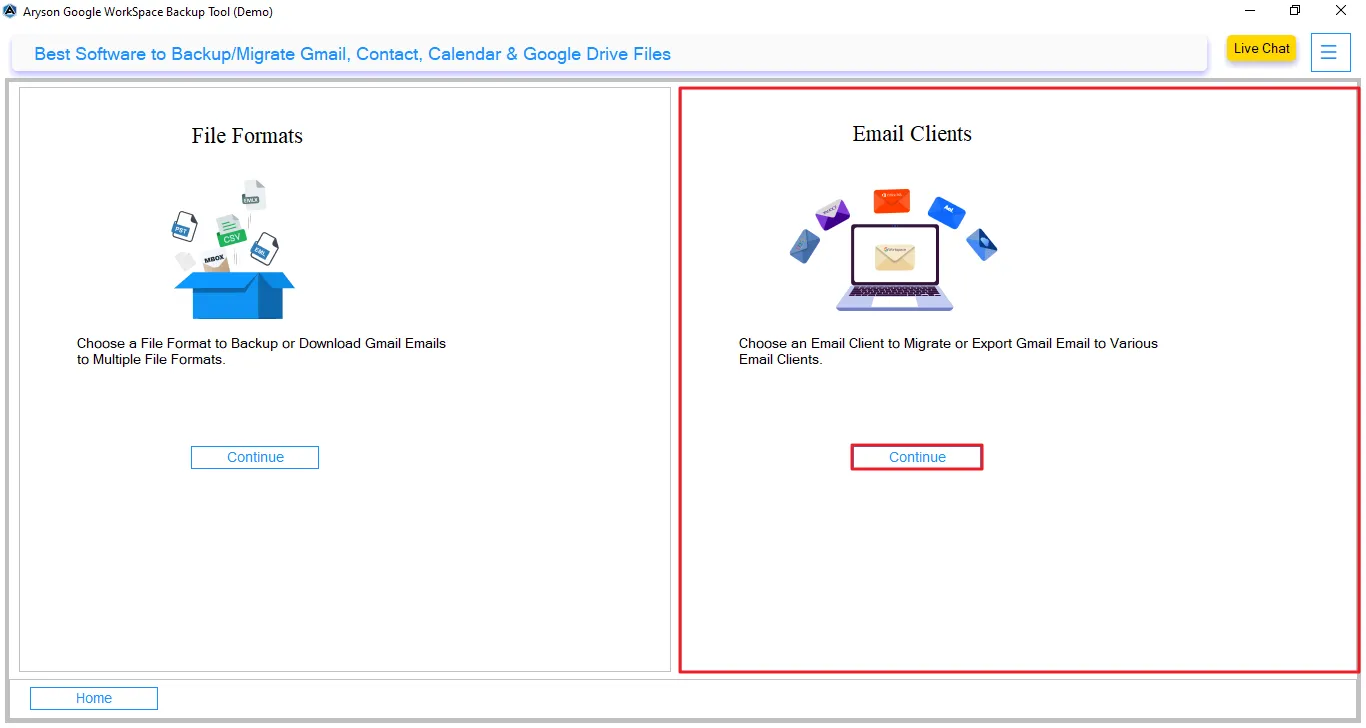
- Authenticate through the Microsoft portal using your admin account credentials.
- On the Tenant Users panel, use the Search users bar to quickly filter specific accounts.
- Click Sample CSV to download a pre-formatted template file for bulk user selection.
- Click Upload CSV to import user list mappings directly from a CSV file.
- Select user checkboxes from the list to pick specific target accounts.
- Click Continue to move forward with the selected tenant accounts.
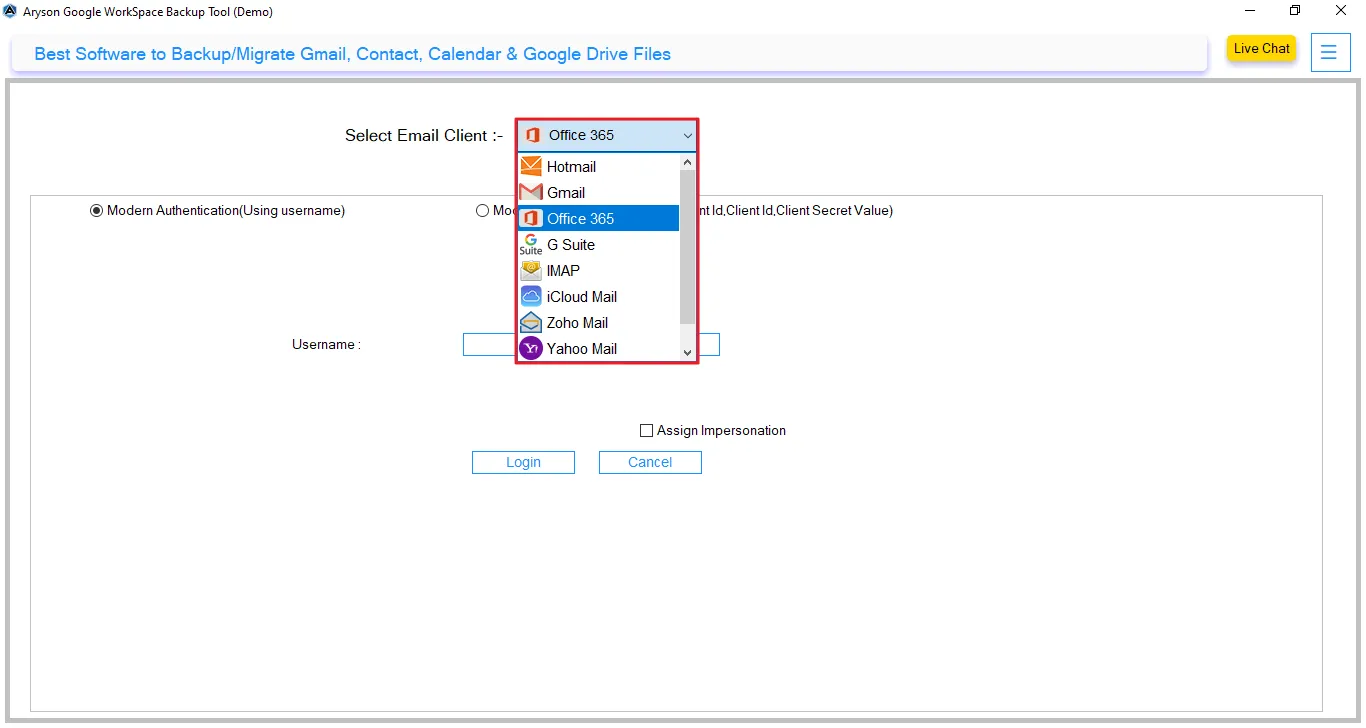
B.2 Client ID / Secret:
- Select the Client ID / Secret radio button to use Azure App registration credentials.
- Enter your Azure Application ID into the Client ID text field.
- Enter your secret value into the Client Secret text field.
- Enter your Azure Active Directory ID into the Tenant ID text field.
- Check “Remember this account for future logins” to save connection settings.
- Click Verify & Login to validate credentials and connect to the Microsoft 365 tenant.
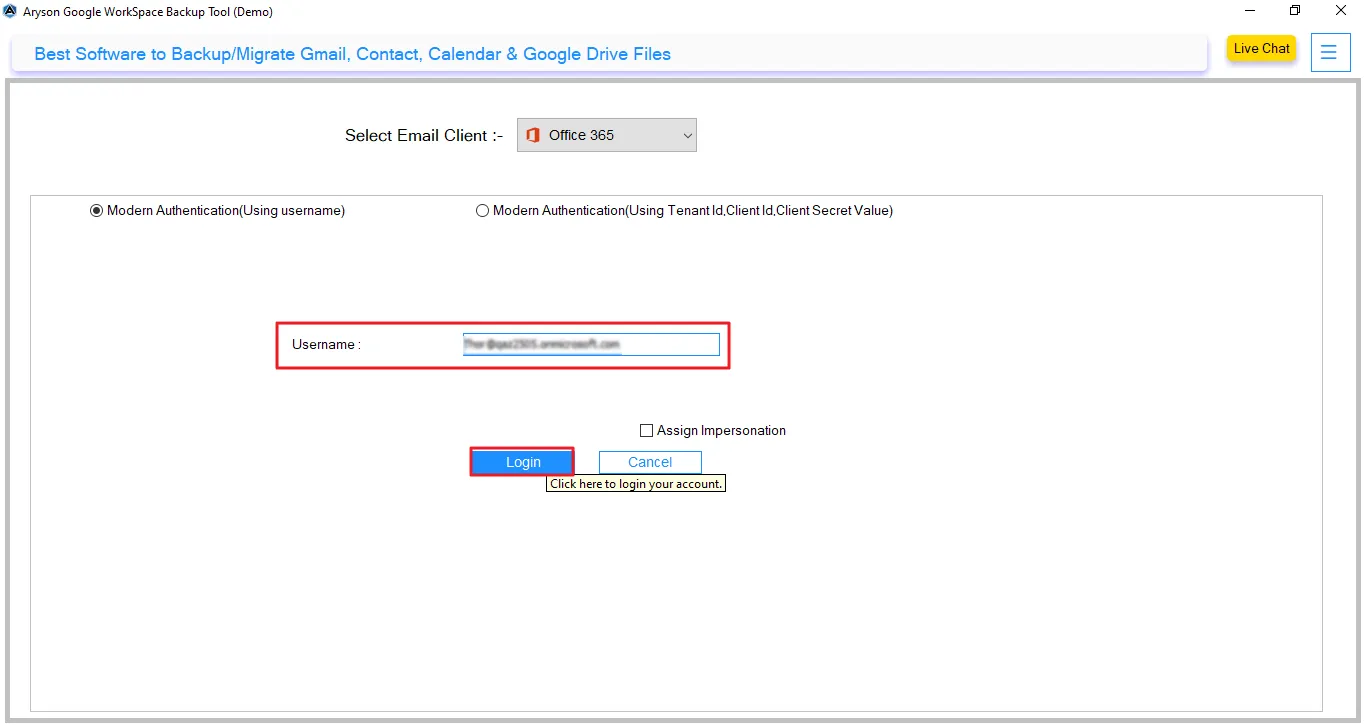
Step 8: Map Mailboxes
- Use Search source... to quickly find a specific source Gmail or Google Workspace account.
- Use Search destination... to filter down target Microsoft 365 mailboxes.
- Select source and destination checkboxes to pair individual Google and Microsoft 365 accounts manually.
- Click Map Selected to link and confirm the manually selected source and target accounts.
- Click Quick Actions to access automated mapping shortcuts.
- Selected Source → All Destinations: Maps the selected source mailboxes to all available destination mailboxes in one action.
- All Sources → Selected Destination: Maps all source mailboxes to the selected destination mailbox in one action.
- Click Clear Mapping to erase all established mailbox pairings at once.
- Click View Mapping to open a modal showing all active source-to-target mapping pairs.
- Click the Remove (X) icon next to any pair inside the modal to delete a specific mapping.
- Click Close to exit the Current Mappings pop-up window.
- View the Mapped column count on the right to quickly see how many targets are linked to each destination mailbox.
- Click Back to navigate to the previous configuration screen.
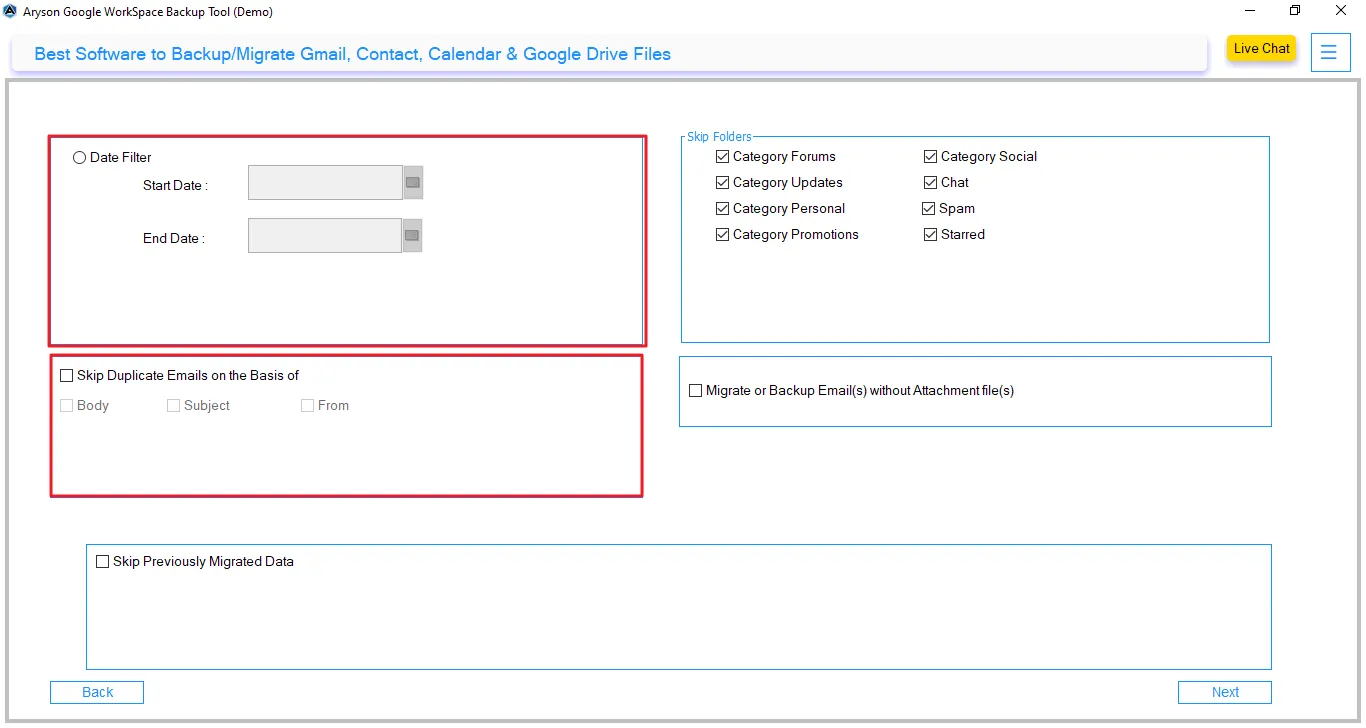
Step 9: Configure Migration Filters – Microsoft 365 Destination
Before starting the Gmail/Google Workspace to Microsoft 365 migration, configure the required filters and settings as needed.
- Item Types: Select the mailbox items to migrate, including emails, contacts, calendars, Keep, and tasks.
- Resume Migration: Enable Skip Previously Migrated Items to avoid remigrating data that has already been transferred.
- Date Range Filter: Migrate only emails within a specific date range by selecting the Start Date and End Date.
- Advanced Email Filter: Migrate specific emails based on criteria such as From, To, Subject, CC, BCC, or Message Content.
- Skip Folders: Exclude Gmail categories such as Promotions, Social, Forums, Updates, Personal, and Unread from the migration.
- Duplicate Handling: Remove duplicate emails based on selected fields such as Subject, From, To, CC, and Body.
- Preserve Folder Hierarchy: Choose this option to map your default folders of the MBOX files to the default Office 365 folders.
- Attachment Options: Choose whether to migrate emails with attachments, skip attachments, or save attachments separately.
- Custom Folder Name: Define a custom name for the destination folder in the target Microsoft 365 mailbox.
- Exclude Empty Folders: Skip folders that do not contain any mailbox items.
- Exclude Deleted/Spam Folders: Prevent deleted or junk email folders from being included in the migration.
- Free Up Server Space: Move or permanently delete emails from the source mailbox after successful migration (optional)—choose Move to Bin or Delete Permanently.
- Save Contacts As VCF: Export contacts separately in VCF format.
- Save Calendar As ICS: Export calendar items separately in ICS format.
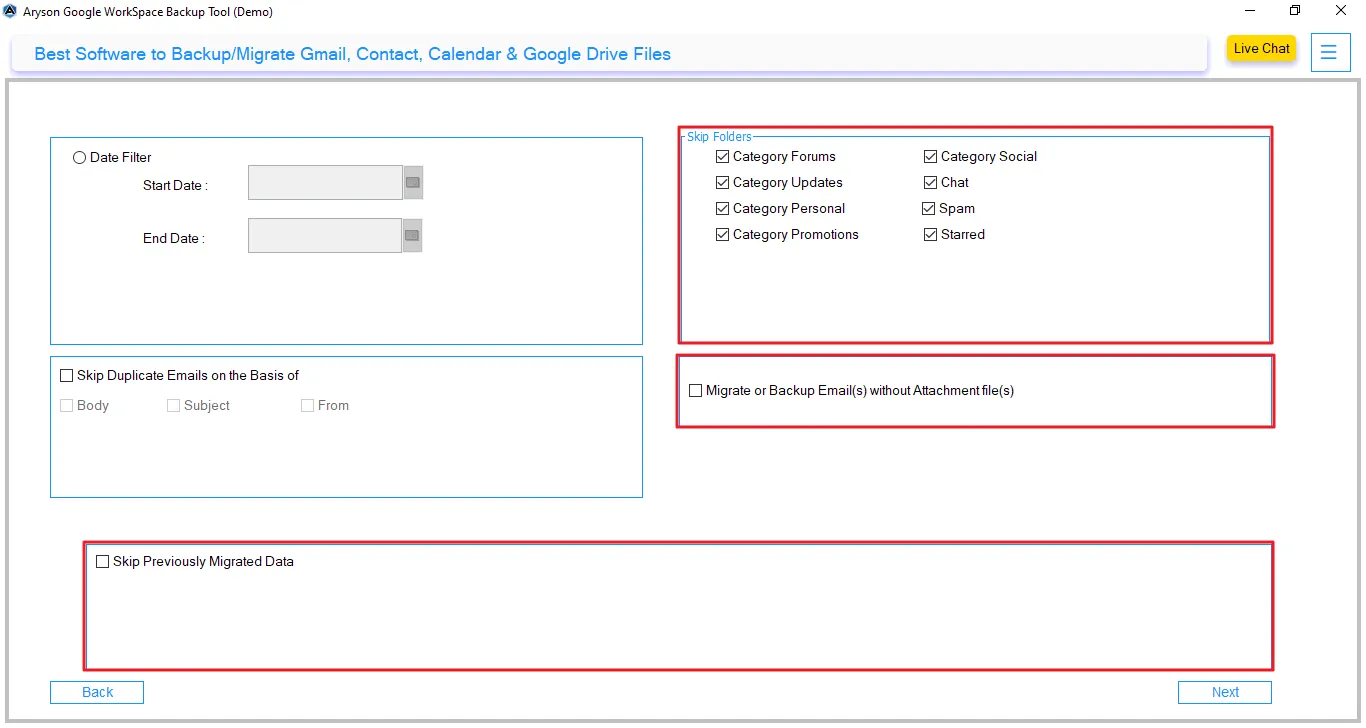
Step 10: Start the Gmail/Google Workspace to Microsoft 365 Migration
After reviewing all settings, click Start Migration to begin transferring mailbox data to Microsoft 365. The software starts migrating the selected mailbox data immediately.
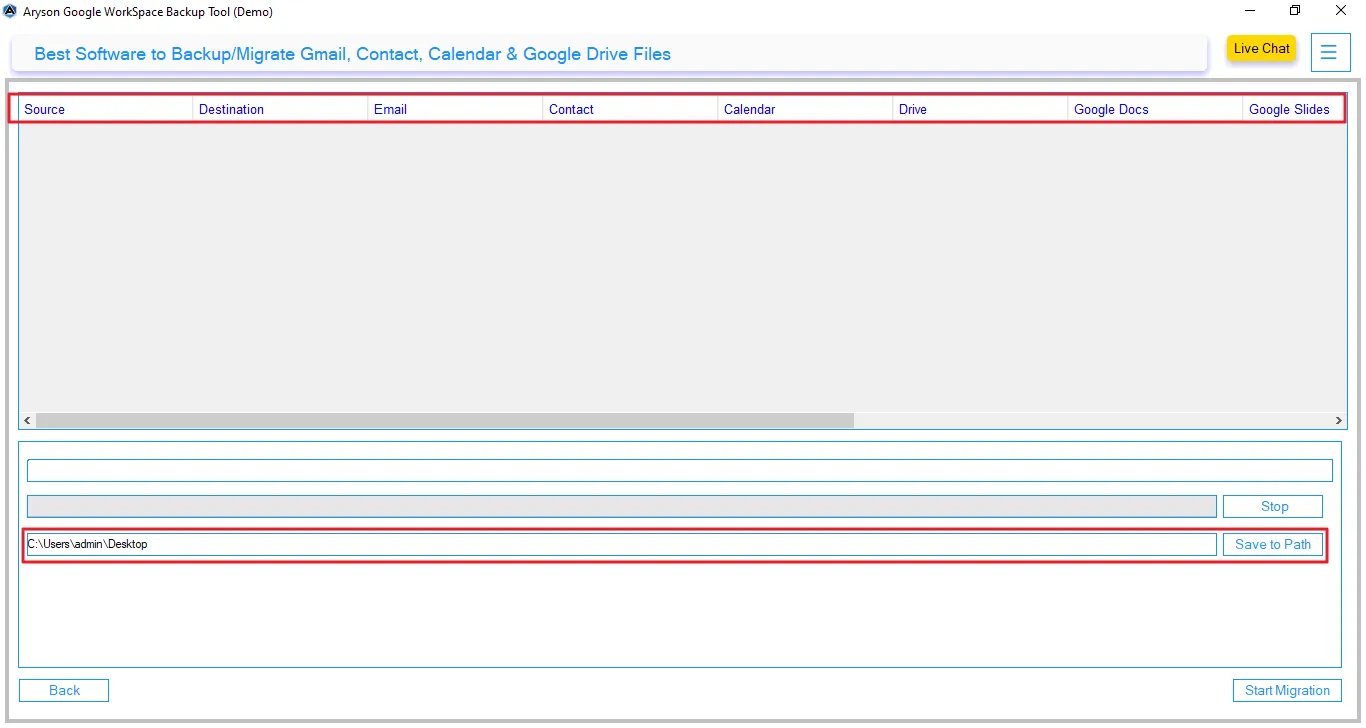
Step 11: Monitor the Migration Progress
Track the real-time migration status, including migrated emails, contacts, calendars, tasks, skipped items, and failed items. The progress bar provides a live overview of the migration process. You can use the Stop Migration button to halt the backup process and even pause or resume it whenever needed via the Resume Migration and Pause Migration buttons.
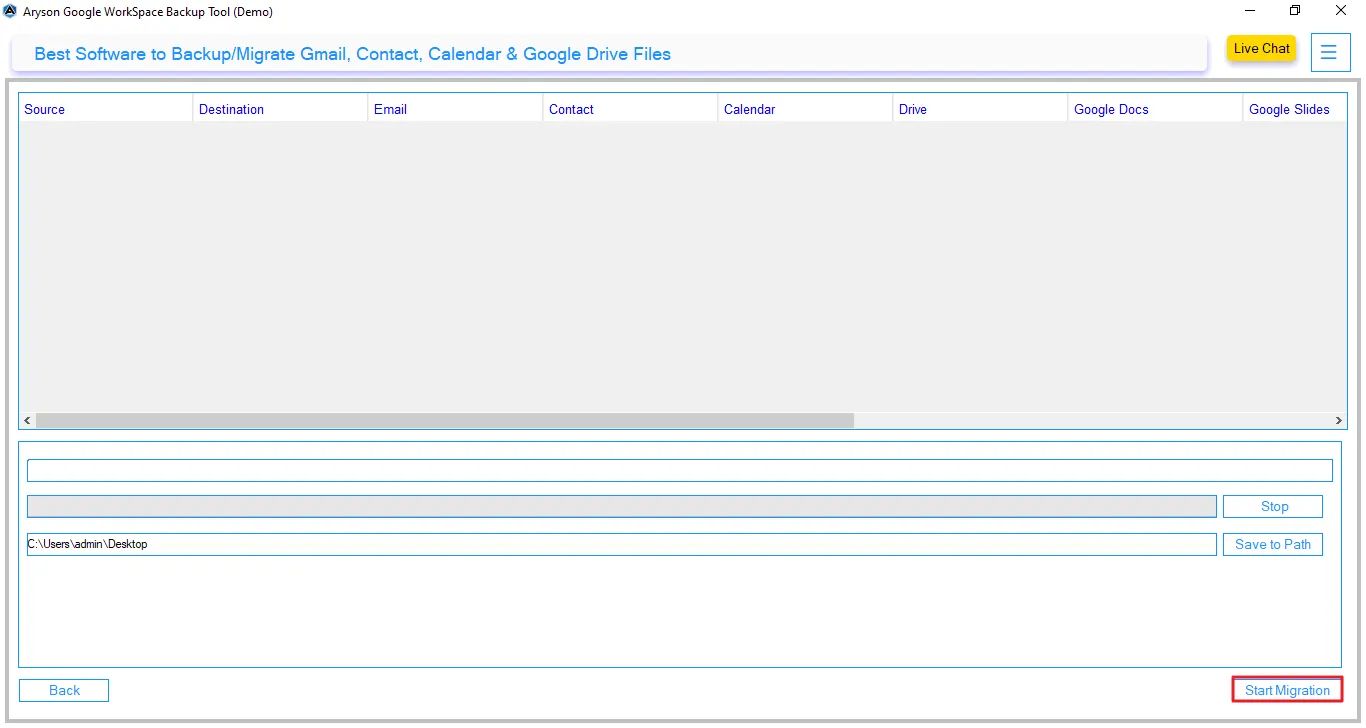
Step 12: Active Tasks / Migration Tasks Panel
- Migration Status: Shows the current migration task and indicates whether it is running.
- Progress: Displays the overall migration percentage through a progress bar.
- Files Migrated: Shows the number of files successfully migrated.
- Skipped Files: Displays the count of files skipped during migration.
- Elapsed Time: Shows how long the migration task has been running.
- View Details: Opens detailed information about the ongoing migration task.
*Redirects the user to the Migration Progress Panel, where they can monitor detailed migration activity and progress*
- Active Tasks: Lets users monitor currently running migration tasks from one place.
- Help and Feedback: Provides access to help resources and feedback options.
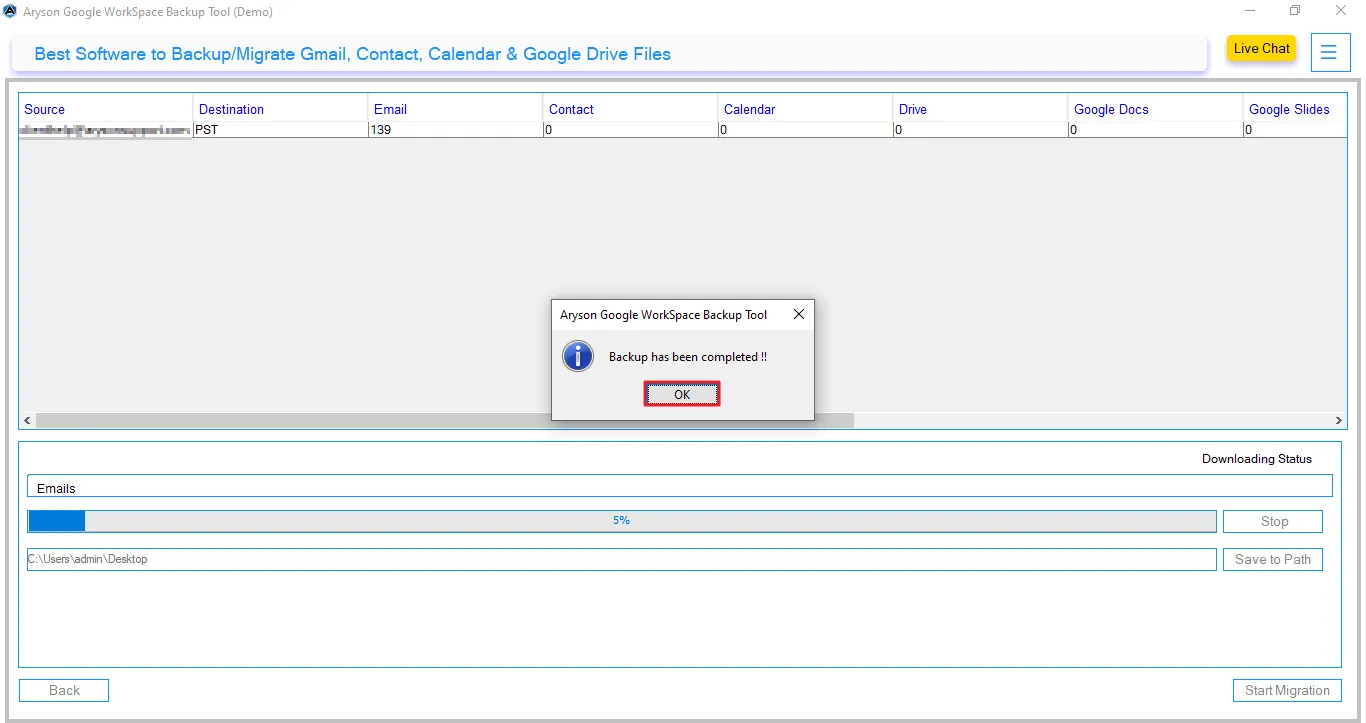
Step 12: The Reports & Audit Logs panel provides a complete record of migration jobs, including job ID, migration type, source account, destination, number of items, errors, completion time, and current status. Users can search and filter reports by job ID, email, date, job type, or status. The panel also allows users to select and delete reports, export all reports in CSV format, view individual reports, and navigate through multiple pages of migration records.
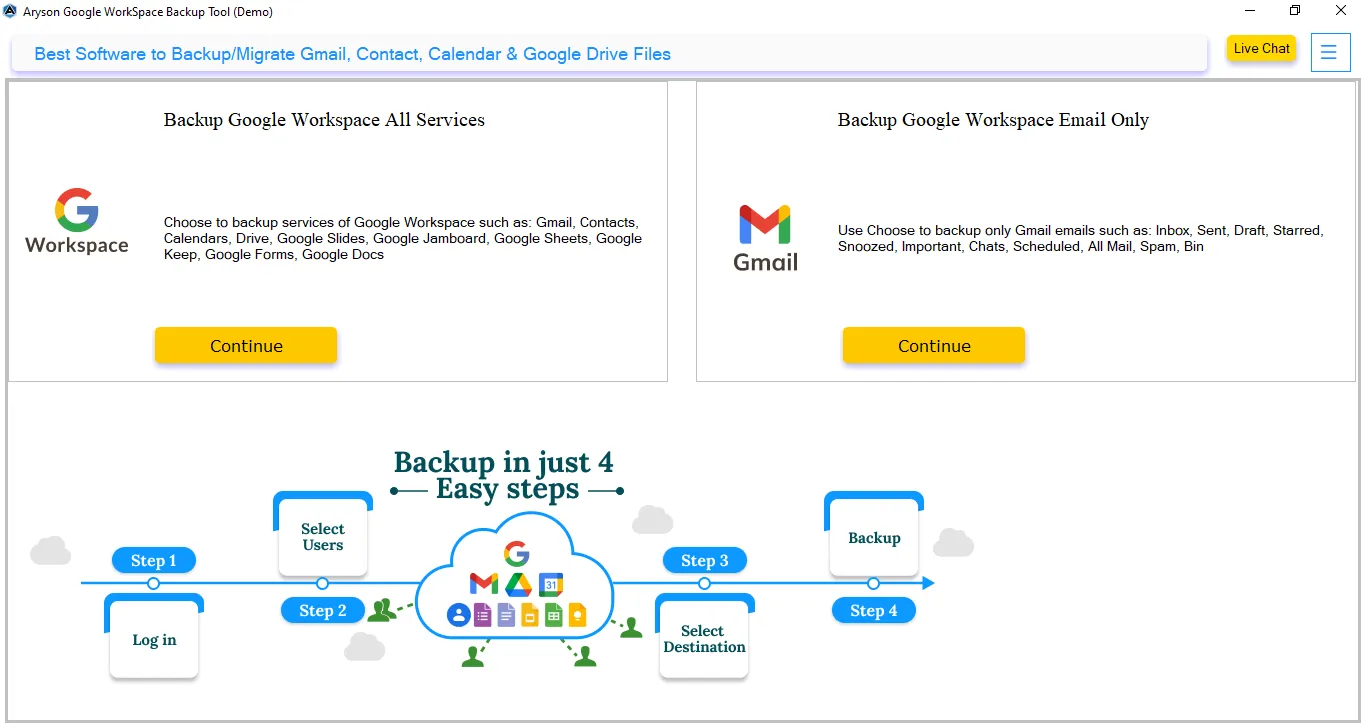
Migrate Gmail/Google Workspace to Exchange Server
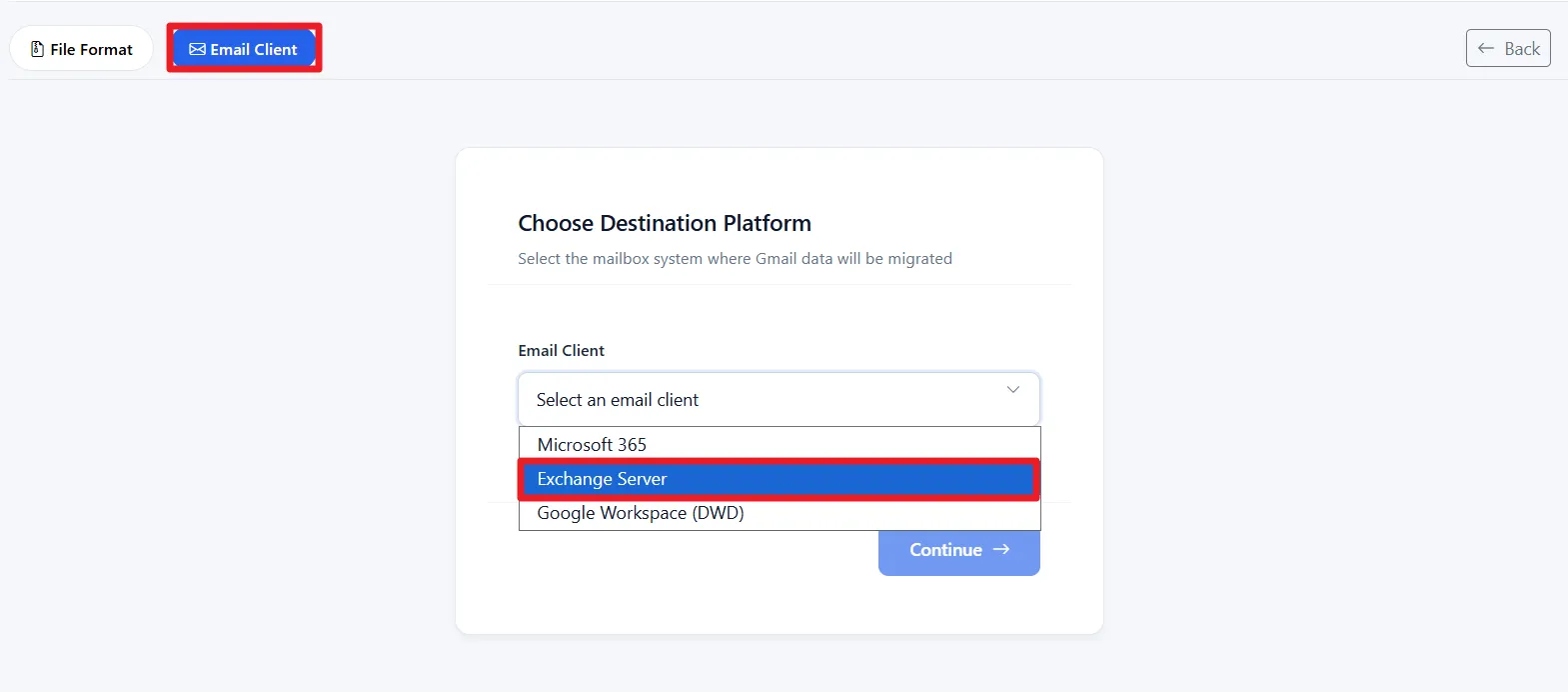
Step 6: Select Exchange Server as the destination
- Go to the Email Client section and select Exchange Server as the destination platform.
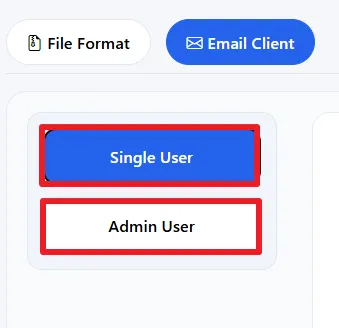
- You can choose the single-user or admin-user login method.
Step 7: Connect the Exchange Server Account
- If you selected Single User:
- Click on Single User to initiate login for an individual account and select the A.1 or A.2 method to log in.
| A.1. Connect to a New Destination Account | A.2. Log in using Saved Accounts |
|---|---|
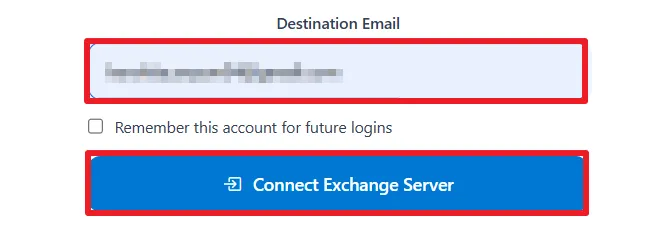
| Enter the destination Exchange Server email for logging in. | Alternatively, select a destination email from the Saved Exchange Connections drop-down menu. |
| Click on the Connect Exchange Server button. | Click the + Add connection button to establish a new tenant login link. |
 |
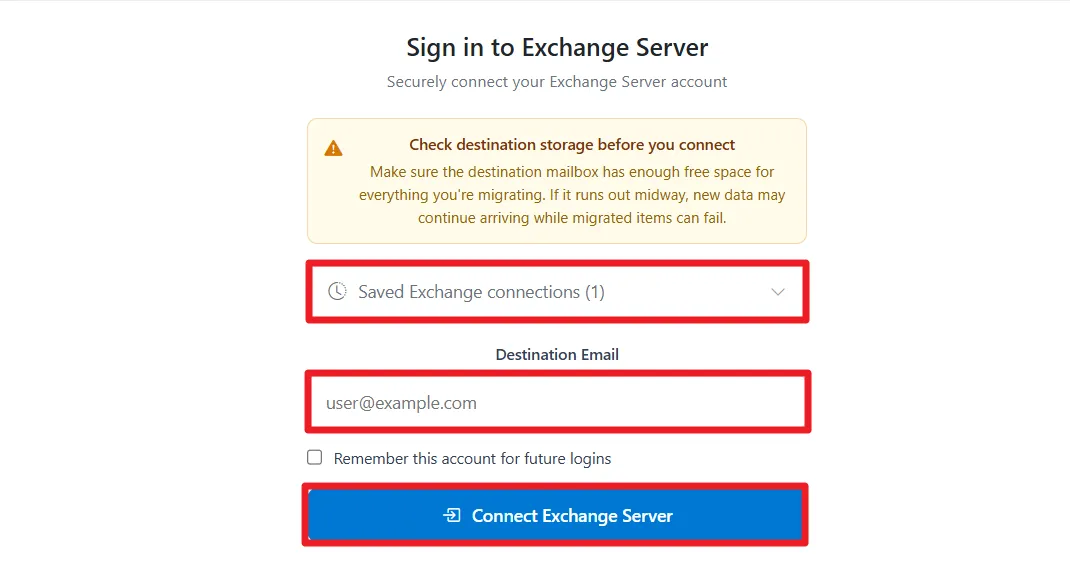 |
- Check the 'Remember this account for future logins’ checkbox to save credentials for subsequent sessions.
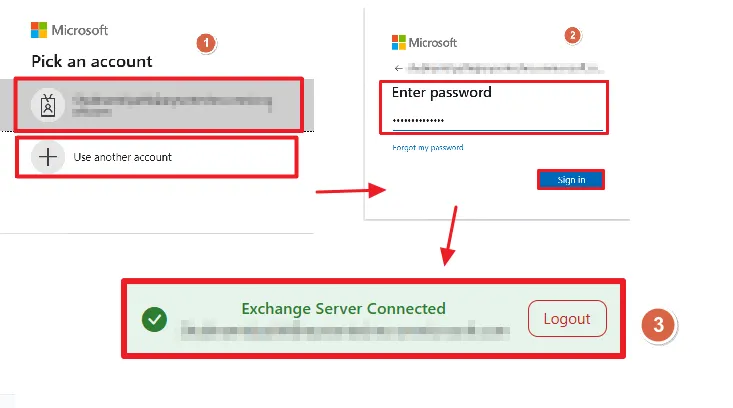
- In the browser window, select your Exchange Server account under Pick an account on the login prompt.
- Enter your account credentials and click Sign in to authenticate.
- The successful migration message appears in the software interface.

- Click Logout if you need to disconnect or switch the active Exchange Server account.
Select Destination Mailbox (Exclusive to Single Login Mode)
Choose the required destination mailbox type for the migration. Select Primary Mailbox, Archive Folder, or Public Folder according to where you want to migrate the selected mailbox data.
- If you selected Admin User:
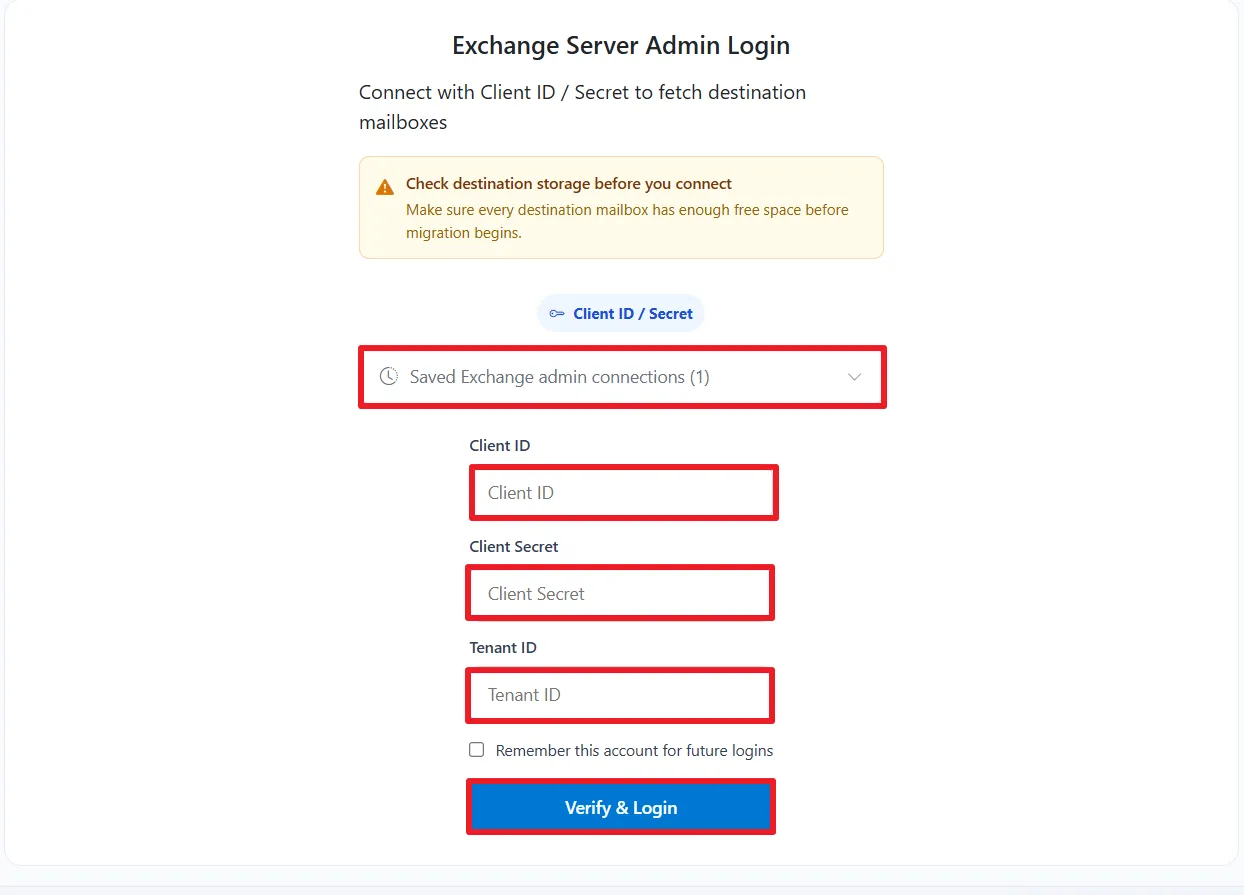
- Click on Admin User to switch to the administrative account authentication mode.
- Enter the Client ID, secret, and Tenant ID to log in to the admin Exchange server account.
2.1. Select the required users
- On the Tenant Users panel, use the Search users bar to quickly filter specific accounts.
- Click Sample CSV to download a pre-formatted template file for bulk user selection.
- Click Upload CSV to import user list mappings directly from a CSV file.
- Select user checkboxes from the list to pick specific target accounts.
- Click Continue to move forward with the selected tenant accounts.
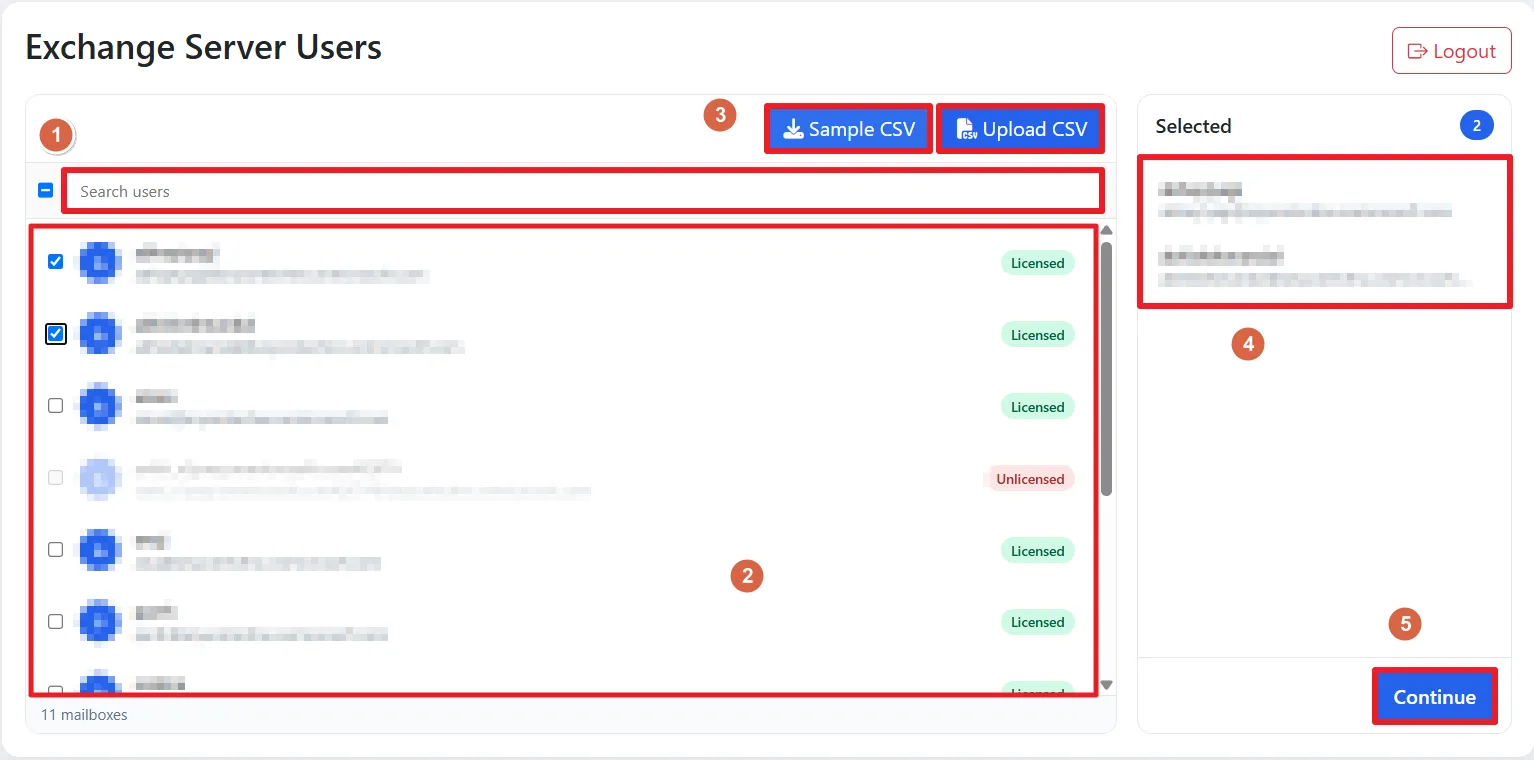
*Once you click the Continue button, the software validates the access permissions of the mailboxes contained in the selected user mailboxes. As per the access provided by the admin, you can map the source data to the destination mailboxes ( whose access is available). *
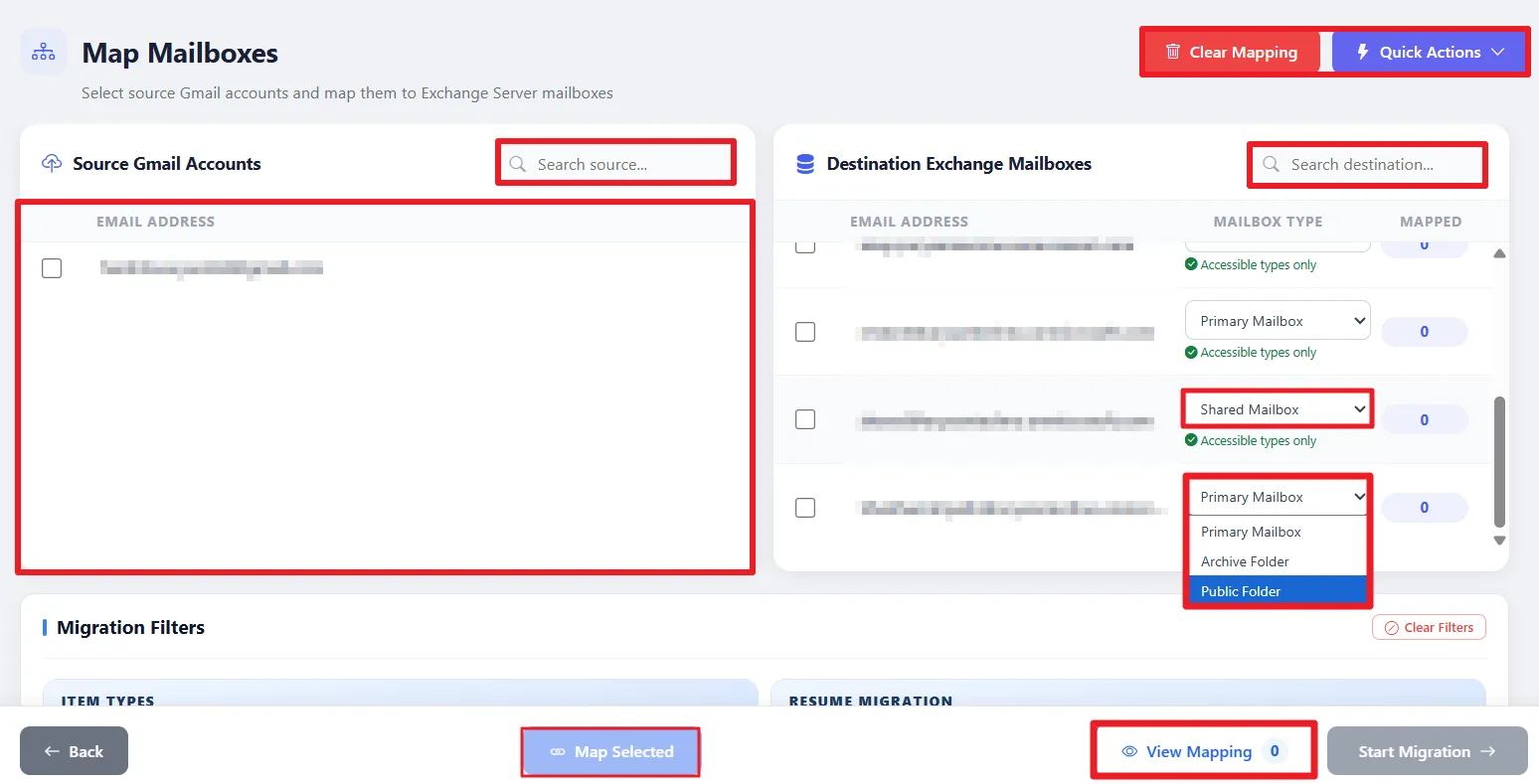
Step 9: Map Mailboxes
- Select the source users using the checkboxes in the left panel.
- Tick the checkboxes for the destination users displayed in the right panel.
- The mailboxes with access permissions will be displayed in the dropdown menu. Select the destination mailbox (Shared Mailbox/Primary Mailbox/Public Folder/Archive Folder) for each user.
- Use the Search source and Search destination fields to quickly find specific accounts or mailboxes.
- Click Map Selected to map the selected source account(s) to the chosen Exchange Server mailbox(es).
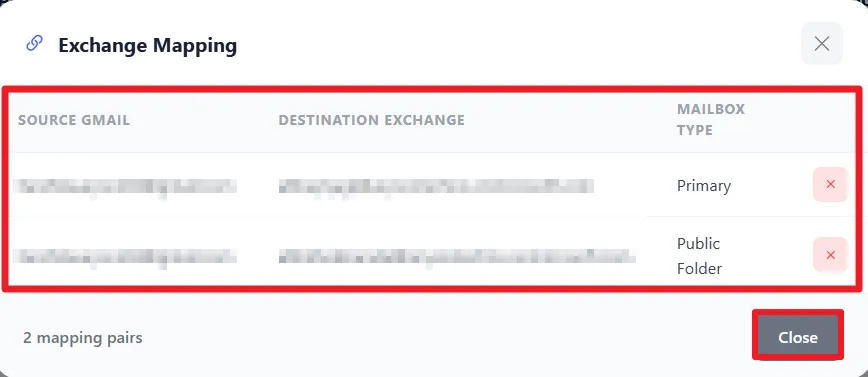
- Click View Mapping to review the configured source-to-destination mailbox mappings.
- Verify the mappings before proceeding with the migration and click on ‘X’ to delete a mapped pair.
- Click Close to exit the Exchange Mapping panel.
Miscellaneous Options
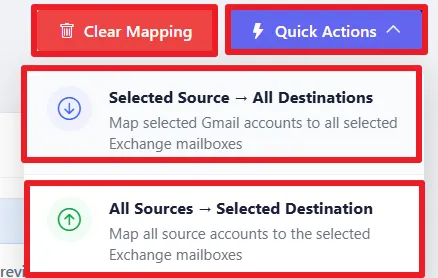
- Click Quick Actions to access bulk mailbox-mapping options.
- Select Selected Source → All Destinations to map the selected Gmail account(s) to all selected Exchange mailboxes.
- Select All Sources → Selected Destination to map all source Gmail accounts to the selected Exchange mailbox(es).
- Use these options when you need to apply the same source-to-destination mapping across multiple accounts.
Step 10: Configure Migration Filters (Optional)
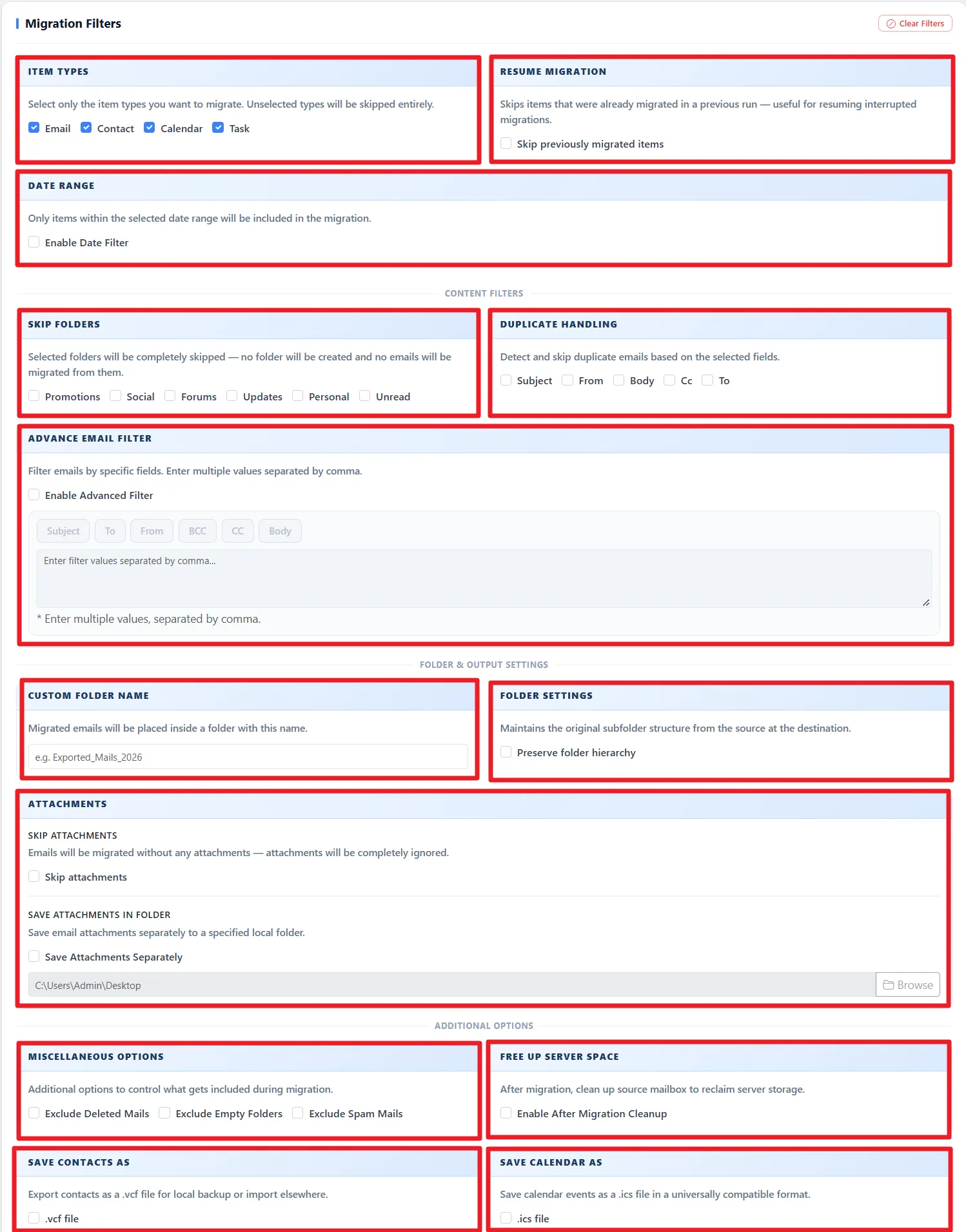
Before starting the Gmail/Google Workspace to Exchange Server migration, configure the required filters and settings as needed.
- Item Types: Select the mailbox items to migrate, including emails, contacts, calendars, and tasks. (Keep notes are included in this list when your source is a Google Workspace account).
- Resume Migration: Enable Skip Previously Migrated Items to avoid migrating data that was already transferred during an earlier run.
- Date Range Filter: Migrate only emails within a specified period by selecting the Start Date and End Date.
- Advanced Email Filter: Filter emails based on From, To, Subject, BCC, CC, or Body criteria.
- Skip Folders: Exclude selected folders or categories such as Promotions, Social, Forums, Updates, Personal, and Unread.
- Duplicate Handling: Detect and skip duplicate emails based on fields such as Subject, From, To, CC, and Body.
- Custom Folder Name: Specify a custom name for the folder where the migrated emails will be placed.
- Folder Settings: Enable Preserve Folder Hierarchy to maintain the original subfolder structure at the destination.
- Attachment Options: Choose to migrate emails with attachments, skip attachments, or save attachments separately to a specified location.
- Miscellaneous Options: Exclude deleted mails, empty folders, or spam mails from the migration as required.
- Free Up Server Space: Enable After Migration Cleanup to clean up the source mailbox after the migration is completed.
- Save Contacts as VCF: Export contacts separately as .vcf files for local backup or use elsewhere.
- Save Calendar as ICS: Export calendar events separately as .ics files for compatibility with other calendar applications.
Step 11: Start the Migration Process
After configuring the required filters, click Start Migration to begin the Gmail/Google Workspace-to-Exchange Server migration process.
Step 12: Monitor Migration Progress
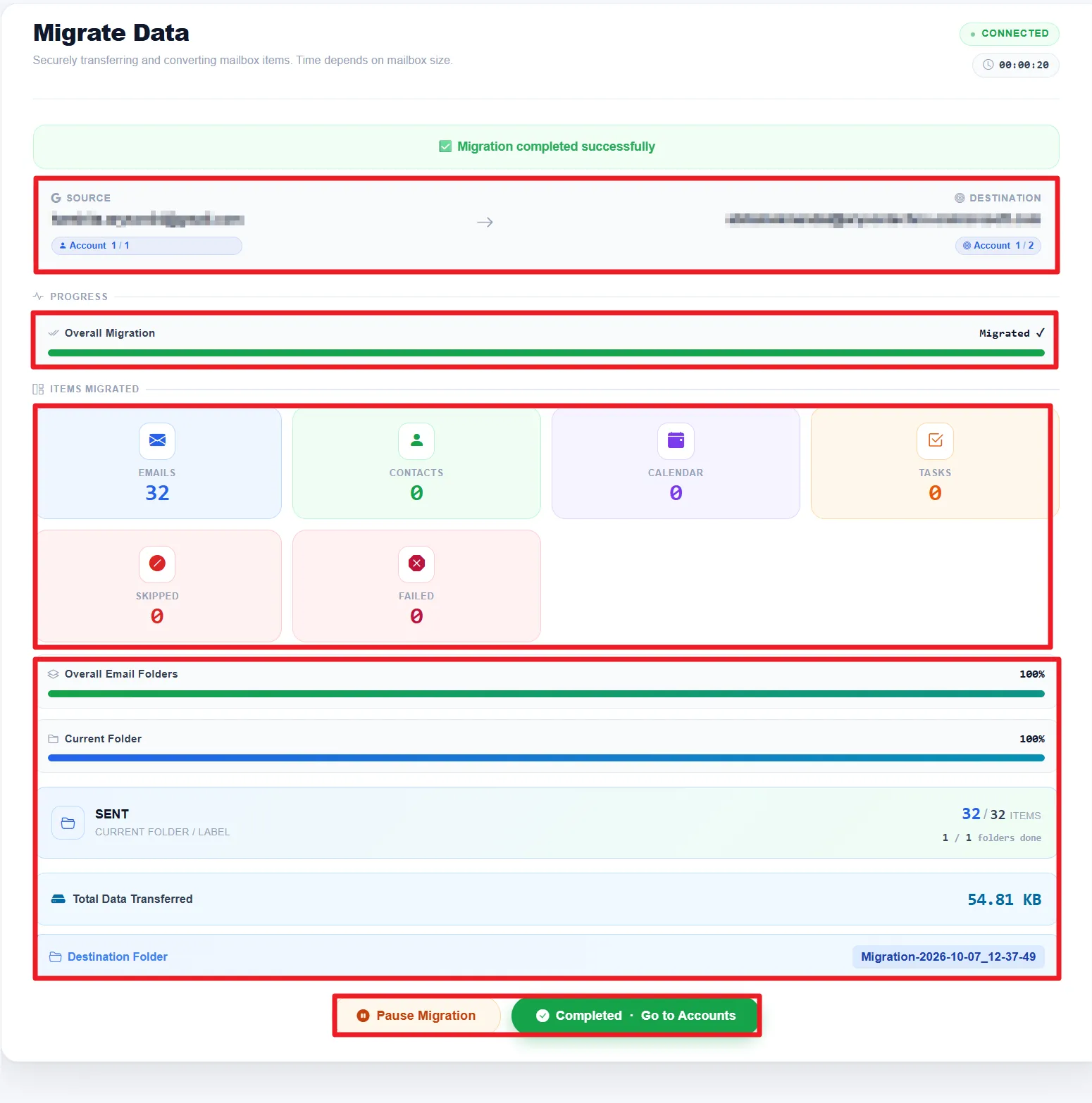
Track the real-time Gmail/Google Workspace-to-Exchange Server migration progress, including the number of migrated emails, contacts, calendars, tasks, skipped items, failed items, overall folder progress, transferred data size, and destination folder. Once the migration is completed successfully, click Completed – Go to Accounts to return to the account screen. You can also use the Pause Migration button to temporarily stop the process and the Resume button to resume it when required.
Step 13: Active Tasks / Migration Tasks Panel
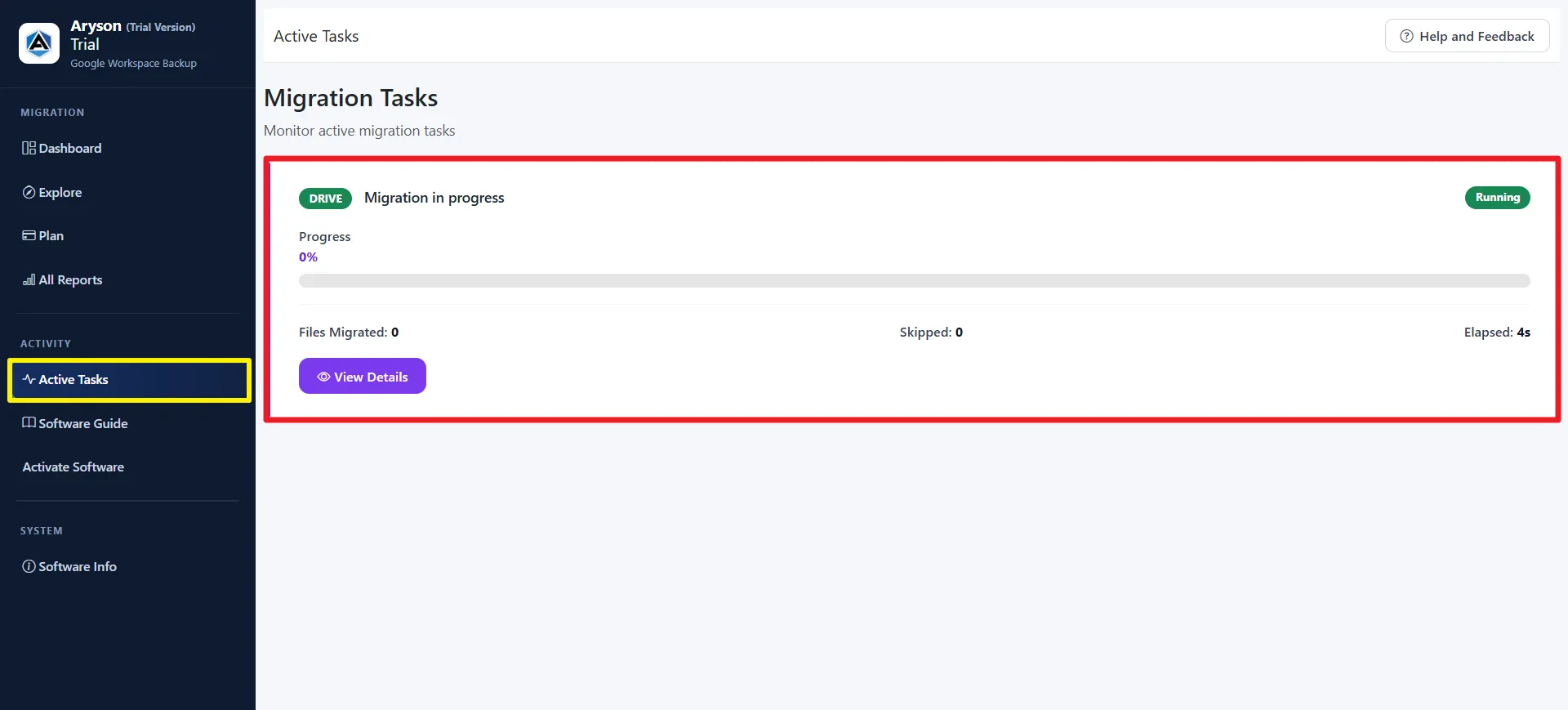
- Migration Status: Shows the current migration task and indicates whether it is running.
- Progress: Displays the overall migration percentage through a progress bar.
- Files Migrated: Shows the number of files successfully migrated.
- Skipped Files: Displays the count of files skipped during migration.
- Elapsed Time: Shows how long the migration task has been running.
- View Details: Opens detailed information about the ongoing migration task.
*Redirects the user to the Migration Progress Panel, where they can monitor detailed migration activity and progress*
- Active Tasks: Lets users monitor currently running migration tasks from one place.
- Help and Feedback: Provides access to help resources and feedback options.
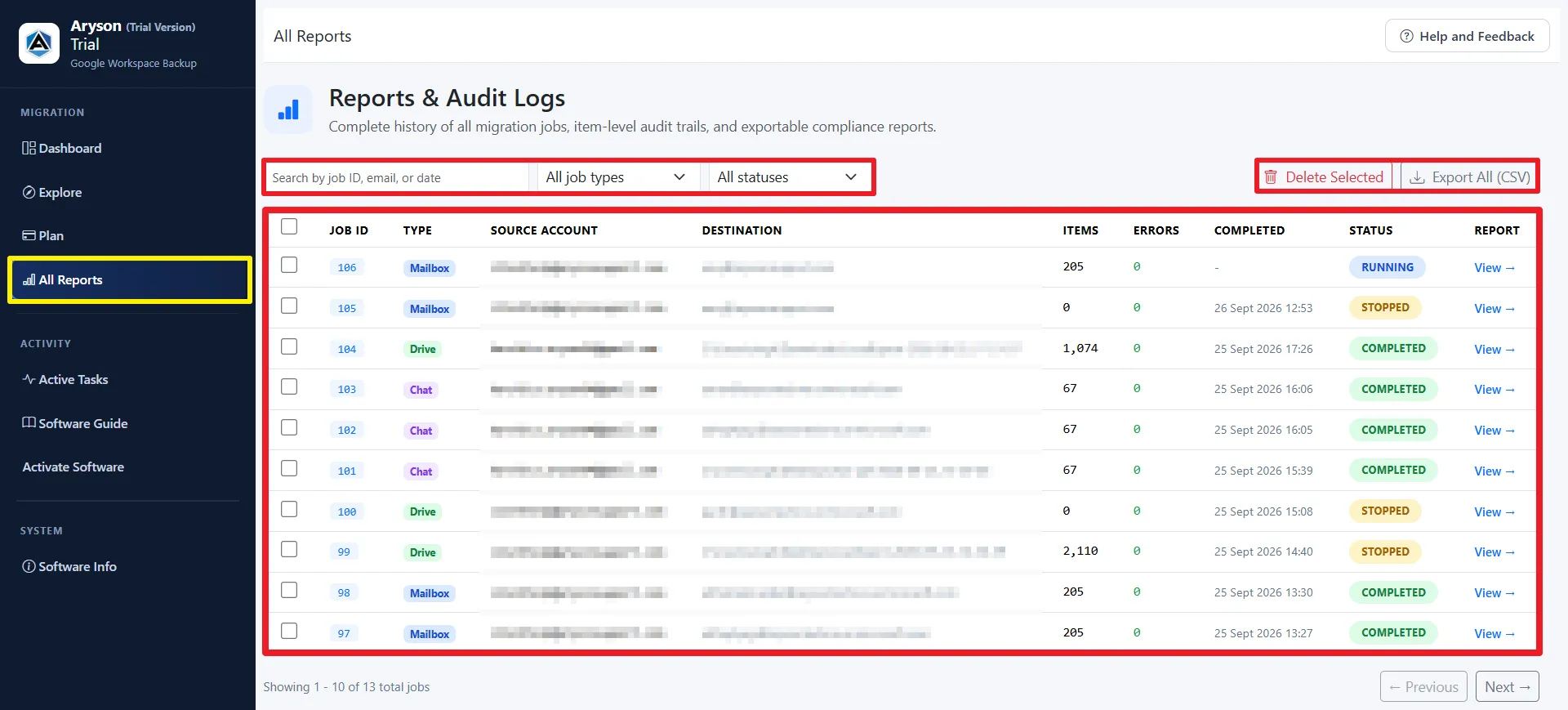
Step 14: The Reports & Audit Logs panel provides a complete record of migration jobs, including job ID, migration type, source account, destination, number of items, errors, completion time, and current status. Users can search and filter reports by job ID, email, date, job type, or status. The panel also allows users to select and delete reports, export all reports in CSV format, view individual reports, and navigate through multiple pages of migration records.
Migrate Gmail/Google Workspace to Google Workspace
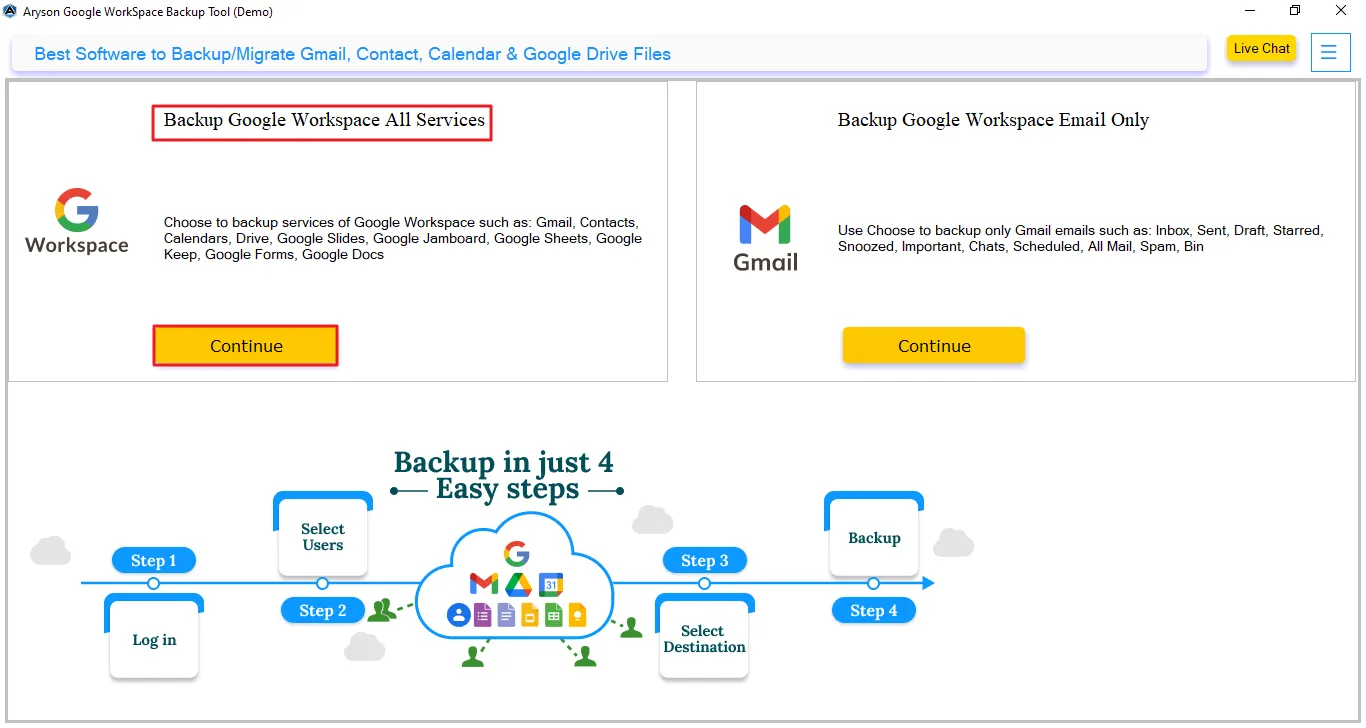
Step 6: Select Google Workspace as the destination
Go to the Email Client section and select Google Workspace as the destination platform.
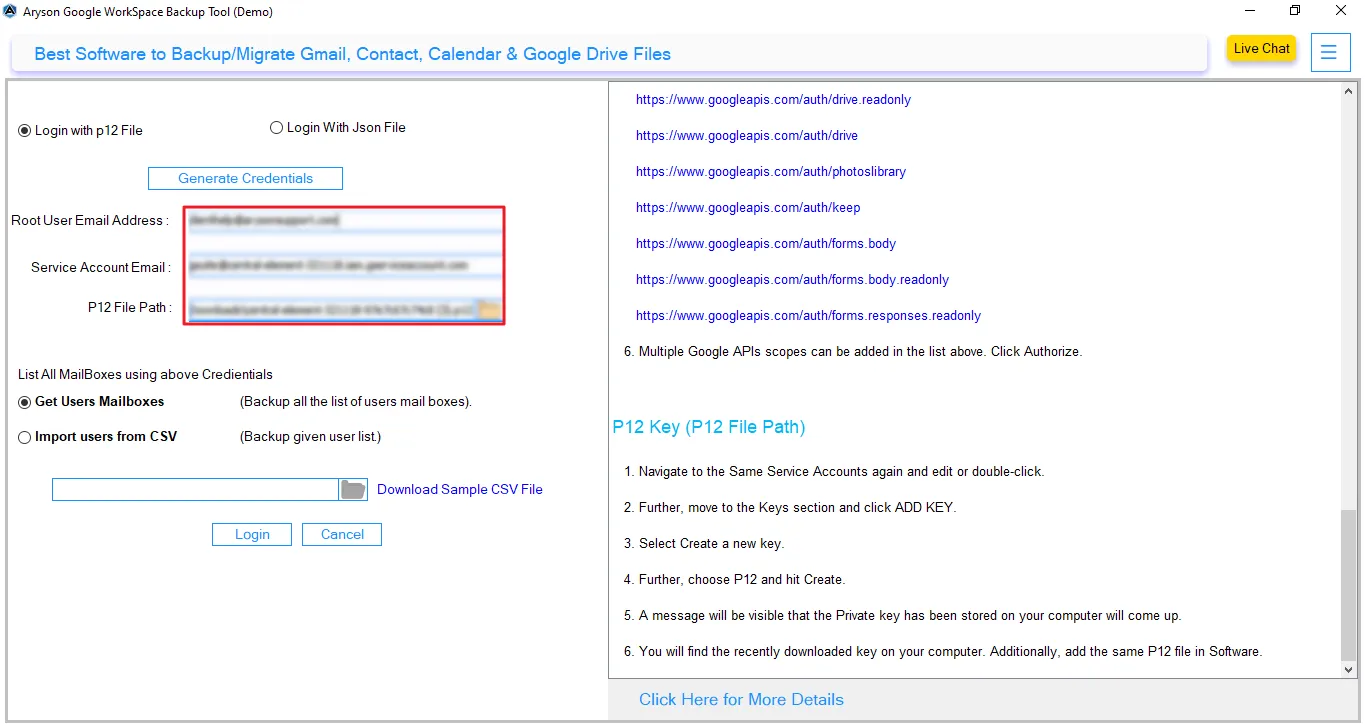
Step 7: Connect to the Target Google Workspace Account
- Select Google Workspace Admin (DWD).
- Enter the Google Workspace Admin email address.
- Choose the credential type:
- JSON Key File
- P12 Key File
- Click Browse and upload the service account key file.
- (Optional) Enable ‘Remember this account for future logins’.
- Click Connect Workspace.
- Alternatively, you can have quick access to the saved Google Workspace account.
- The software authenticates the Google Workspace domain.
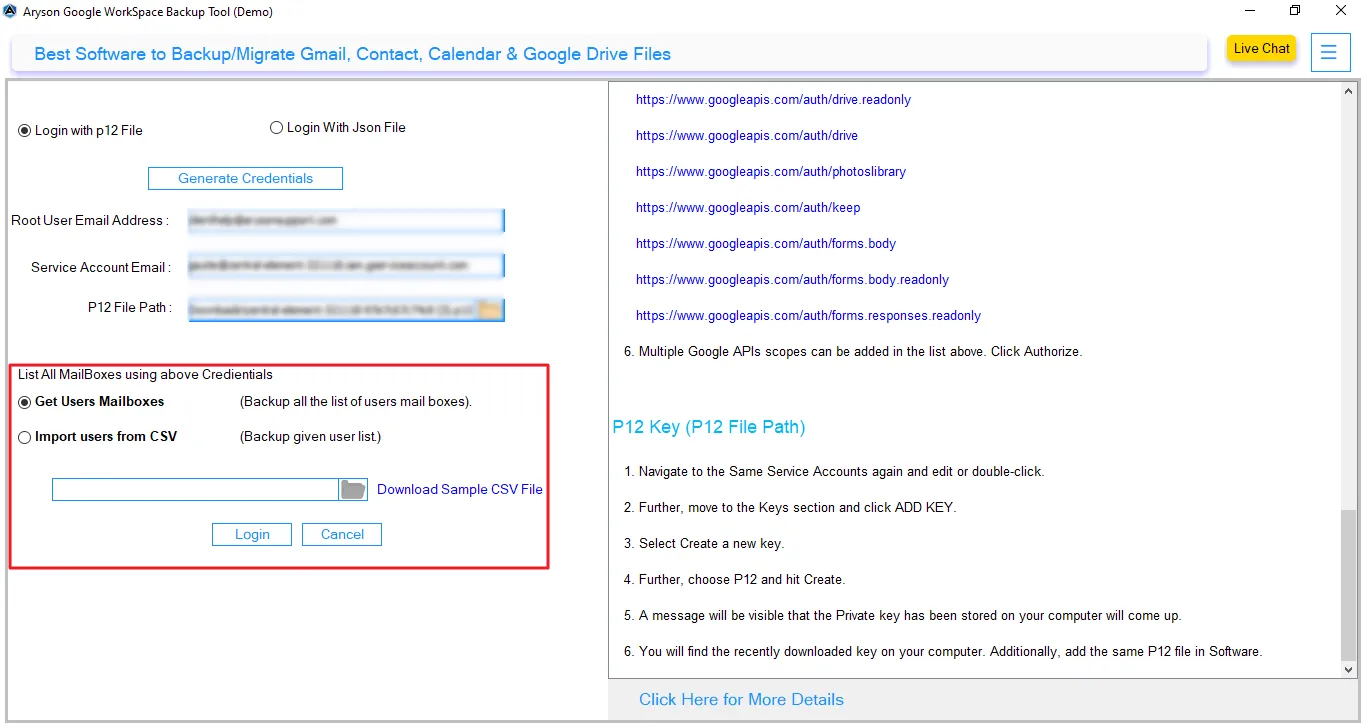
Step 8: Select the mailboxes to migrate to the Target Google Workspace mailboxes
- On the Destination Workspace Users panel, use the Search users bar to quickly filter specific accounts.
- Click Sample CSV to download a pre-formatted template file for bulk user selection.
- Click Upload CSV to import user list mappings directly from a CSV file.
- Select user checkboxes from the list to pick specific target accounts.
- Click Continue to move forward with the selected tenant accounts.
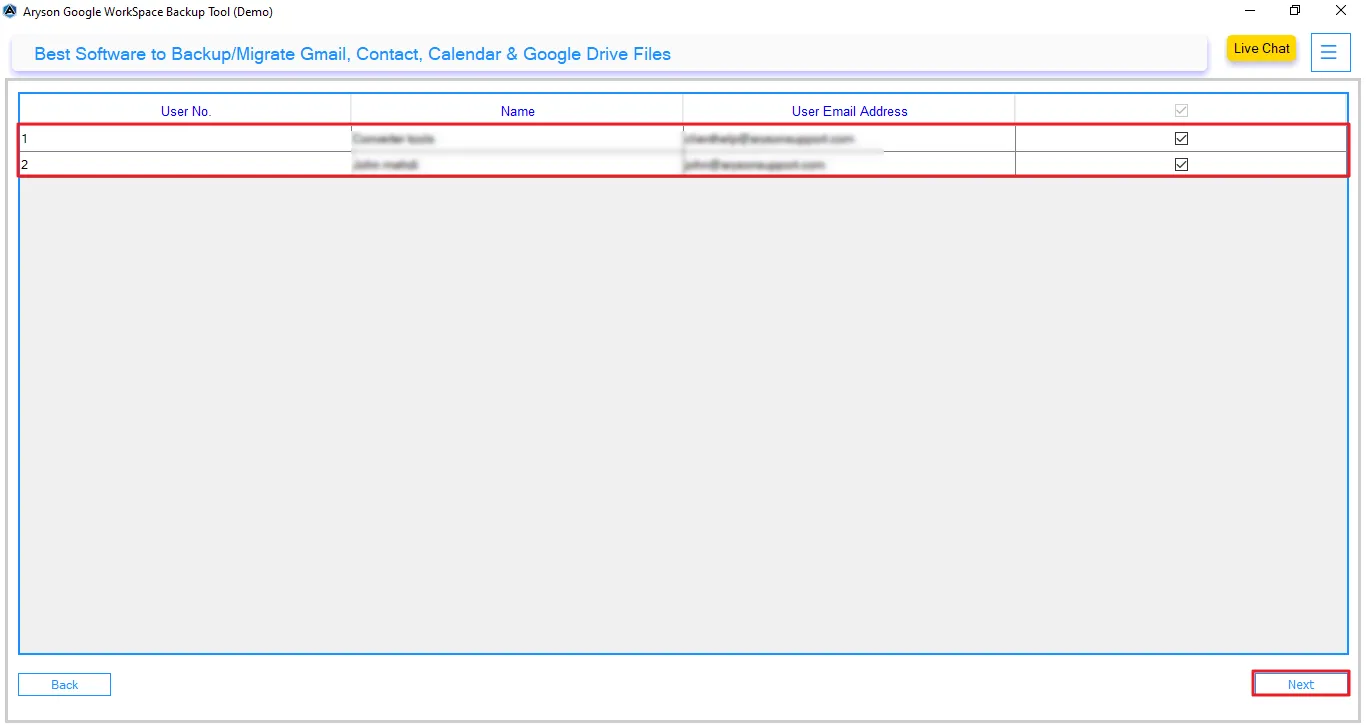
Step 9: Map Mailboxes
- Use Search source... to quickly find a specific Google Workspace account.
- Use Search destination... to filter down target Google Workspace mailboxes.
- Select source and destination checkboxes to pair individual Google and Google Workspace accounts manually.
- Click Map Selected to link and confirm the manually selected source and target accounts.
- Click Quick Actions to access automated mapping shortcuts.
- Selected Source → All Destinations: Maps the selected source mailboxes to all available destination mailboxes in one action.
- All Sources → Selected Destination: Maps all source mailboxes to the selected destination mailbox in one action.
- Click Clear Mapping to erase all established mailbox pairings at once.
- Click View Mapping to open a modal showing all active source-to-target mapping pairs.
- The current mapping panel appears. Click the Remove (X) icon next to any pair inside the modal to delete a specific mapping.
- Click Close to exit the Current Mappings pop-up window.
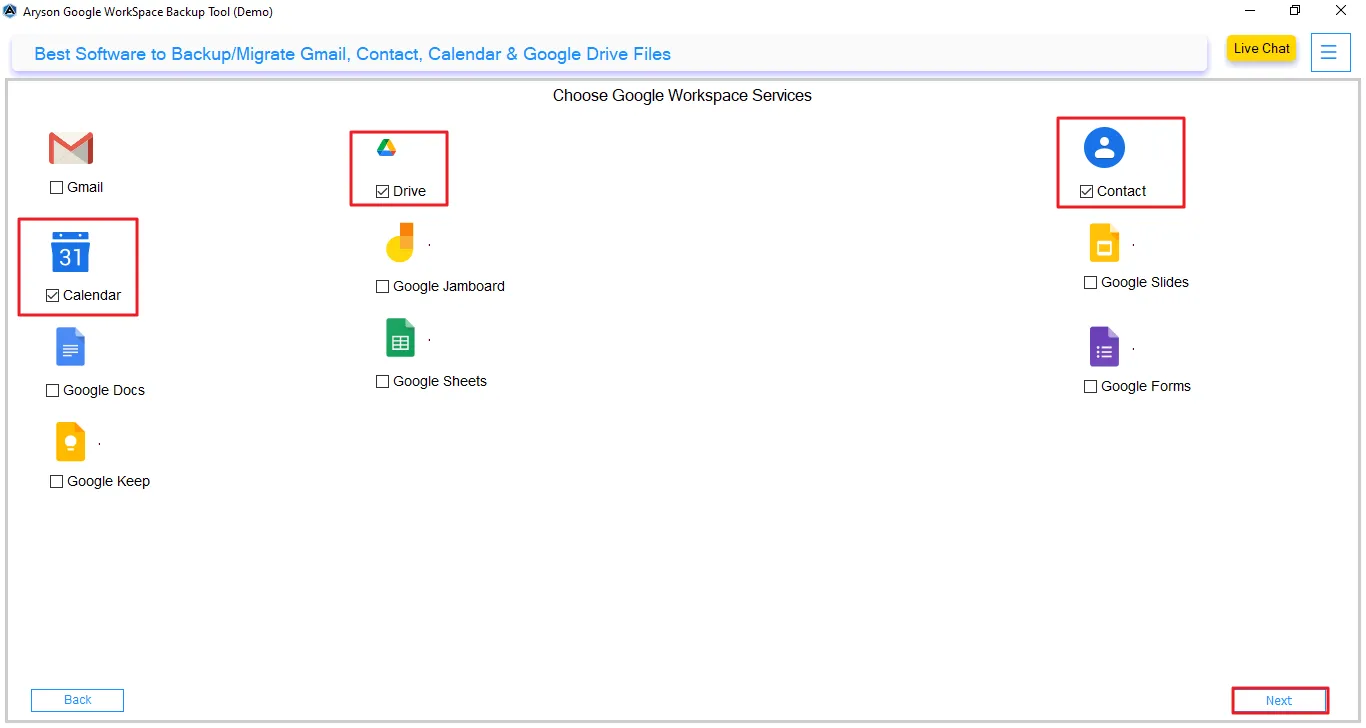
- View the Mapped column count on the right to quickly see how many targets are linked to each destination mailbox.
- Click Back to navigate to the previous configuration screen.
Step 10: Configure Migration Filters – Google Workspace Destination
Before starting the Google Workspace to Google Workspace migration, configure the required filters and settings to control the data transferred.
- Item Types: Select the mailbox items to migrate, including emails, contacts, calendars, tasks, and Google Keep data.
- Resume Migration: Enable Skip Previously Migrated Items to avoid transferring items that were already migrated in an earlier run.
- Date Range Filter: Enable the date filter to migrate only items within the selected date range.
- Skip Folders: Select folders such as Promotions, Social, Forums, Updates, Personal, or Unread to exclude them from migration.
- Duplicate Handling: Detect and skip duplicate emails based on selected fields such as Subject, From, Body, CC, and To.
- Advanced Email Filter: Filter specific emails using values entered for Subject, To, From, BCC, CC, or Body.
- Custom Folder Name: Specify a custom folder name under which the migrated emails will be placed in the destination Google Workspace mailbox.
- Preserve Folder Hierarchy: This will map the data from the source default folders to the target account’s default folders.
- Skip Attachments: Migrate emails without transferring their attachments.
- Save Attachments Separately: Save email attachments separately to a selected local folder.
- Exclude Deleted Mails: Exclude deleted emails from the Google Workspace migration.
- Exclude Empty Folders: Skip folders that contain no mailbox items.
- Exclude Spam Mails: Prevent spam emails from being transferred to the destination account.
- Free Up Server Space: Enable After Migration Cleanup to clean up the source mailbox after the migration.
- Save Contacts as VCF: Export contacts separately in .vcf format for local backup or use in another application.
- Save Calendar as ICS: Export calendar events separately in .ics format for backup or use with compatible calendar applications.
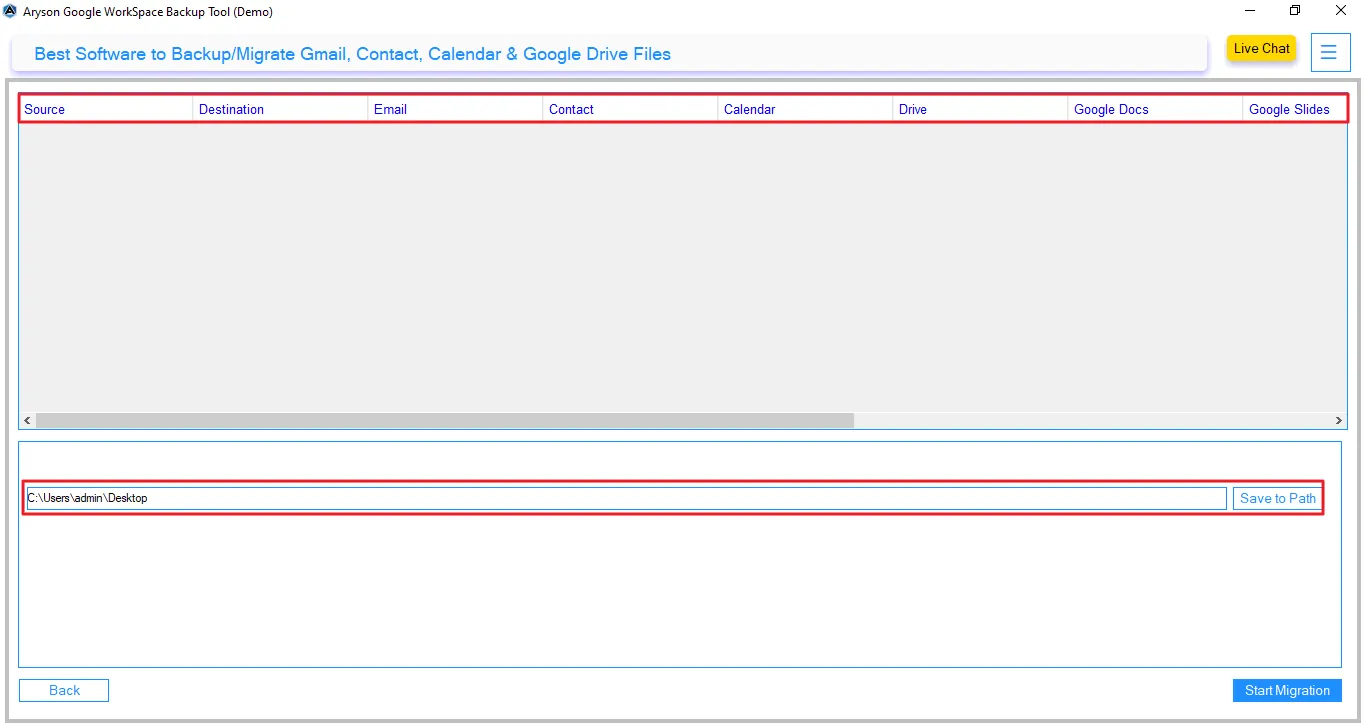
Step 11: Start the Google Workspace to Google Workspace Migration
After reviewing all settings, click Start Migration to begin transferring mailbox data to Google Workspace. The software starts migrating the selected mailbox data immediately.
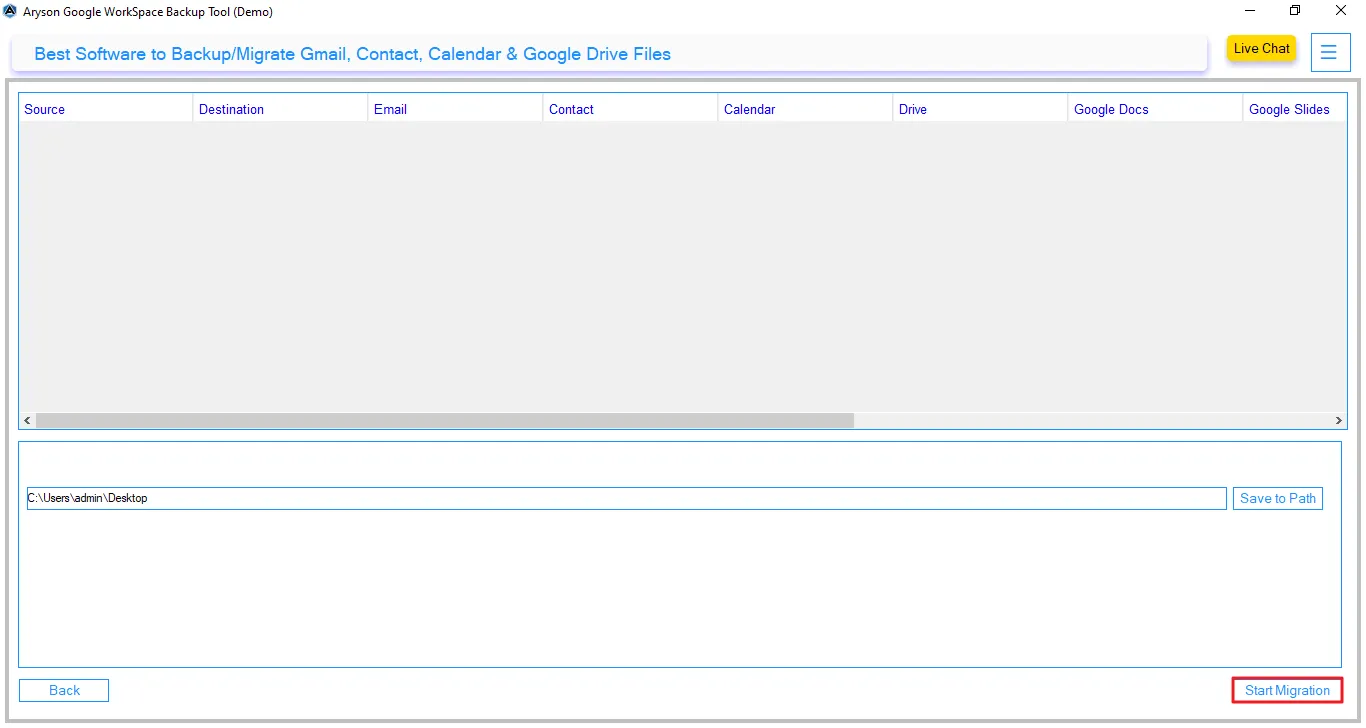
Step 12: Migration Progress Panel
- Connection Status: Displays whether the source and destination accounts are successfully connected.
- Source & Destination: Shows the source mailbox and the destination mailbox selected for migration.
- Folder Preparation: Creates the required destination folders before transferring mailbox data.
- Migration Progress: Displays the overall migration progress through a progress bar.
- Items Migrated: Shows separate counts for Emails, Contacts, Calendar, Tasks, and Notes.
- Skipped & Failed Items: Tracks items that were skipped or could not be migrated.
- Overall Email Folders: Indicates the percentage of mailbox folders processed.
- Current Folder: Shows the progress of the folder currently being migrated.
- Folder Details: Displays the current folder name, migrated items, and total folders completed.
- Data Transfer Status: Shows the total amount of data transferred during migration.
- Destination Folder: Displays the folder/location where migrated data is stored.
- Migration Controls: Provides pause migration and stop migration options for controlling the process.
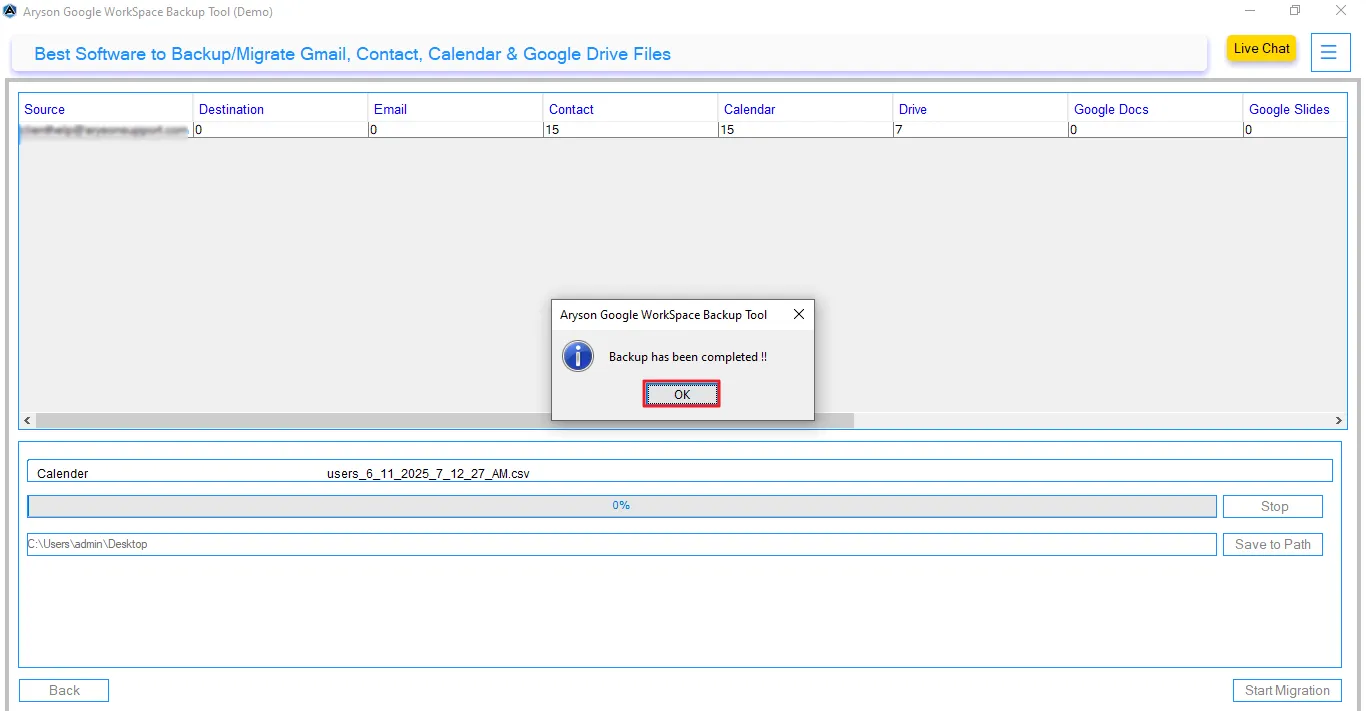
Step 13: Active Tasks / Migration Tasks Panel
- Migration Status: Shows the current migration task and indicates whether it is running.
- Progress: Displays the overall migration percentage through a progress bar.
- Files Migrated: Shows the number of files successfully migrated.
- Skipped Files: Displays the count of files skipped during migration.
- Elapsed Time: Shows how long the migration task has been running.
- View Details: Opens detailed information about the ongoing migration task.
*Redirects the user to the Migration Progress Panel, where they can monitor detailed migration activity and progress*
- Active Tasks: Lets users monitor currently running migration tasks from one place.
- Help and Feedback: Provides access to help resources and feedback options.
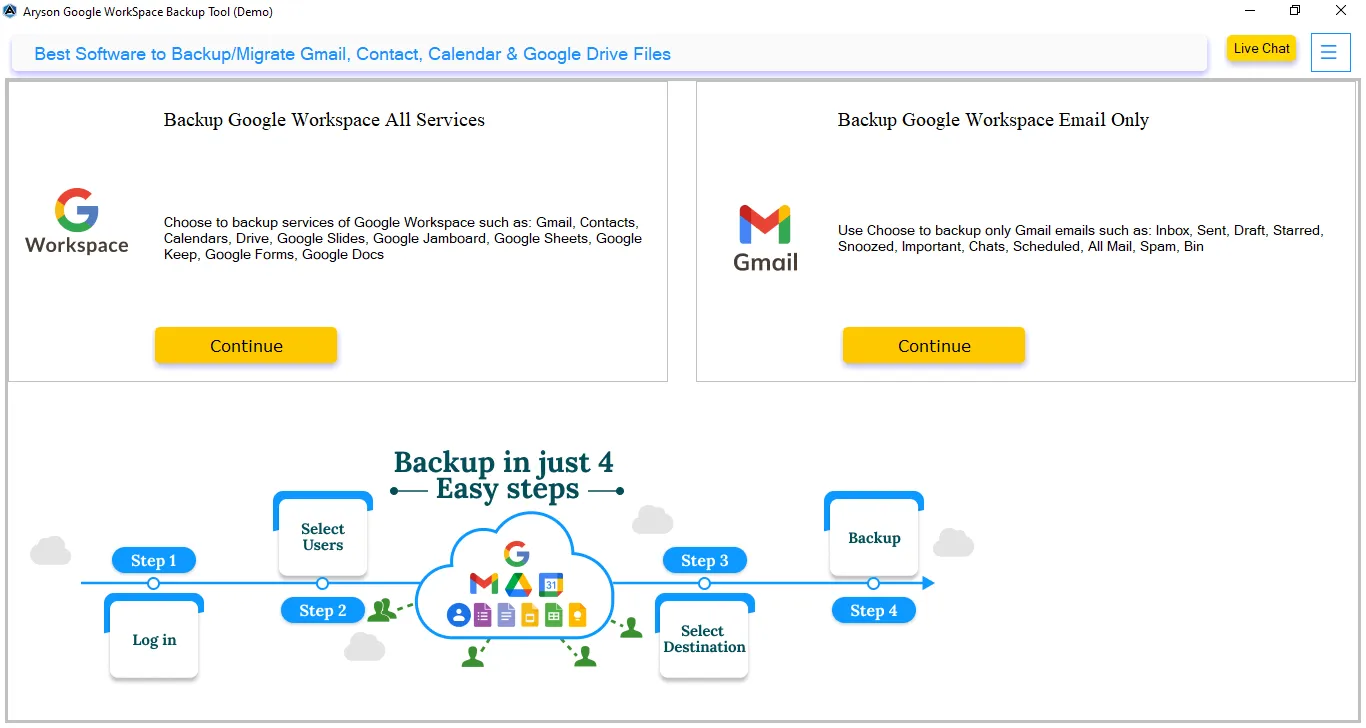
Step 14: The Reports & Audit Logs panel provides a complete record of migration jobs, including job ID, migration type, source account, destination, number of items, errors, completion time, and current status. Users can search and filter reports by job ID, email, date, job type, or status. The panel also allows users to select and delete reports, export all reports in CSV format, view individual reports, and navigate through multiple pages of migration records.
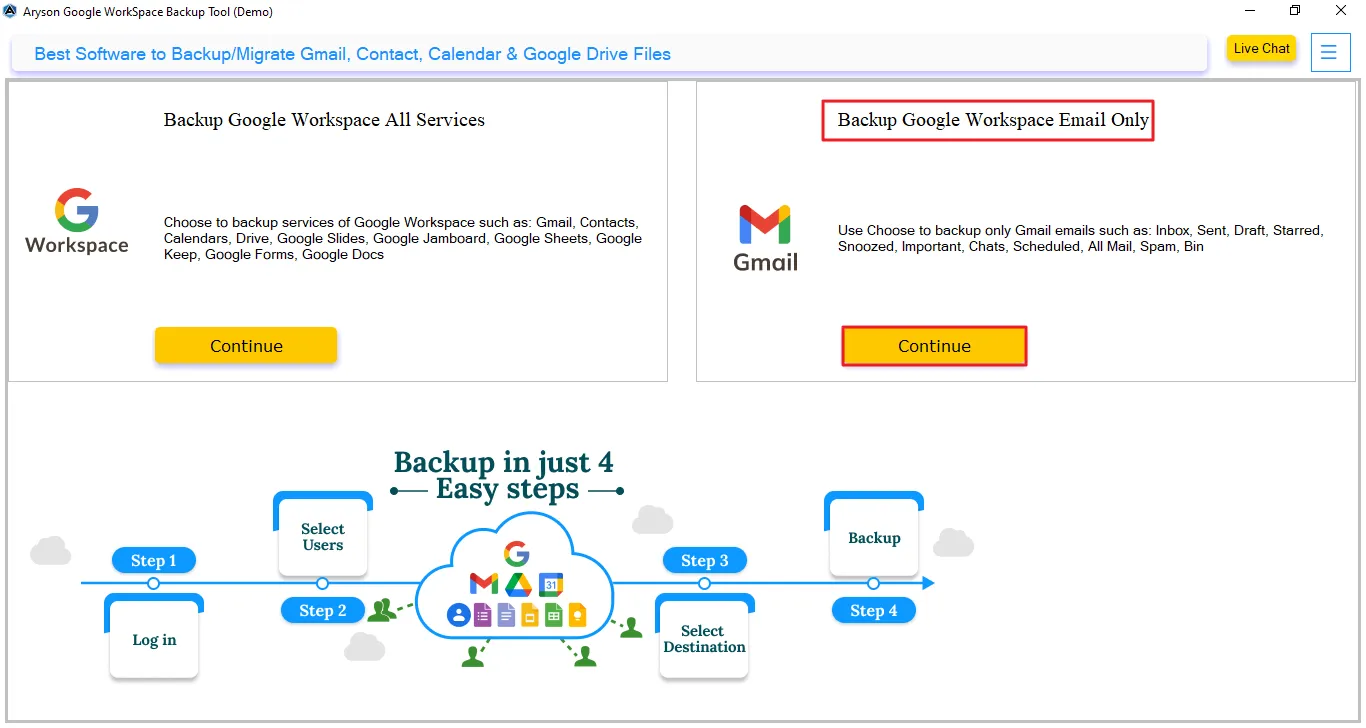
Migrate Google Drive Data
Step 1: Download and install the Aryson Google Workspace Migration Tool.
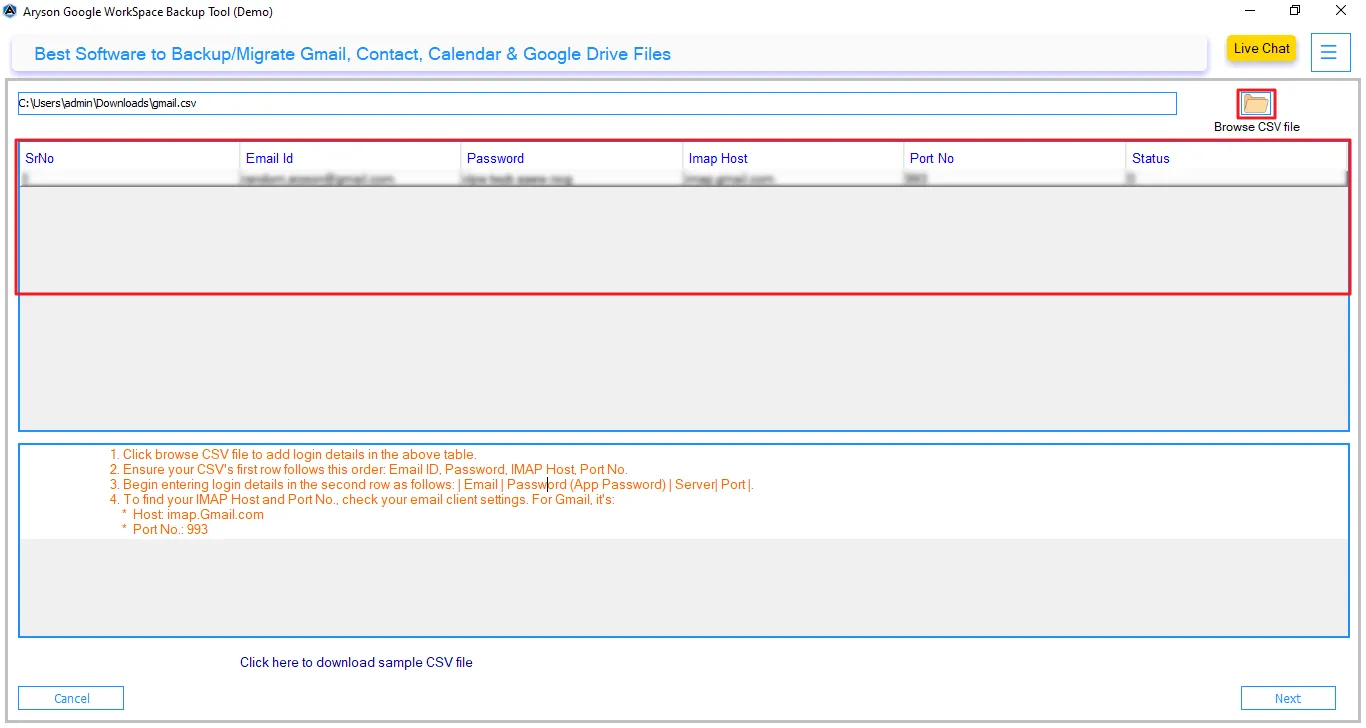
Step 2: Select the Google Drive Migration card under Choose Migration Mode.
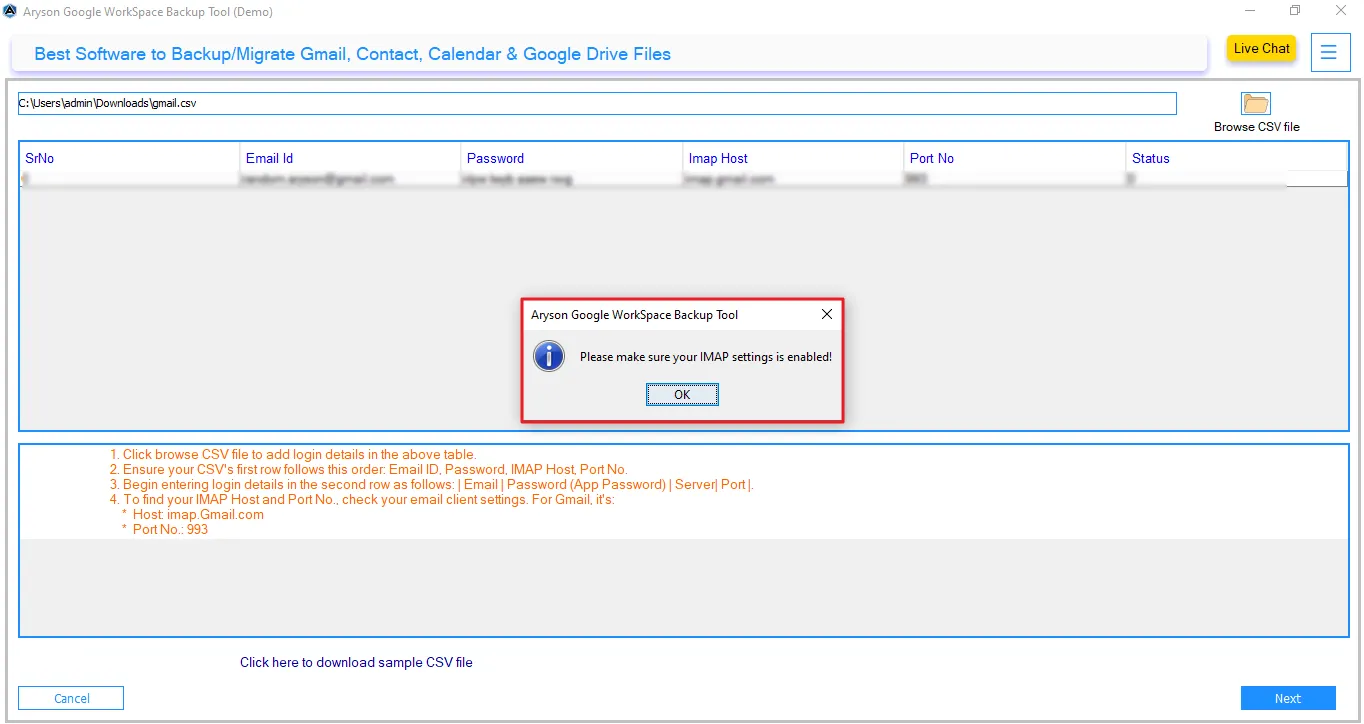
Step 3: Connect Your Google Workspace Account
The software provides two authentication methods to connect to your Google account. Choose between the A and B migration methods.
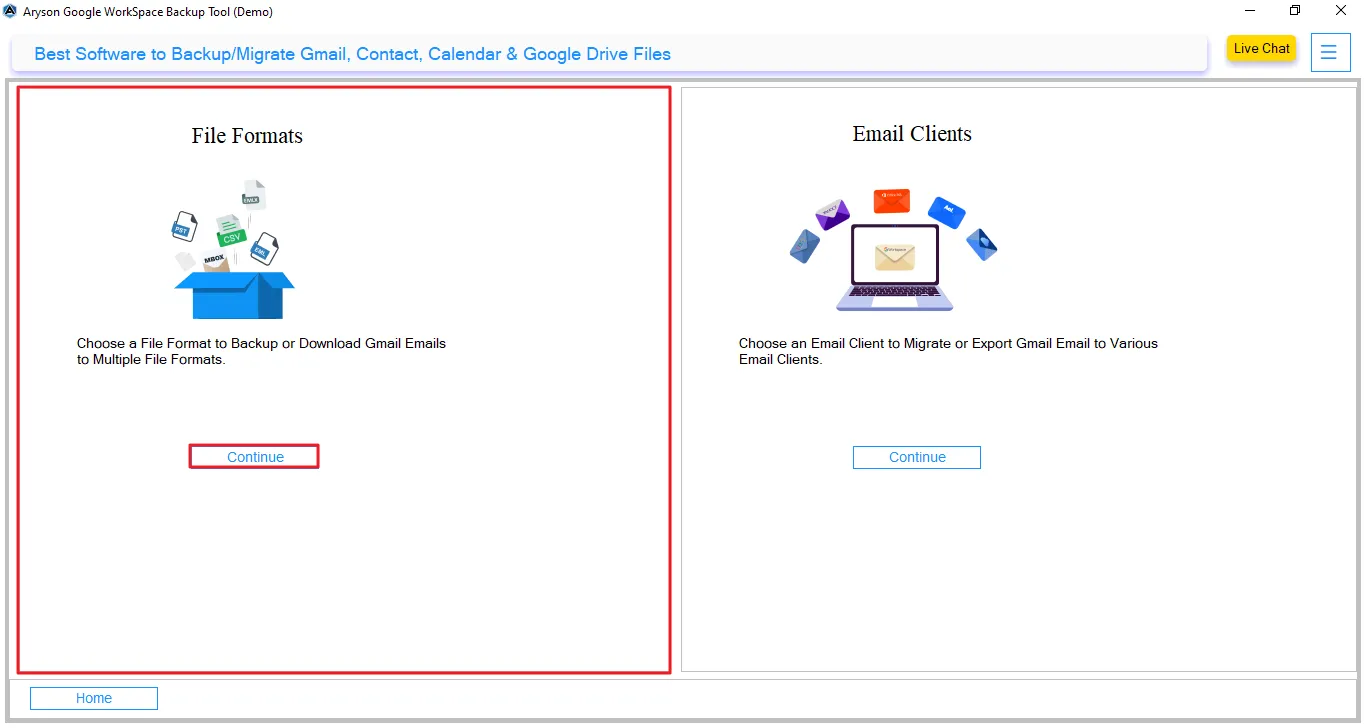
Step 3(A): Log in via OAuth 2.0 / Modern Authentication
- Select OAuth 2.0 / Modern Auth.
- Enter the Gmail email address.
- Provide the Client ID and Client Secret generated from the Google Cloud Console (optional).
- If you do not have your own OAuth credentials, enable "I don't have a Client ID & Client Secret".
- (Optional) Enable Remember this account for future logins.
- Click Continue with Google.
- Sign in to your Google account and grant the required permissions.
- The account will be authenticated and added to the software.
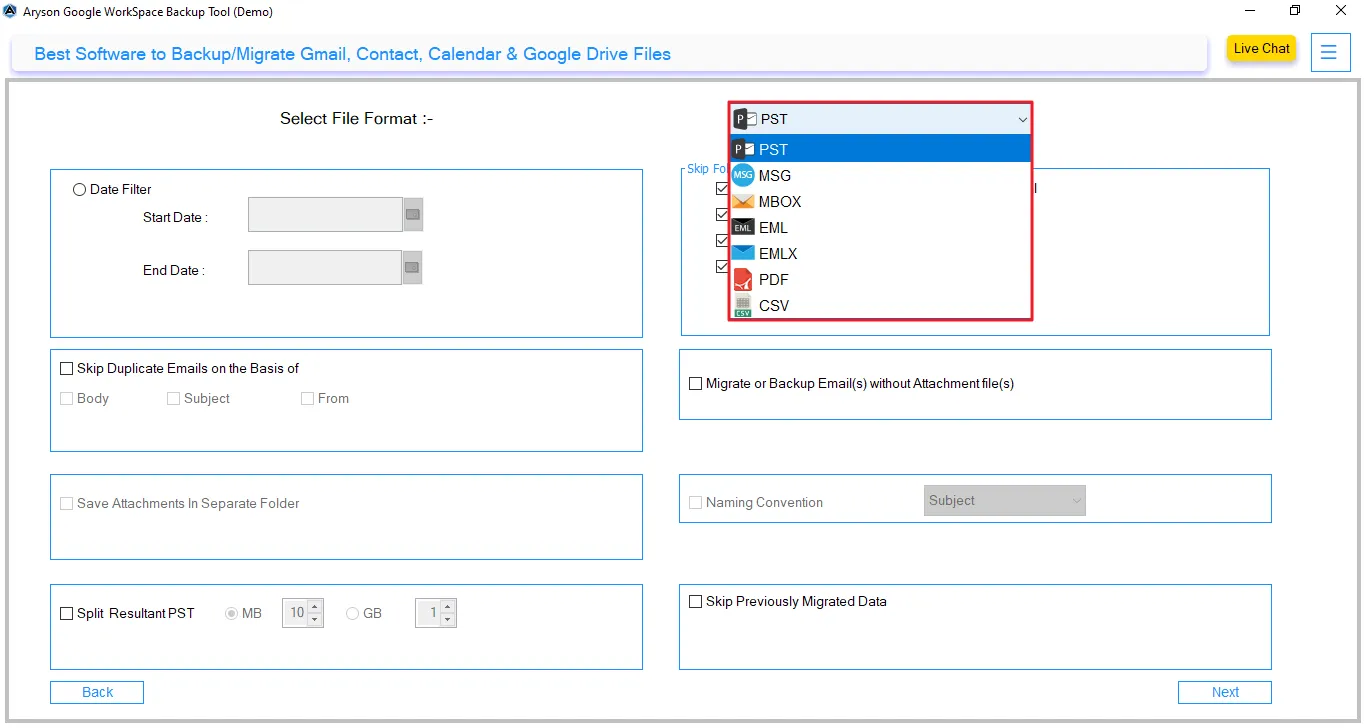
Step 3(B): Log in via Google Workspace Admin (DWD)
- Select Workspace Admin (DWD).
- Enter the Google Workspace Admin email address.
- Choose the credential type:
- JSON Key File
- P12 Key File
- Click Browse and upload the JSON key.
- (Optional) Enable Remember this account for future logins.
- Click Connect Workspace.
- The software authenticates the Google Workspace domain and loads available user accounts.
This method is recommended for bulk Google Drive backup and migration.
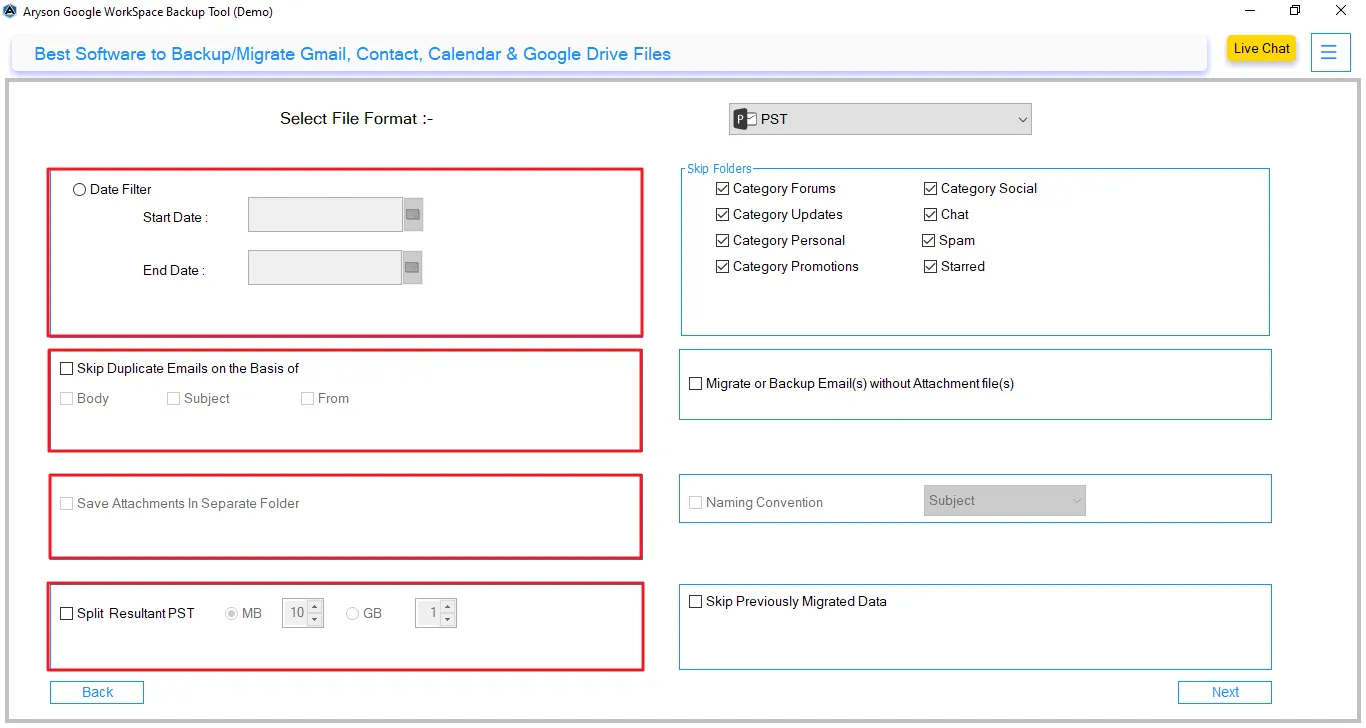
Step 4: Select Users for Google Drive Migration
- The software displays all available users retrieved from the connected account.
- Select the required user(s) using the checkbox.
- Use Search by Email to quickly find a specific user.
- Review selected users in the Selected Users panel.
- Click the Remove (X) icon to remove any user from the selection.
- Verify the license status of the selected user.
- Check the total number of selected users at the bottom-right corner.
- Click Continue to proceed to the Filters section.
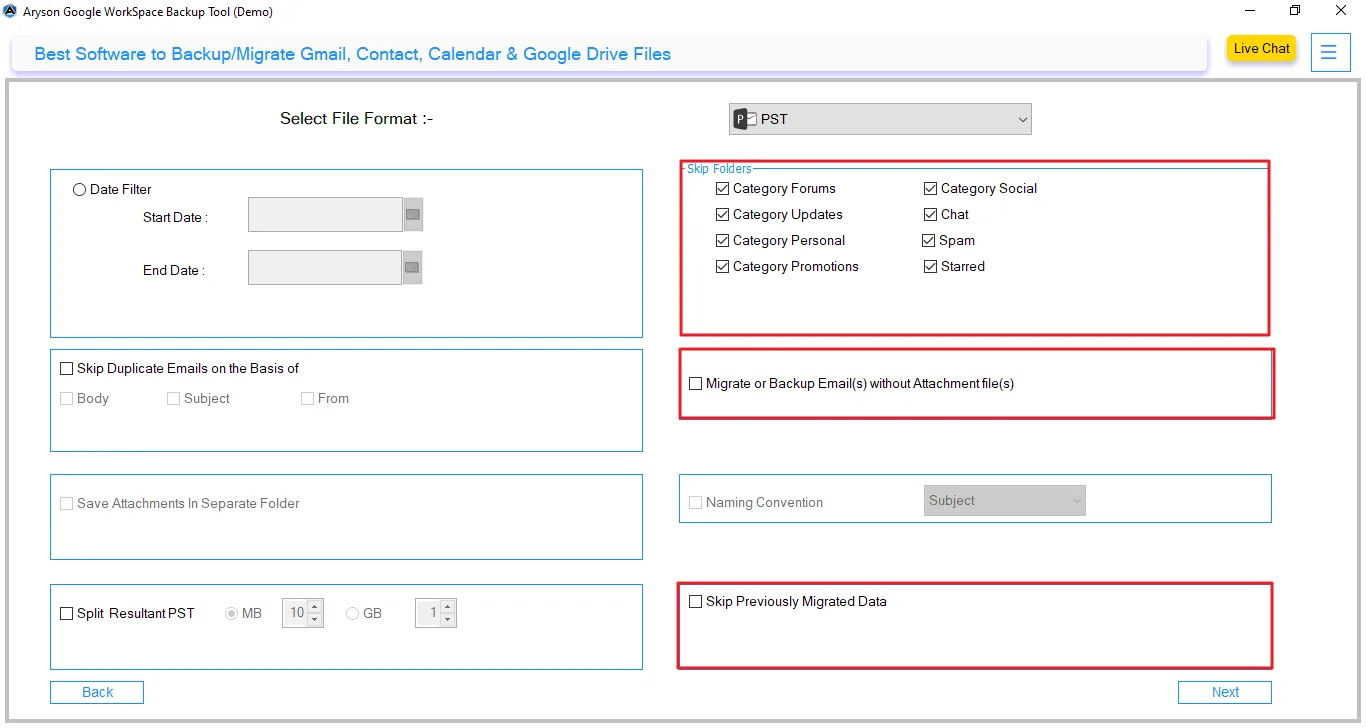
Export Google Drive Locally
Step 5: Select Local Export as the Destination
The Local Drive option is selected by default, so you do not need to change it. This will help you save Google Drive data to your local system.
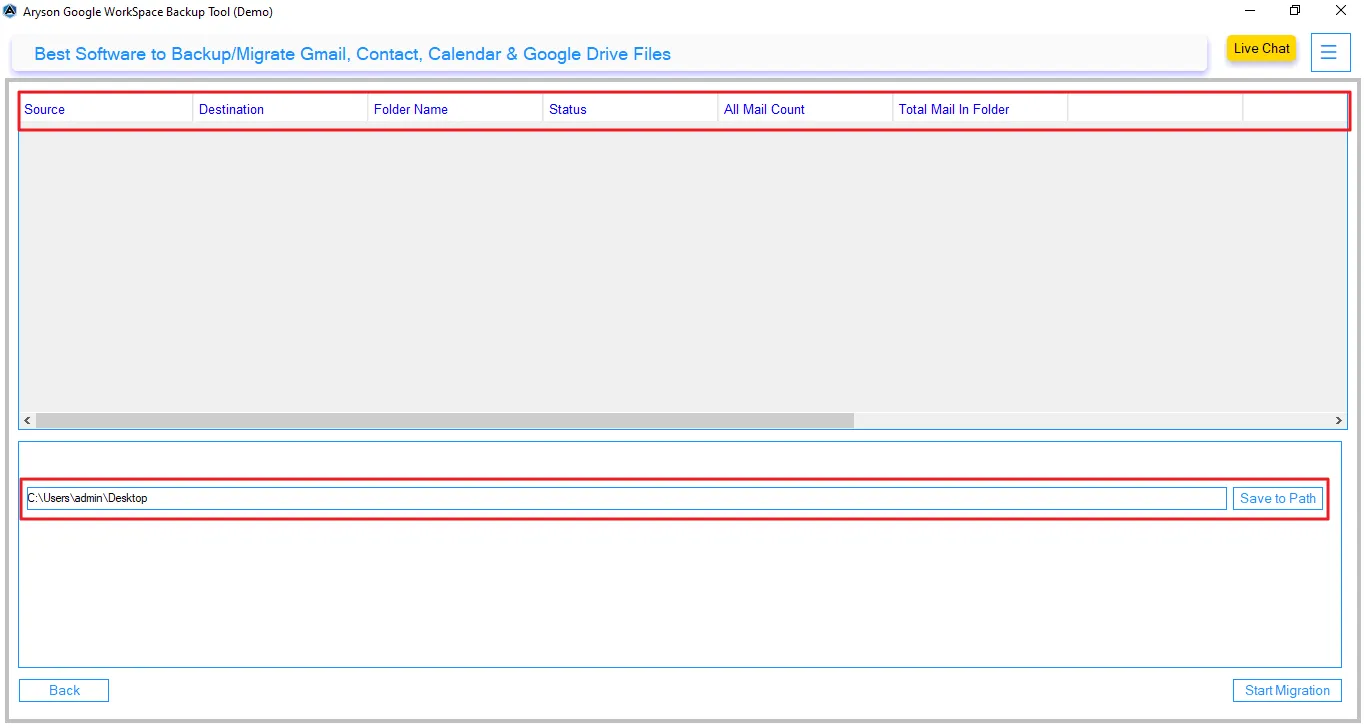
Step 6: Set the Destination Path
Click Browse and select the destination path where you want to save the exported Google Drive data.
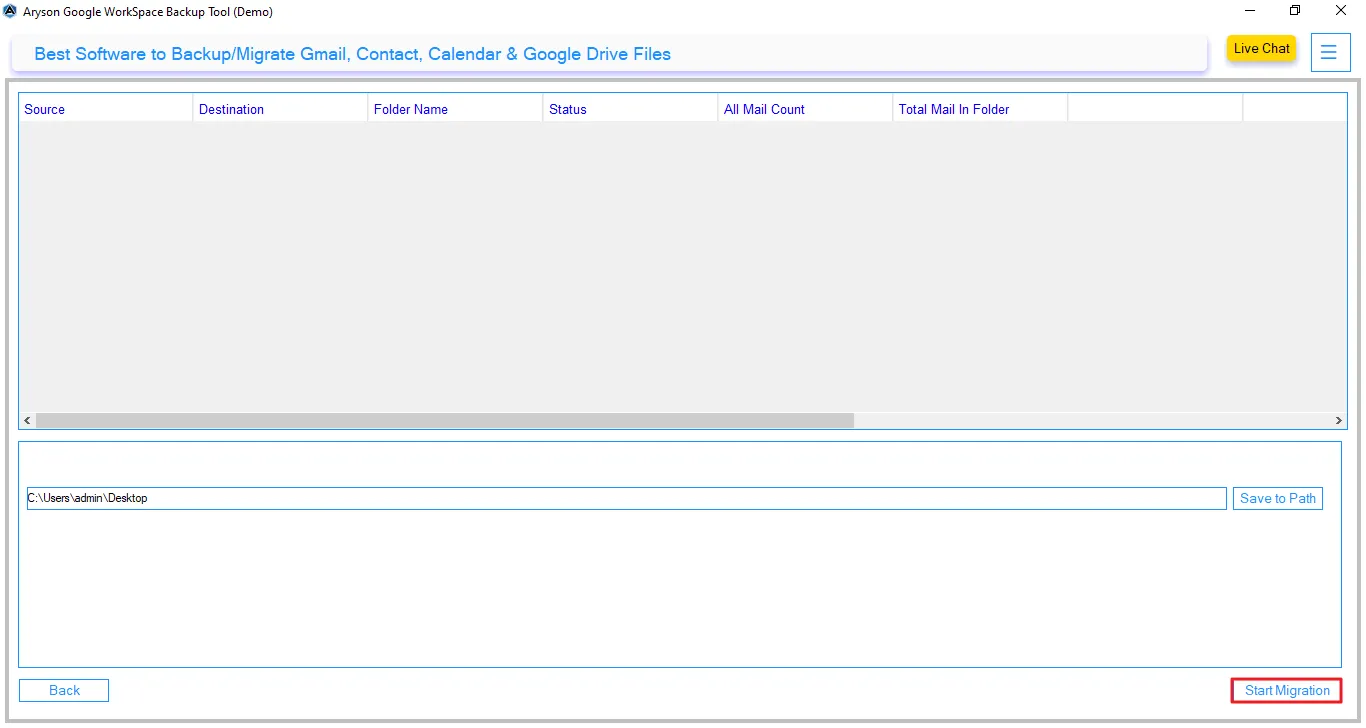
Step 7: Configure Migration Filters – Local Drive Destination
Before starting the Google Drive to Local Drive migration, configure the required filters and settings as needed.
- Resume Migration: Enable Resume Migration to skip previously migrated items and continue an interrupted migration.
- Date Range Filter: Migrate only the items that fall within a specific date range by selecting the Start Date and End Date.
- Skip Duplicates: Select the required duplicate-check criteria, such as Name, Size, Modified, or Checksum, to detect and skip duplicate files during export.
- Skip Drive Sections: Choose the Google Drive sections you want to exclude from the export, such as My Drive, Shared With Me, Trash, or Shared Drives.
- File Type Filter: Enable the File Type Filter option, then select specific Google Workspace file types such as Docs, Sheets, Slides, and Forms, or enter custom file extensions to export only the selected file types.
- Set Minimum File Size: Specify a minimum file size value (in MB or GB) to skip files smaller than the defined size during export.
- Set Maximum File Size: Specify a maximum file size value (in MB or GB) to exclude files larger than the defined size from export.
- Preserve Folder Hierarchy: Enable this option to maintain the original Google Drive folder structure in the exported data.
- Custom Folder Name: Specify a custom name for the folder where migrated data will be saved.
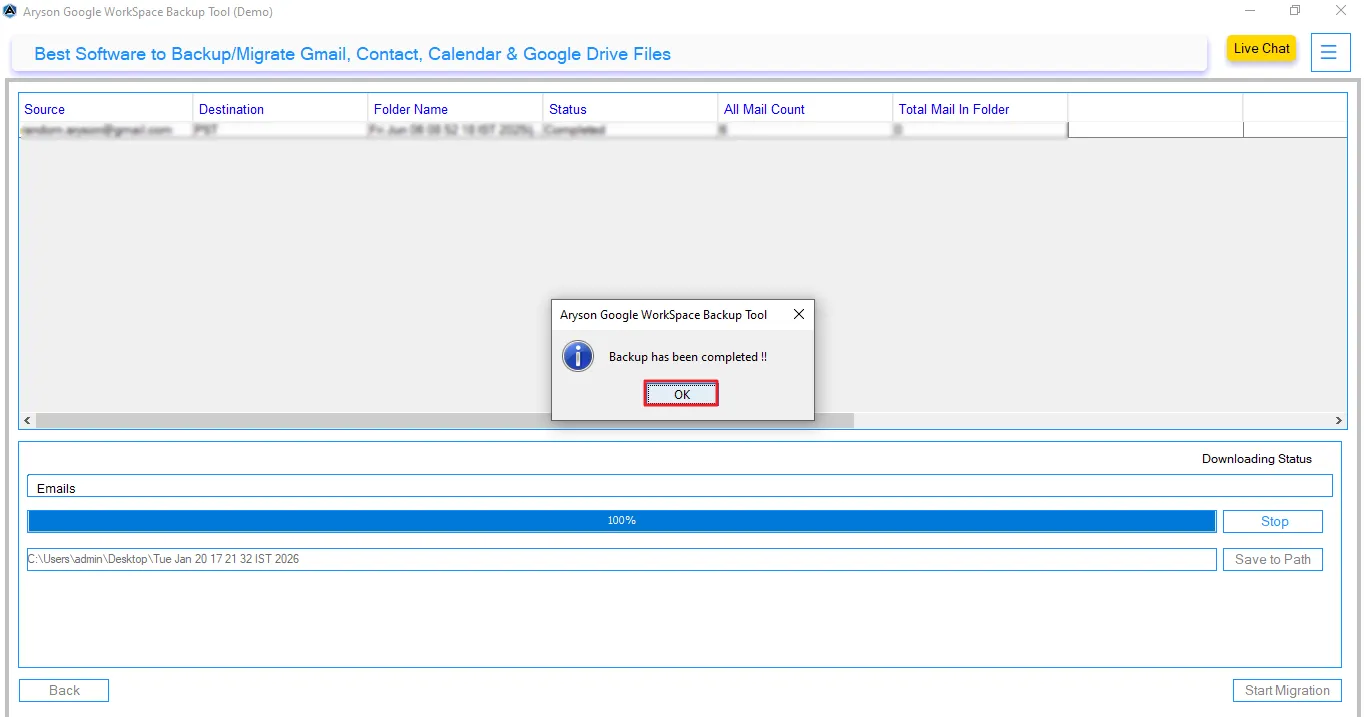
Step 8: Start the Google Drive to Local Drive Migration
After reviewing all settings, click Start Migration to begin transferring Google Drive data to the local destination. The software starts exporting the selected Drive data immediately.
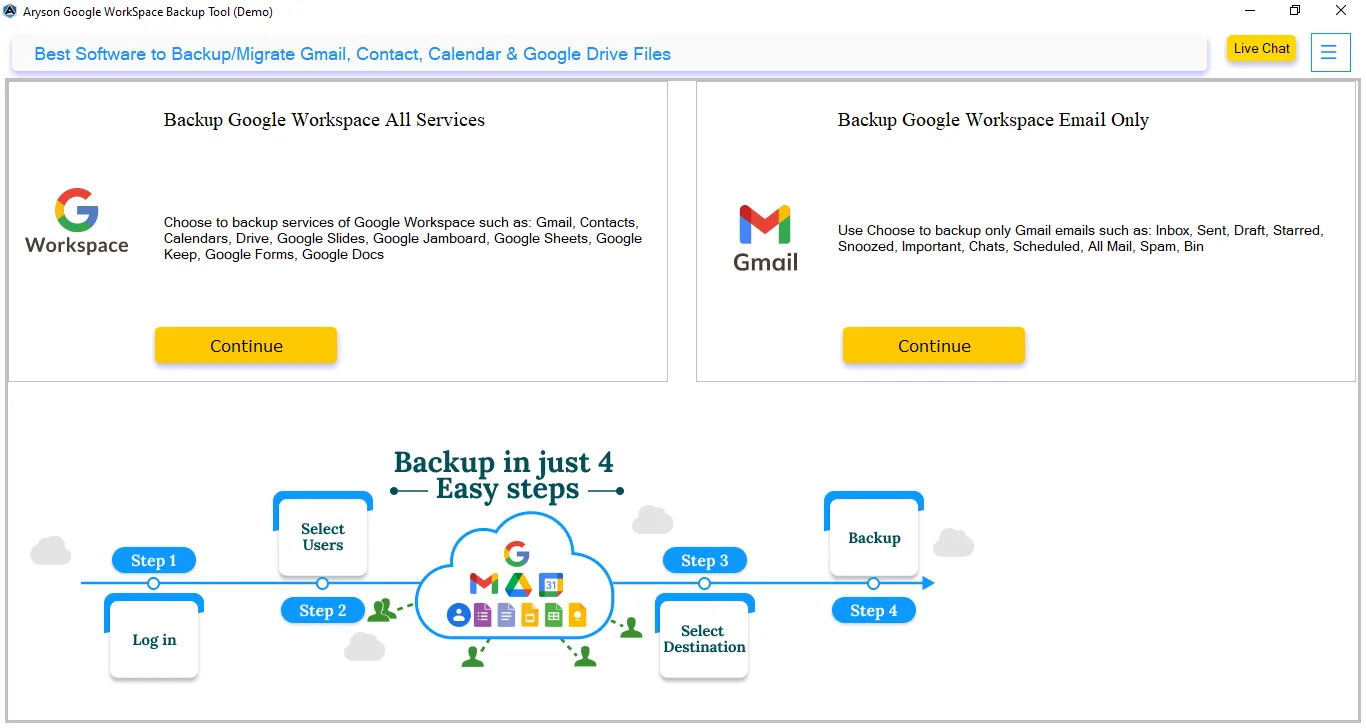
Step 9: Monitor the Migration Progress
Track the real-time migration status, including migrated files, skipped items, and failed items. The progress bar provides a live overview of the export process.
You can use the Stop Migration button to halt the backup process and even pause or resume it whenever needed via the Resume Migration and Pause Migration buttons.
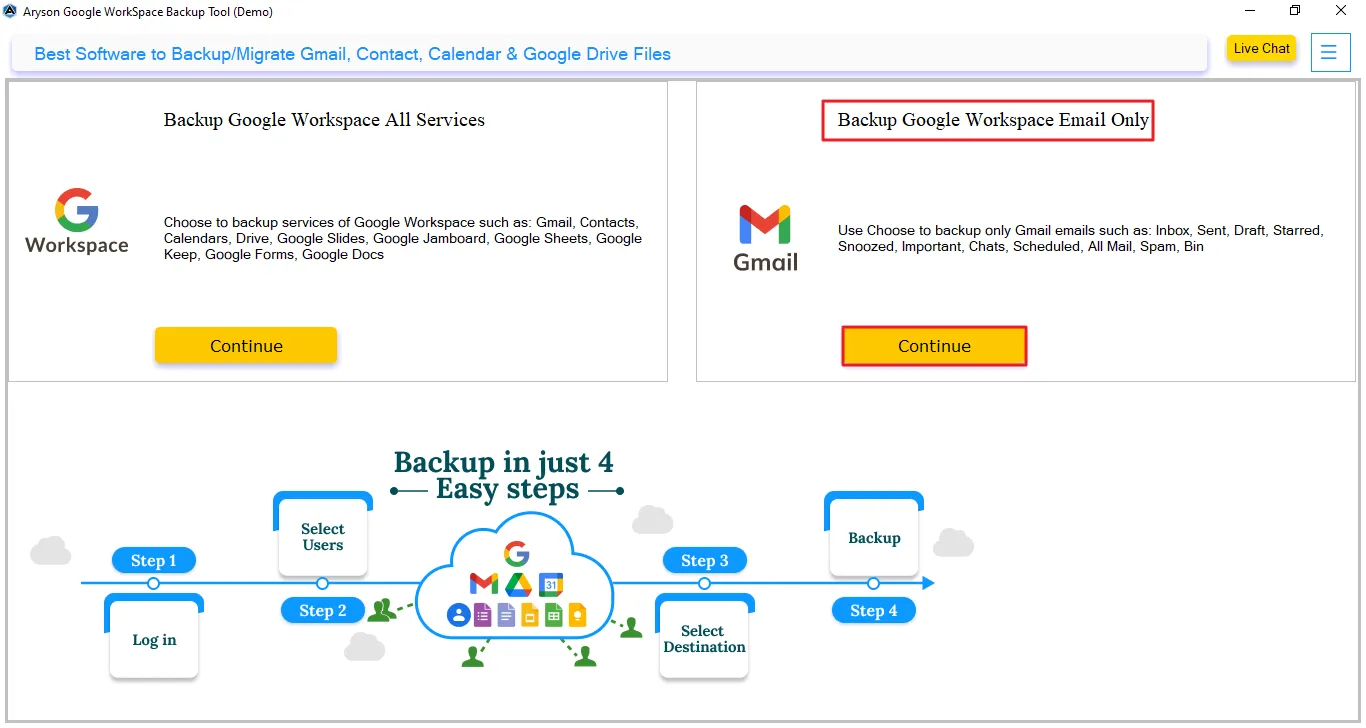
Step 10: Active Tasks / Migration Tasks Panel
- Migration Status: Shows the current migration task and indicates whether it is running.
- Progress: Displays the overall migration percentage through a progress bar.
- Files Migrated: Shows the number of files successfully migrated.
- Skipped Files: Displays the count of files skipped during migration.
- Elapsed Time: Shows how long the migration task has been running.
- View Details: Opens detailed information about the ongoing migration task.
*Redirects the user to the Migration Progress Panel, where they can monitor detailed migration activity and progress*
- Active Tasks: Lets users monitor currently running migration tasks from one place.
- Help and Feedback: Provides access to help resources and feedback options.
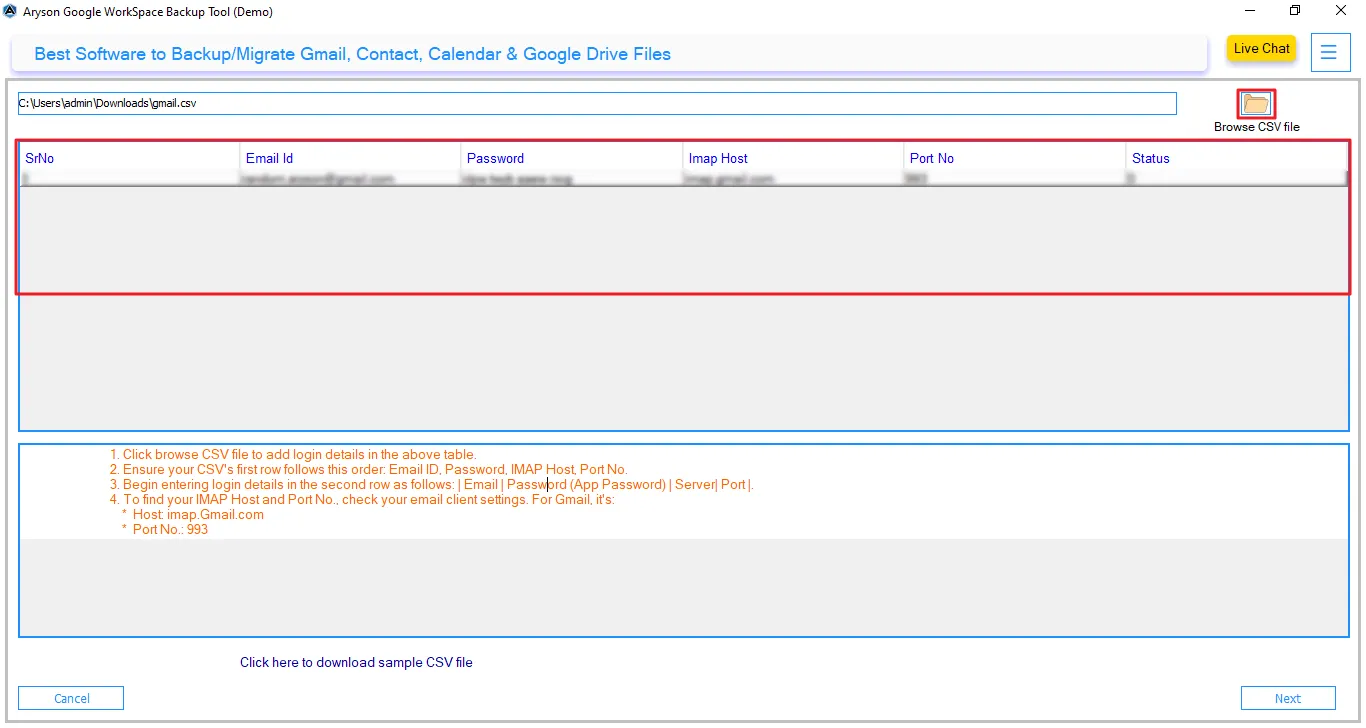
Step 11: The Reports & Audit Logs panel provides a complete record of migration jobs, including job ID, migration type, source account, destination, number of items, errors, completion time, and current status. Users can search and filter reports by job ID, email, date, job type, or status. The panel also allows users to select and delete reports, export all reports in CSV format, view individual reports, and navigate through multiple pages of migration records.
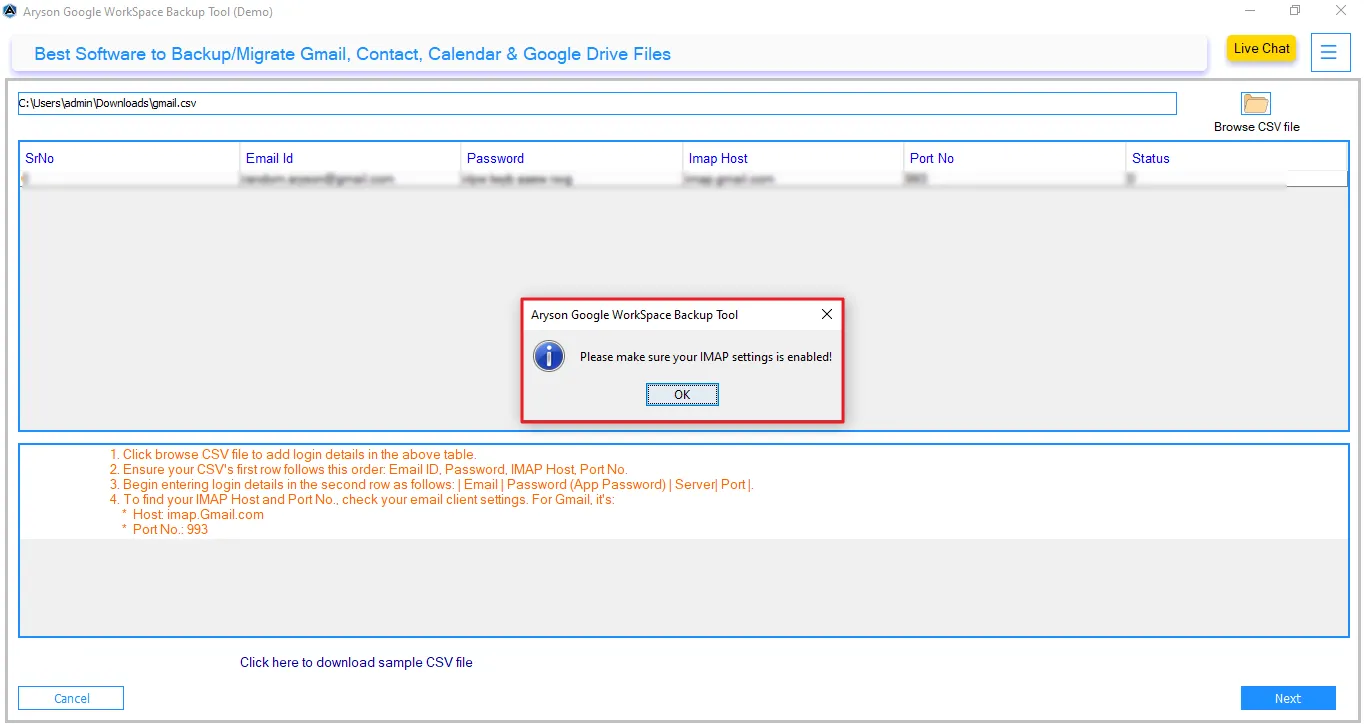
Migrate Google Drive Data to Microsoft 365
Step 5: Select Microsoft 365 (OneDrive) as the Destination
- Go to the Email Client section and select Microsoft 365 as the destination platform.
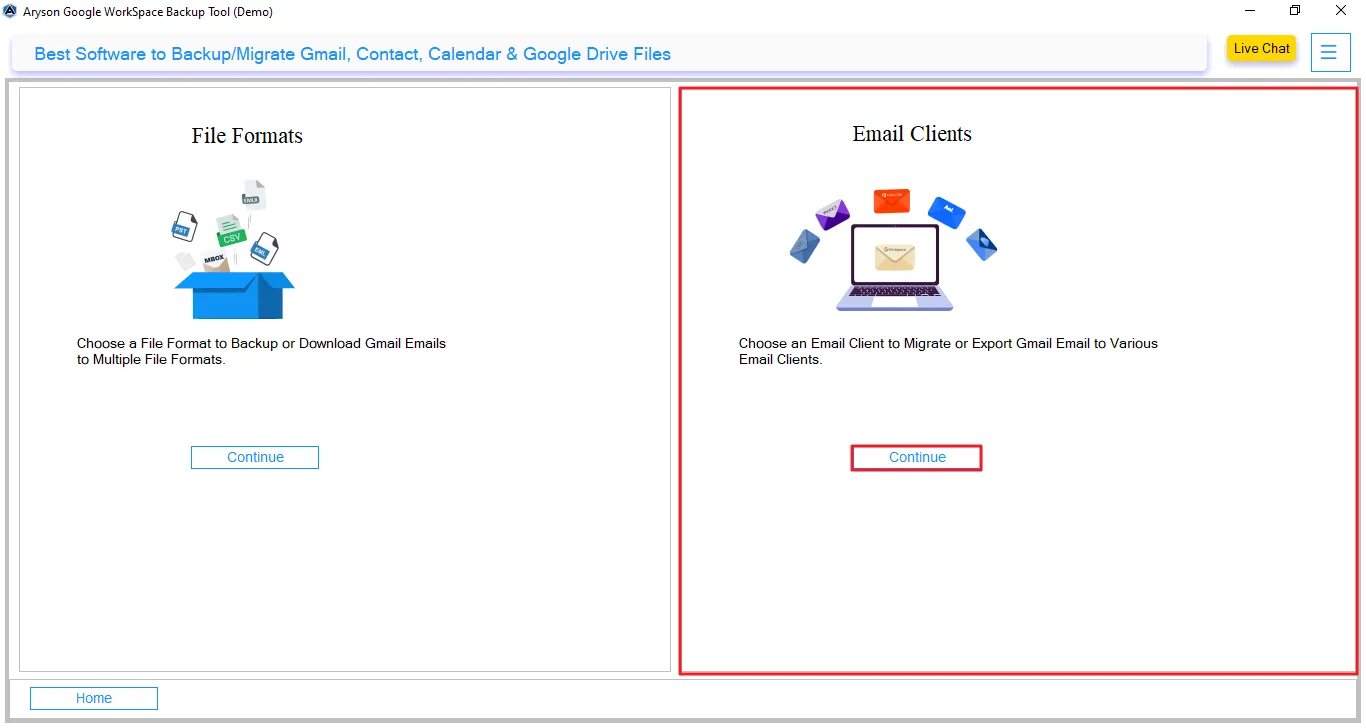
- You can choose the single-user or admin-user login method.
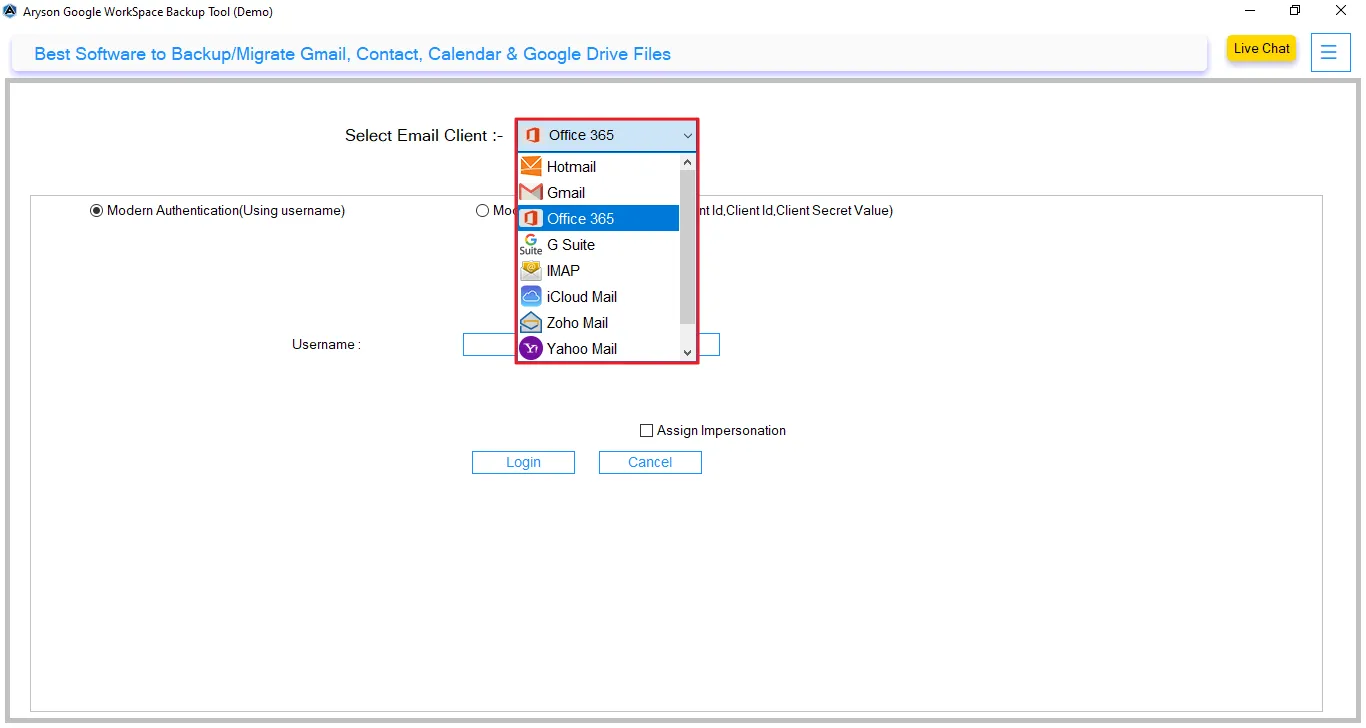
Step 6: Connect the Microsoft 365 Account
- If you selected Single User:
- Click on Single User to initiate login for an individual account.
- Check the 'Remember this account for future logins' checkbox to save credentials for subsequent sessions.
- Click the Select a tenant connection... dropdown menu to pick a saved Microsoft 365 connection.
- Click + Add connection to establish a new tenant login link.
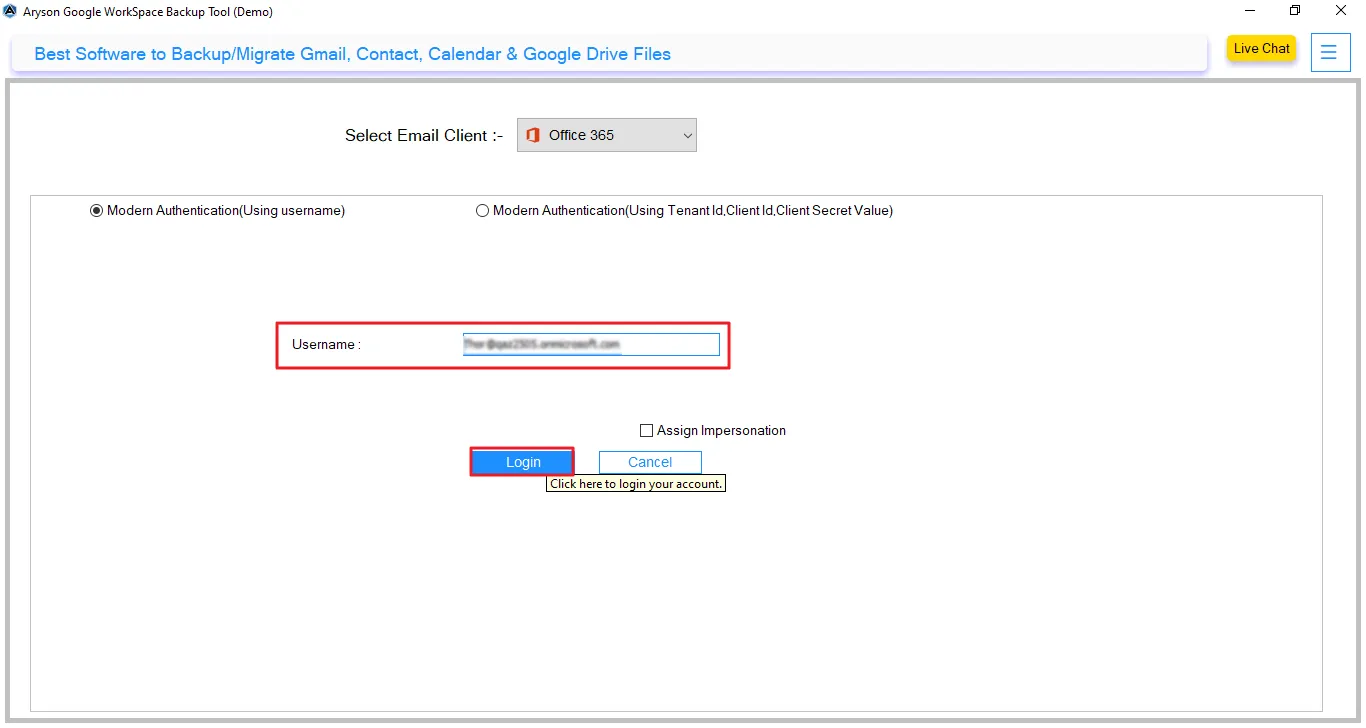
- Select your Microsoft account under Pick an account on the login prompt.
- Enter your account credentials and click Sign in to authenticate.
- A successful migration message is displayed on the software interface.
- Click Logout if you need to disconnect or switch the active Microsoft 365 account.
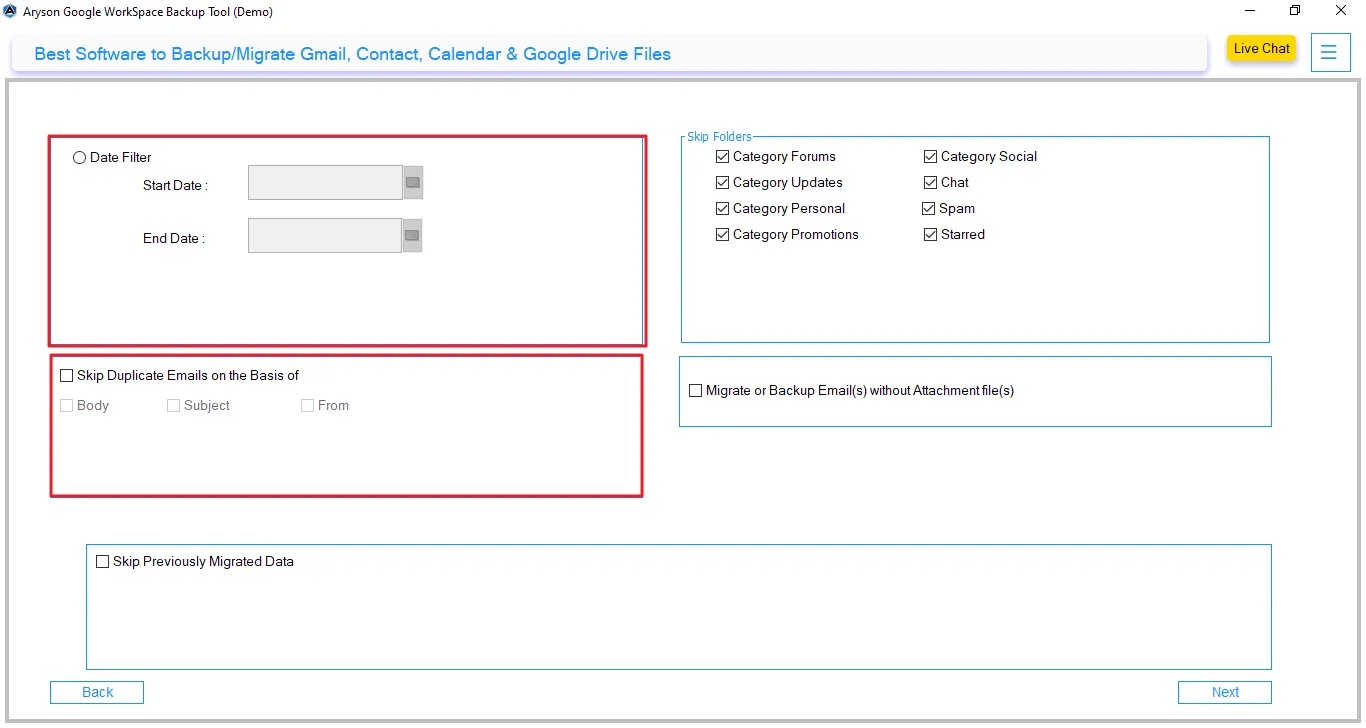
- If you selected Admin User:
Click on Admin User to switch to the administrative account authentication mode.
- B.1 Modern Authentication:
- Select the Modern Authentication radio button to use Microsoft's standard OAuth sign-in workflow.
- Check ‘Remember this account for future logins’ to store session details securely.
- Click Select a tenant connection... to choose an existing Microsoft 365 tenant profile.
- Authenticate through the Microsoft portal using your admin account credentials.
- On the Tenant Users panel, use the Search users bar to quickly filter specific accounts.
- Click Sample CSV to download a pre-formatted template file for bulk user selection.
- Click Upload CSV to import user list mappings directly from a CSV file.
- Select user checkboxes from the list to pick specific target accounts.
- Click Continue to move forward with the selected tenant accounts.
Note: Unlicensed users are not allowed to proceed further with the migration process.
B.2 Client ID / Secret:
- Select the Client ID / Secret radio button to use Azure App registration credentials.
- Enter your Azure Application ID into the Client ID text field.
- Enter your secret value into the Client Secret text field.
- Enter your Azure Active Directory ID into the Tenant ID text field.
- Check “Remember this account for future logins” to save connection settings.
- Click Verify & Login to validate credentials and connect to the Microsoft 365 tenant.
Note: Data from My Drive is migrated directly to My Drive while preserving the original folder hierarchy. Data from Shared Drive, Shared with Me, and Trash are migrated into separate folders created under My Drive, with the original folder hierarchy also preserved.
Step 7: Map Mailboxes from Source to Target Accounts
- Use Search source... to quickly find a specific source Gmail or Google Workspace account.
- Use Search destination... to filter down target Microsoft 365 mailboxes.
- Select source and destination checkboxes to pair individual Google and Microsoft 365 accounts manually.
- Click Map Selected to link and confirm the manually selected source and target accounts.
- Click Quick Actions to access automated mapping shortcuts.
- Selected Source → All Destinations: Maps the selected source data to all available destination mailboxes in one action.
- All Sources → Selected Destination: Maps all source data to the selected destination mailbox in one action.
- Click Clear Mapping to erase all established mailbox pairings at once.
- Click View Mapping to open a modal showing all active source-to-target mapping pairs.
- Click the Remove (X) icon next to any pair inside the modal to delete a specific mapping.
- Click Close to exit the Current Mappings pop-up window.
- View the Mapped column count on the right to quickly see how many targets are linked to each destination mailbox.
- Click Back to navigate to the previous configuration screen.
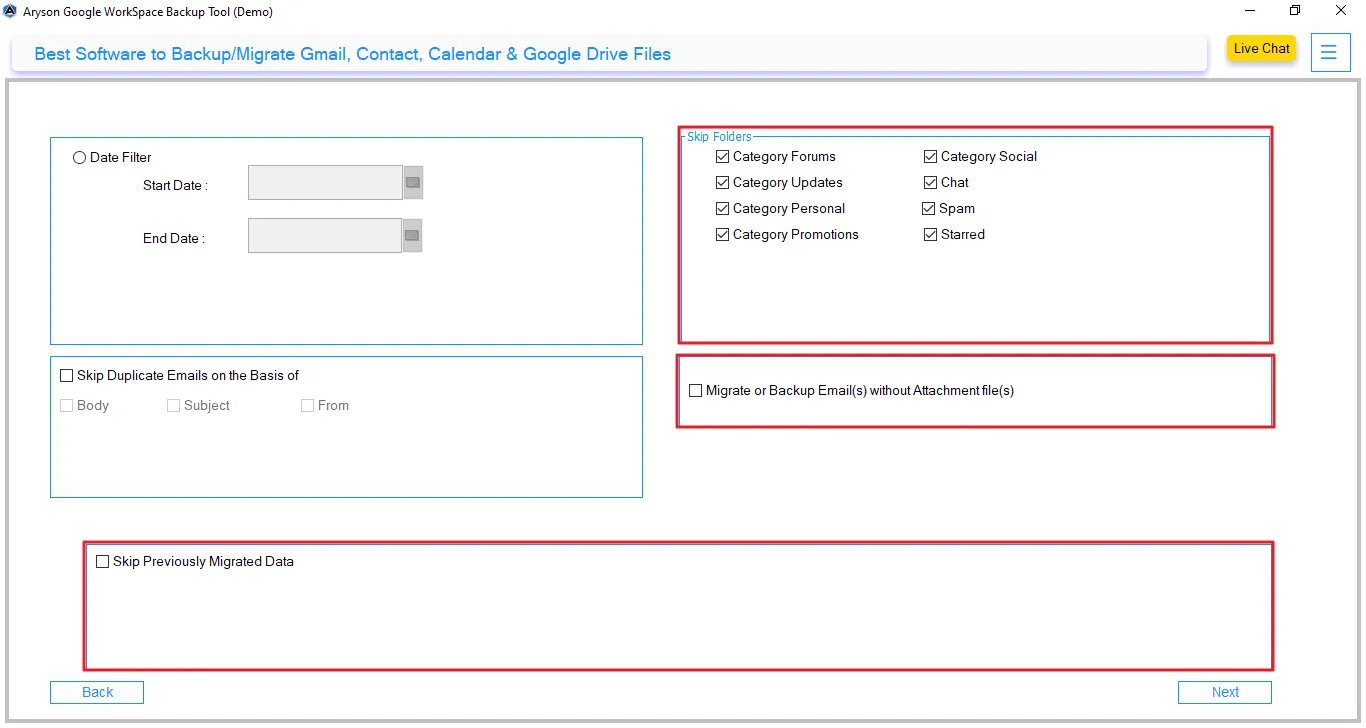
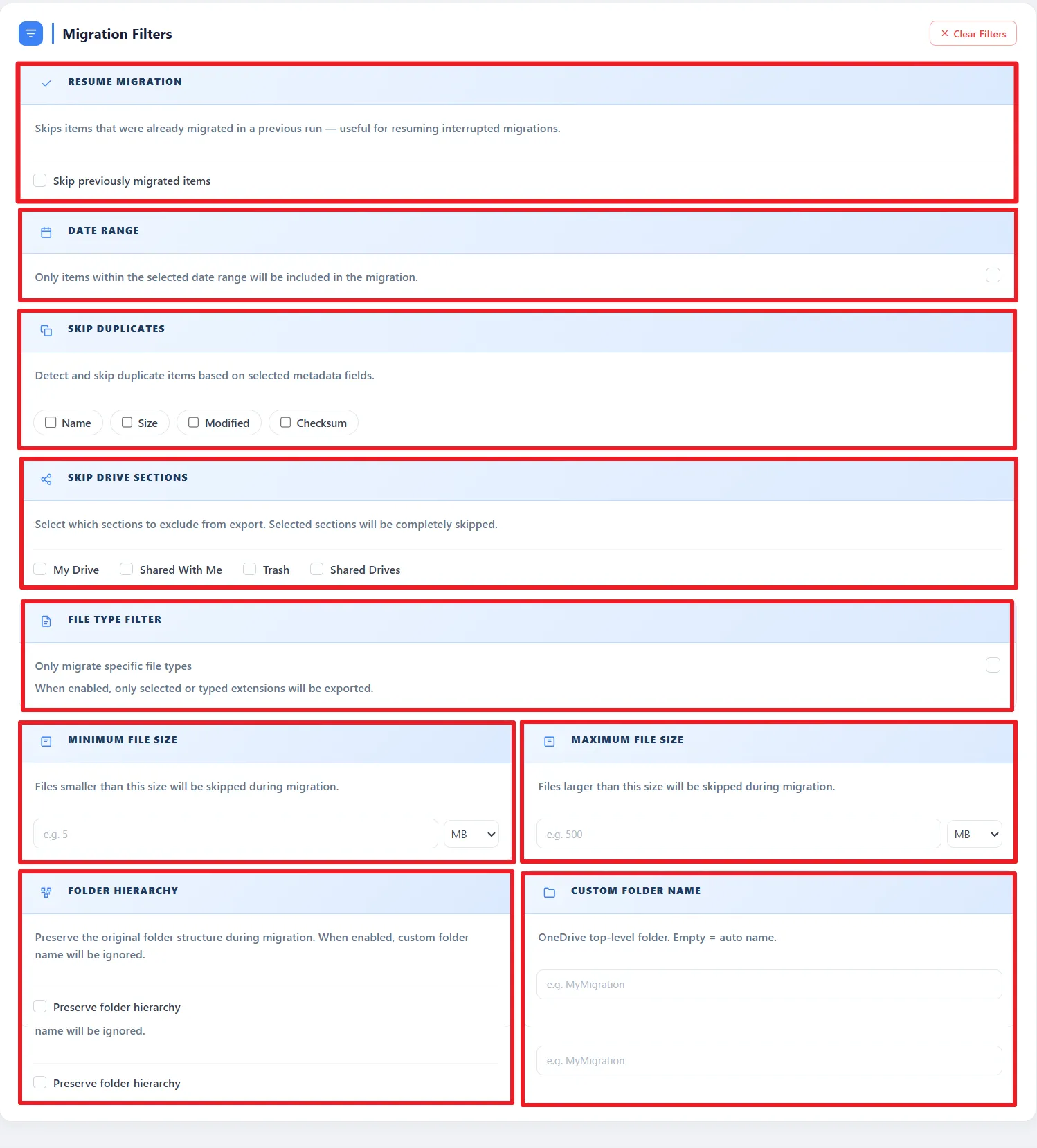
Step 8: Configure Migration Filters (Optional) – Microsoft 365 Destination
Before starting the Google Drive to Microsoft 365 migration, configure the required filters and settings as needed.
- Resume Migration: Enable Resume Migration to skip previously migrated items and continue an interrupted migration.
- Date Range Filter: Migrate only the items that fall within a specific date range by selecting the Start Date and End Date.
- Skip Duplicates: Select the required duplicate-check criteria, such as Name, Size, Modified, or Checksum, to detect and skip duplicate files during migration.
- Skip Drive Sections: Choose the Google Drive sections you want to exclude from the migration, such as My Drive, Shared With Me, Trash, or Shared Drives.
- File Type Filter: Enable the File Type Filter option, then select specific Google Workspace file types such as Docs, Sheets, Slides, and Forms, or enter custom file extensions to migrate only the selected file types.
- Set Minimum File Size: Specify a minimum file size value (in MB or GB) to skip files smaller than the defined size during migration.
- Set Maximum File Size: Specify a maximum file size value (in MB or GB) to exclude files larger than the defined size from migration.
- Custom Folder Name: Specify a custom name for the folder where migrated data will be saved.
- Preserve Folder Hierarchy: Tick this checkbox to keep the folder hierarchy intact at the target mailbox as well.
Step 9: Start the Google Drive to Microsoft 365 Migration
After reviewing all settings, click Start Migration to begin transferring Google Drive data to the Microsoft 365 destination. The software starts migrating the selected Drive data immediately.
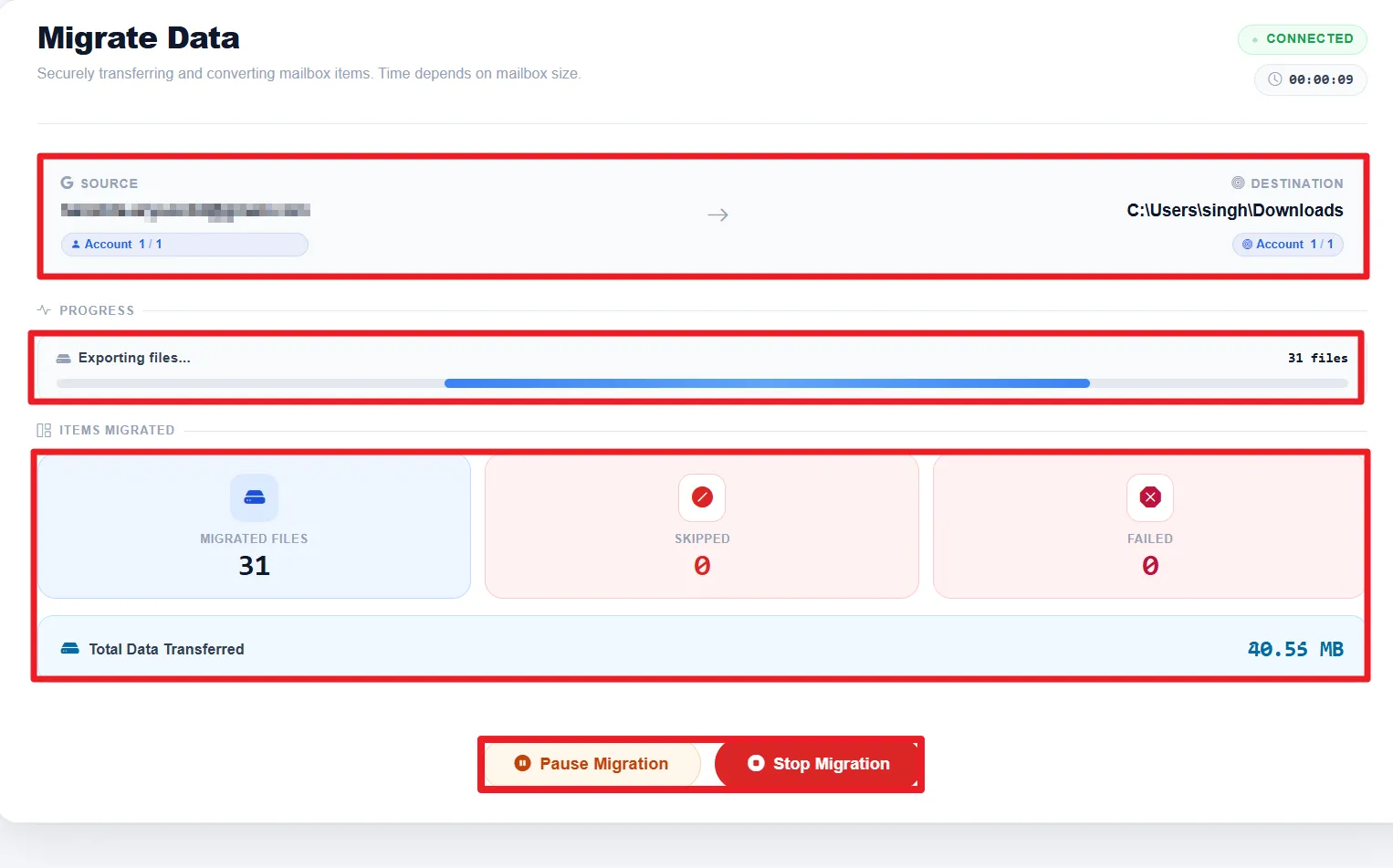
Step 10: Monitor the Migration Progress
Track the real-time migration status, including migrated files, skipped items, and failed items. The progress bar provides a live overview of the migration process.
You can use the Stop Migration button to halt the backup process and even pause or resume it whenever needed via the Resume Migration and Pause Migration buttons.
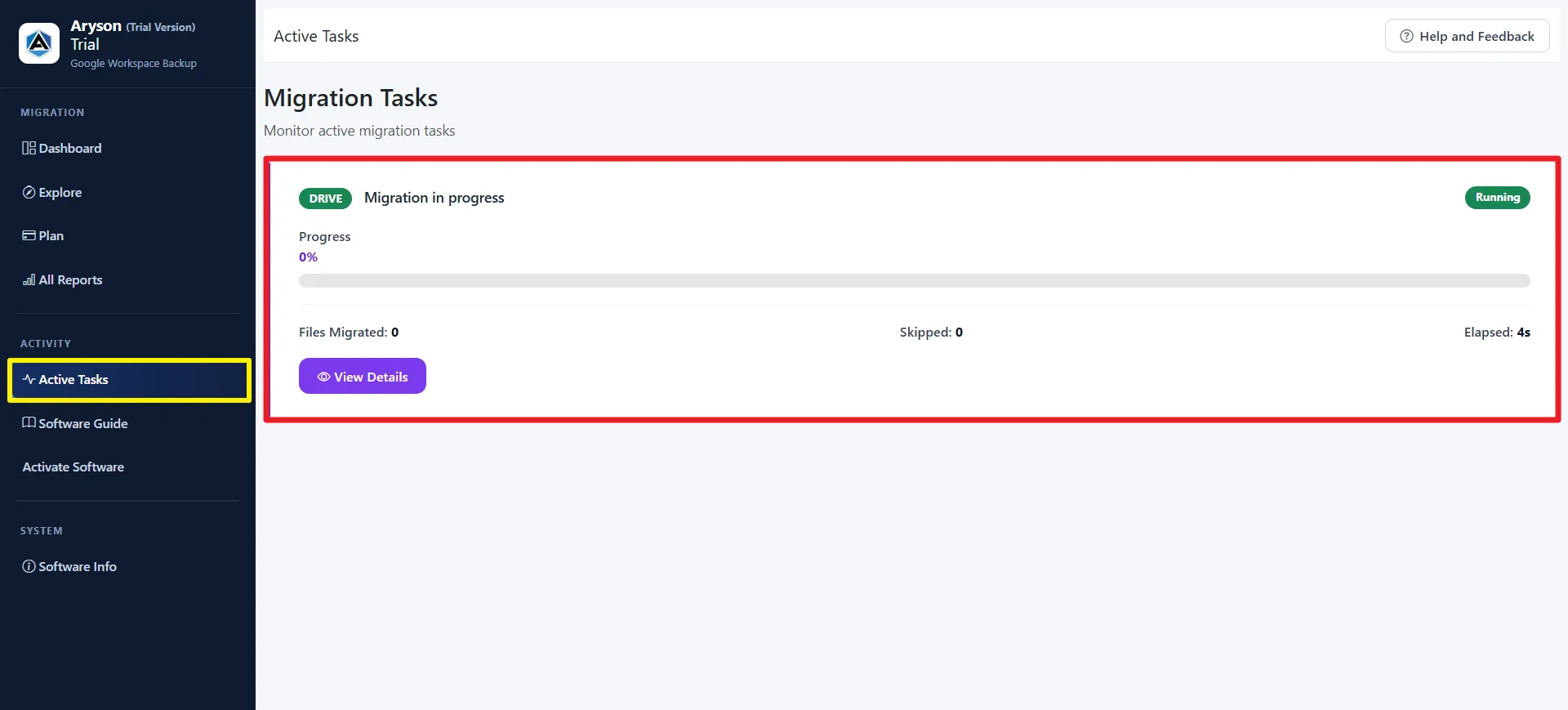
Step 11: Active Tasks / Migration Tasks Panel
- Migration Status: Shows the current migration task and indicates whether it is running.
- Progress: Displays the overall migration percentage through a progress bar.
- Files Migrated: Shows the number of files successfully migrated.
- Skipped Files: Displays the count of files skipped during migration.
- Elapsed Time: Shows how long the migration task has been running.
- View Details: Opens detailed information about the ongoing migration task.
*Redirects the user to the Migration Progress Panel, where they can monitor detailed migration activity and progress*
- Active Tasks: Lets users monitor currently running migration tasks from one place.
- Help and Feedback: Provides access to help resources and feedback options.
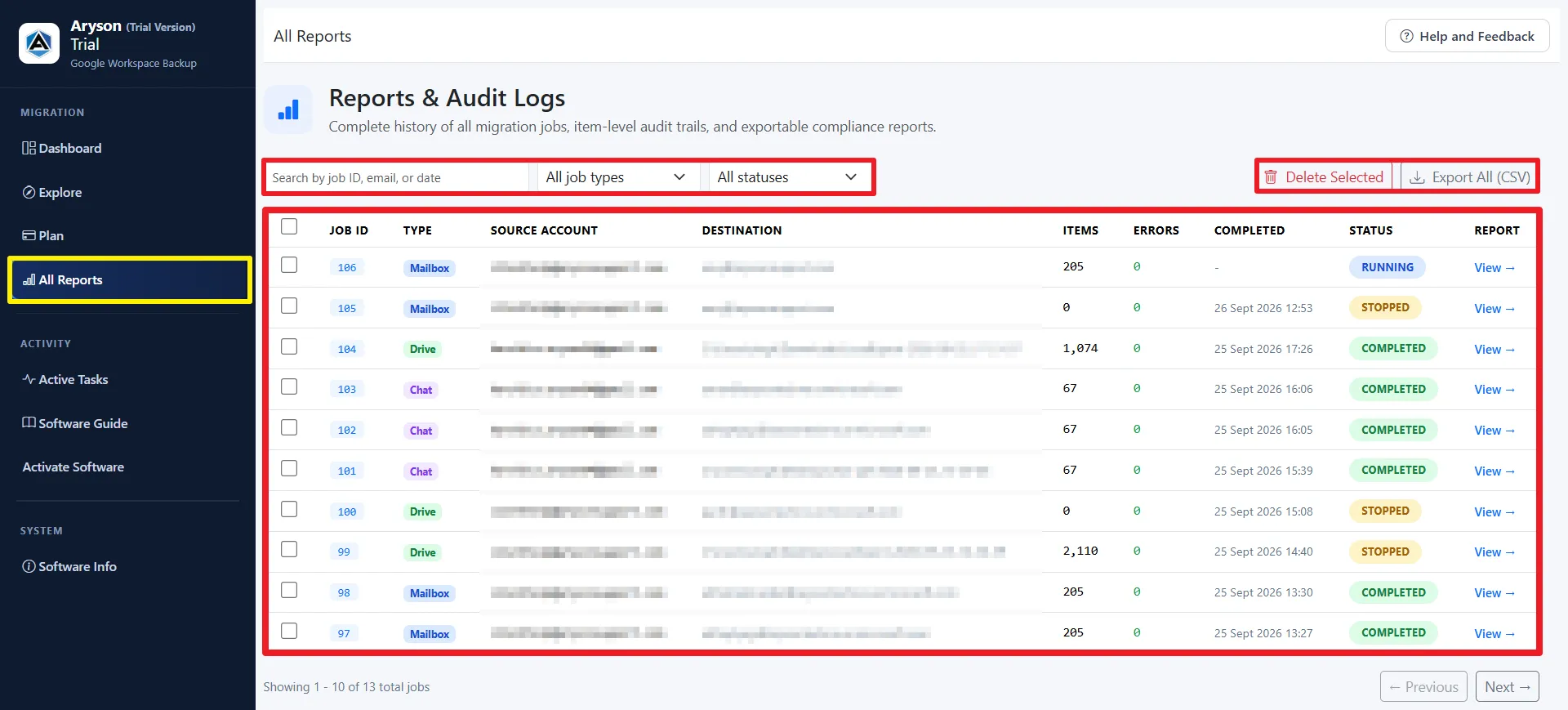
Step 12: The Reports & Audit Logs panel provides a complete record of migration jobs, including job ID, migration type, source account, destination, number of items, errors, completion time, and current status. Users can search and filter reports by job ID, email, date, job type, or status. The panel also allows users to select and delete reports, export all reports in CSV format, view individual reports, and navigate through multiple pages of migration records.
Migrate Google Chats
Step 1: Download and install the Aryson Google Workspace Migration Tool.
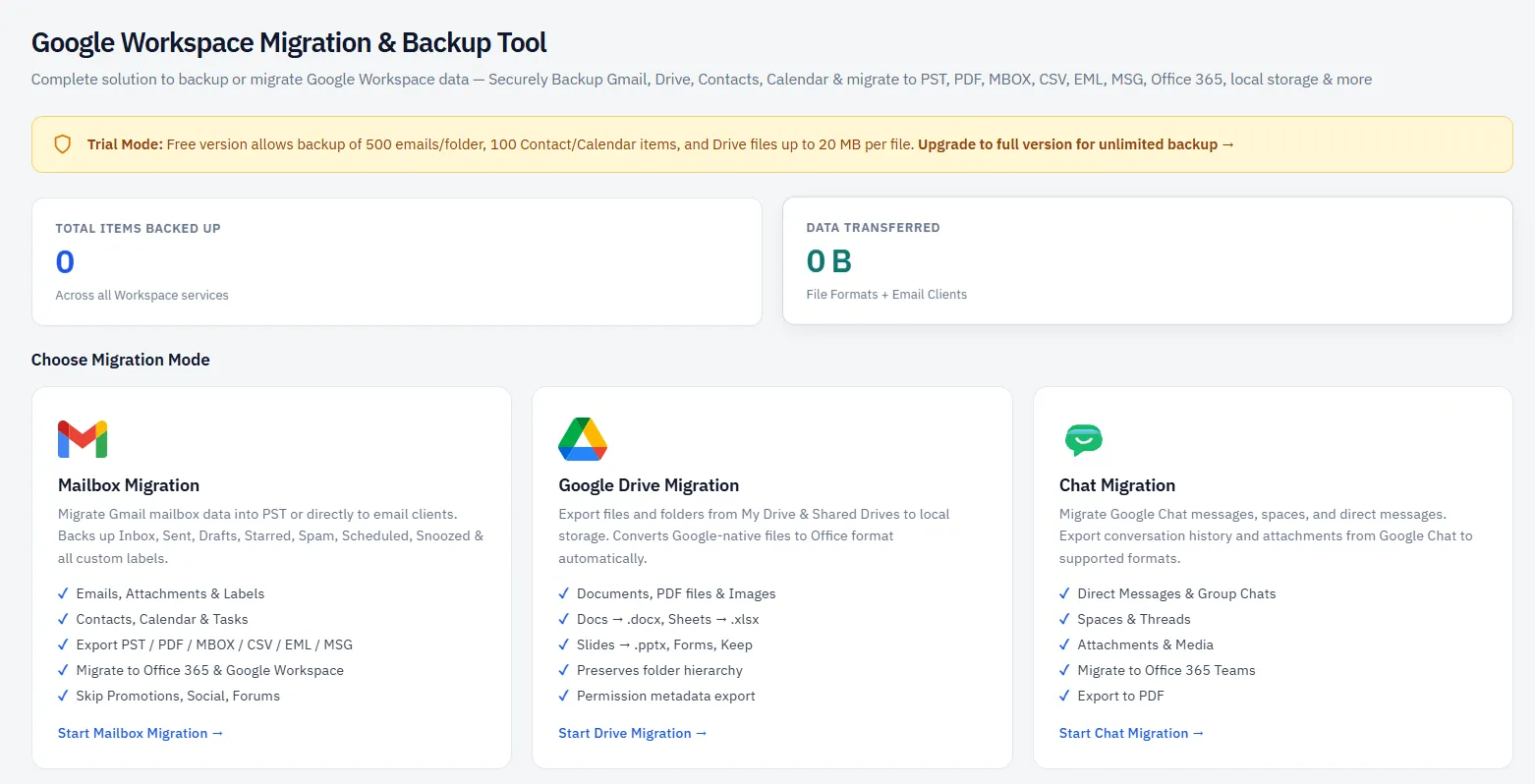
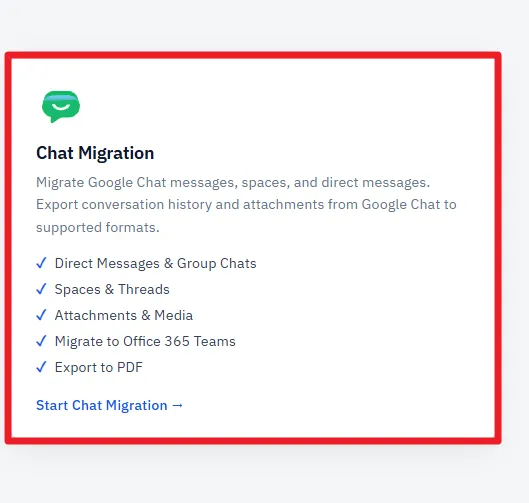
Step 2: Select the Chat Migration card under Choose Migration Mode.
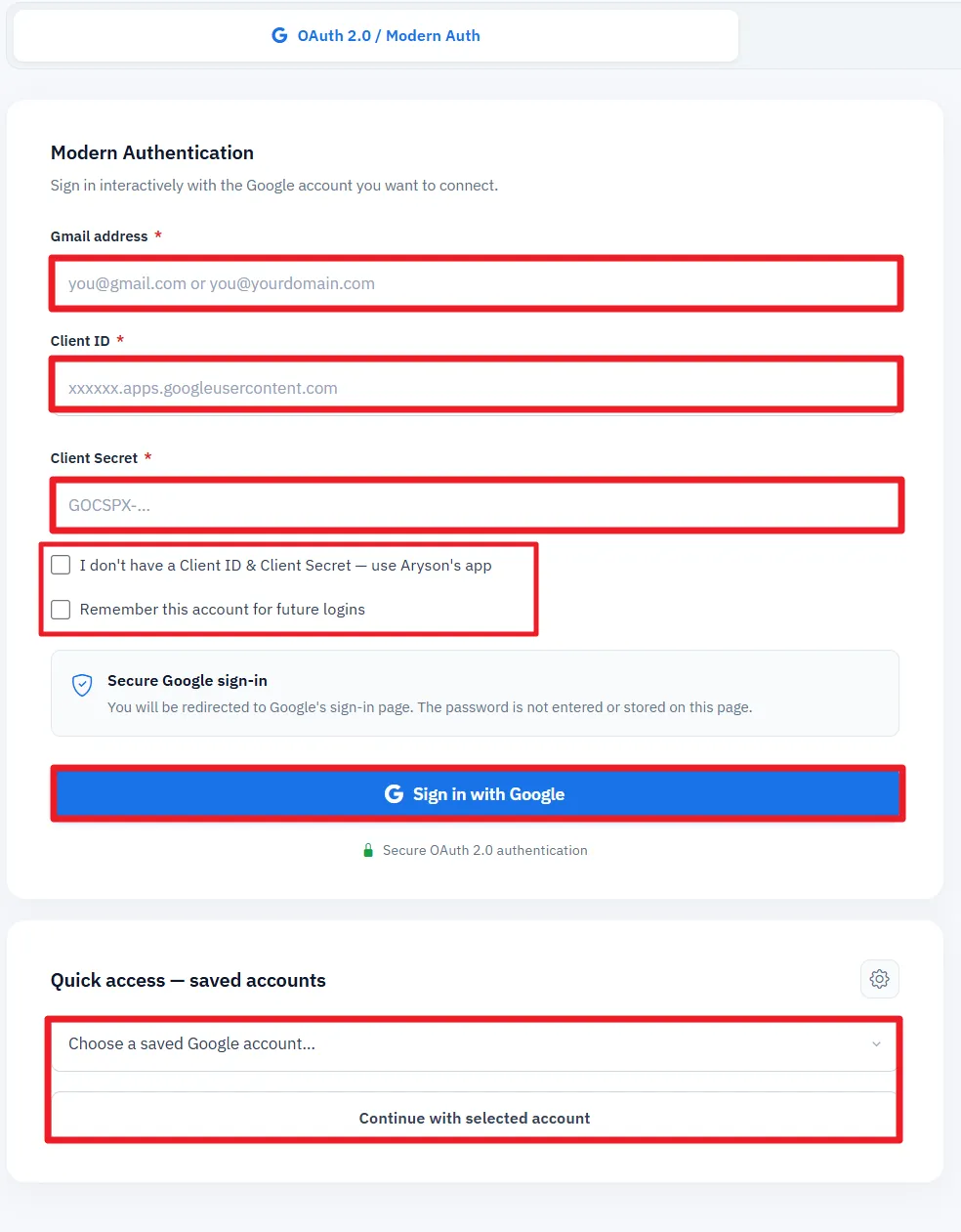
Step 3: Connect Your Google Workspace Account
The software provides two authentication methods to connect to your Google account. Choose between the A and B migration methods.

Step 3(A): Log in via OAuth 2.0 / Modern Authentication
- Select OAuth 2.0 / Modern Auth.
- Enter the Gmail email address.
- Provide the Client ID and Client Secret generated from the Google Cloud Console (optional).
- If you do not have your own OAuth credentials, enable "I don't have a Client ID & Client Secret".
- (Optional) Enable Remember this account for future logins.
- Click Continue with Google.
- Sign in to your Google account and grant the required permissions.
- The account will be authenticated and added to the software.
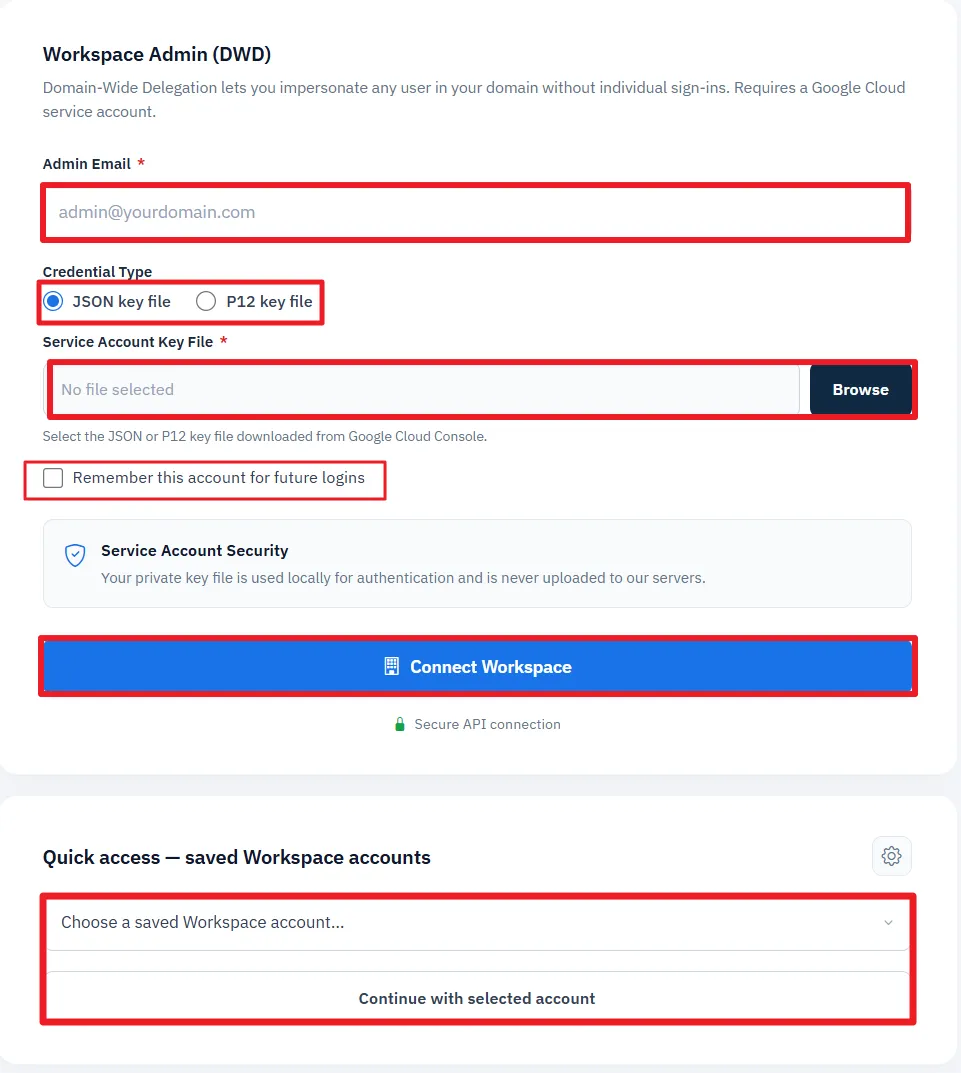
Step 3(B): Log in via Google Workspace Admin (DWD)
- Select Workspace Admin (DWD).
- Enter the Google Workspace Admin email address.
- Choose the credential type:
- JSON Key File
- P12 Key File
- Click Browse and upload the JSON key.
- (Optional) Enable Remember this account for future logins.
- Click Connect Workspace.
- The software authenticates the Google Workspace domain and loads available user accounts.
This method is recommended for bulk Google Chat backup and migration.
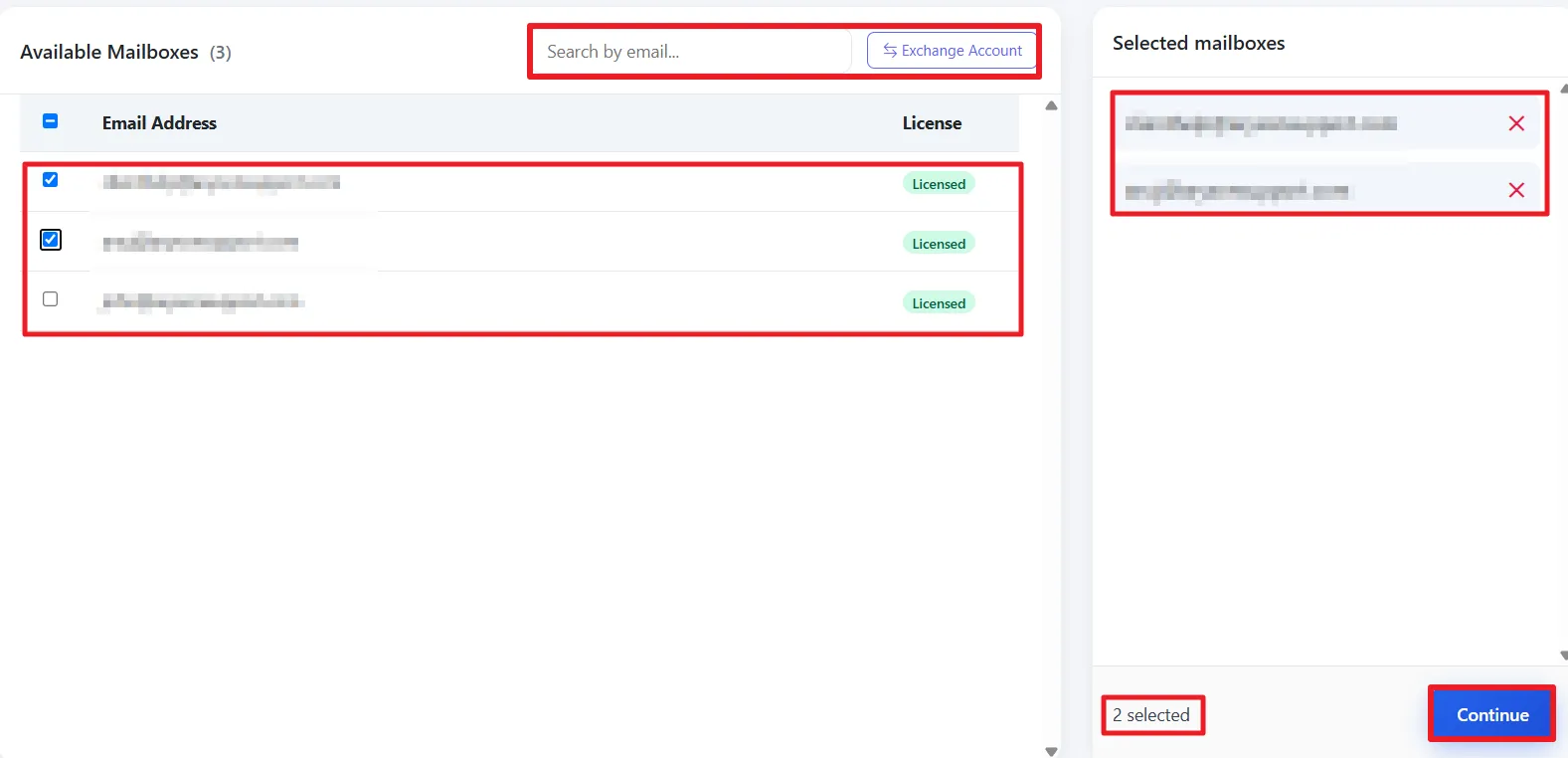
Step 4: Select Users for Google Chat Migration
- The software displays all available users retrieved from the connected account.
- Select the required user(s) using the checkbox.
- Use Search by Email to quickly find a specific user.
- Review selected users in the Selected Users panel.
- Click the Remove (X) icon to remove any user from the selection.
- Verify the license status of the selected user.
- Check the total number of selected users at the bottom-right corner.
- Click Continue to proceed to the Filters section.
Export Google Chats to File Formats
Step 5: Select the Output File Format
Go to the File Format tab and select the required format from the Export File Format drop-down menu. The Aryson Google Workspace Backup Tool supports the PDF format to export your chats.

Step 6: Set the Destination Path
Click Browse and select the destination path where you want to save the exported Google chats.

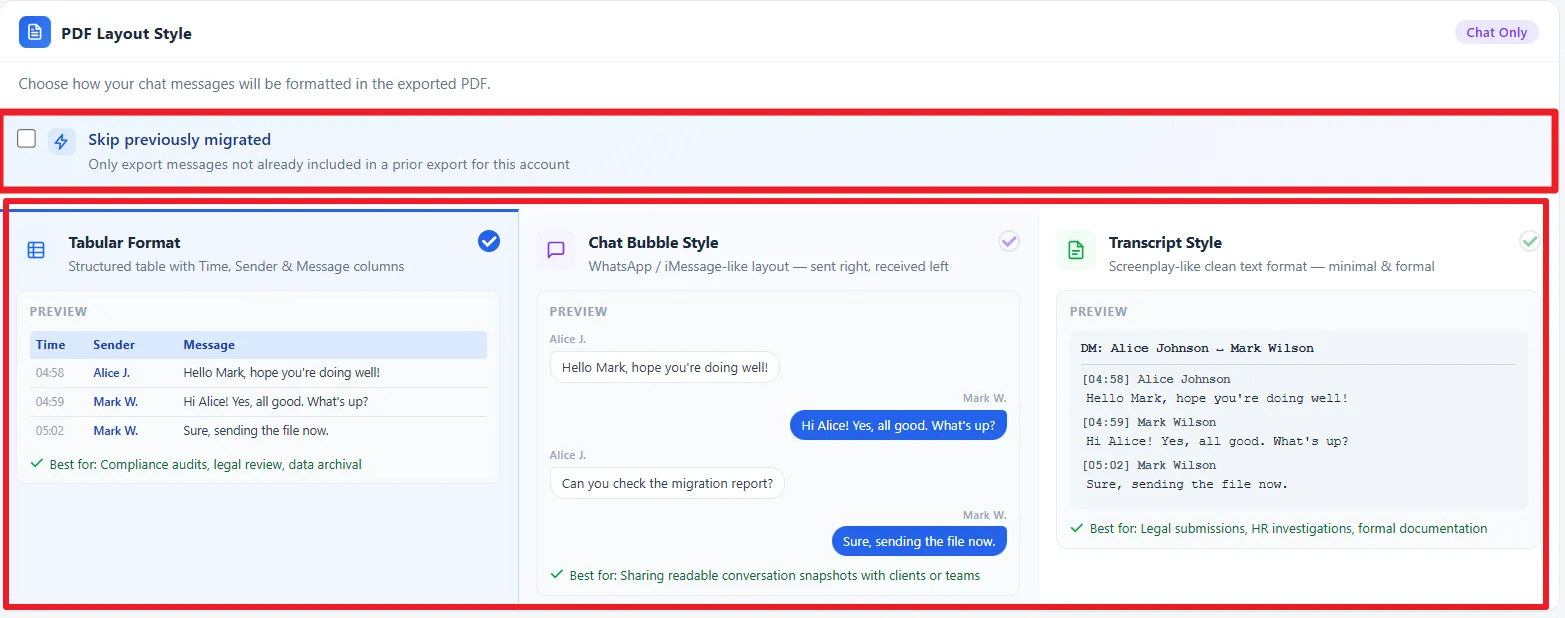
Step 7: Choose the PDF Layout Style
- Select the Skip previously migrated checkbox to export only messages that were not included in a prior export for this account.
- Click Tabular Format to structure chat messages into an organized table with Time, Sender, and Message columns.
- Click Chat Bubble Style to format the export into a messaging app view with sent items on the right and received items on the left.
- Click Transcript Style to format messages in a clean, screenplay-like text format ideal for formal documentation.
Step 8: Start the Google Chat to Export Process
After reviewing all settings, click Start Migration to begin transferring Google Chat data to the file format. The software starts exporting the selected chats immediately.

Step 9: Monitor the Migration Progress
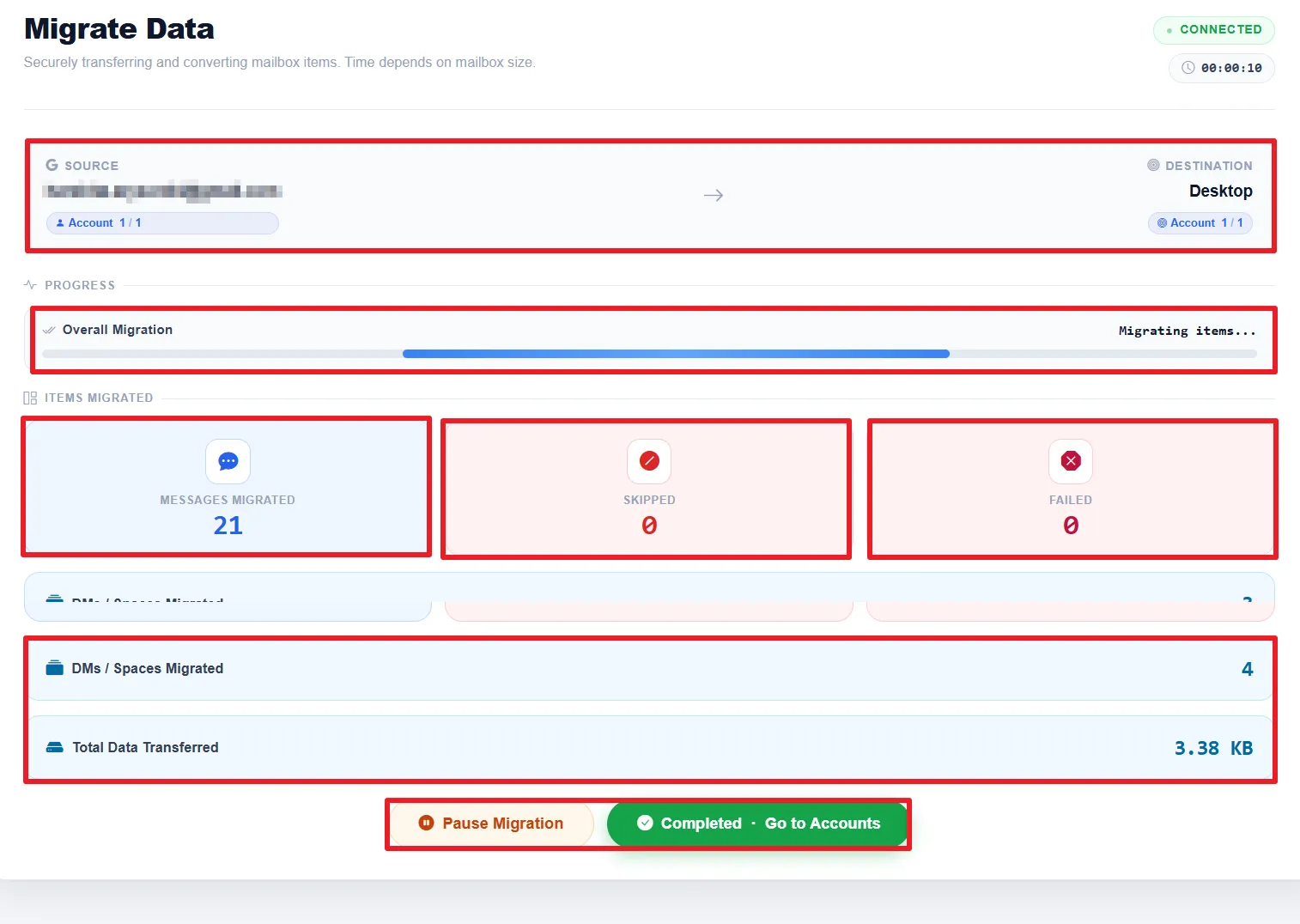
Track the real-time migration status, including source accounts, destination paths, messages, skipped items, and failed items. The progress bar provides a live overview of the transfer process. You can view the overall transferred data volume and use Pause Migration to halt the process or click Completed. · Go to Accounts when finished.
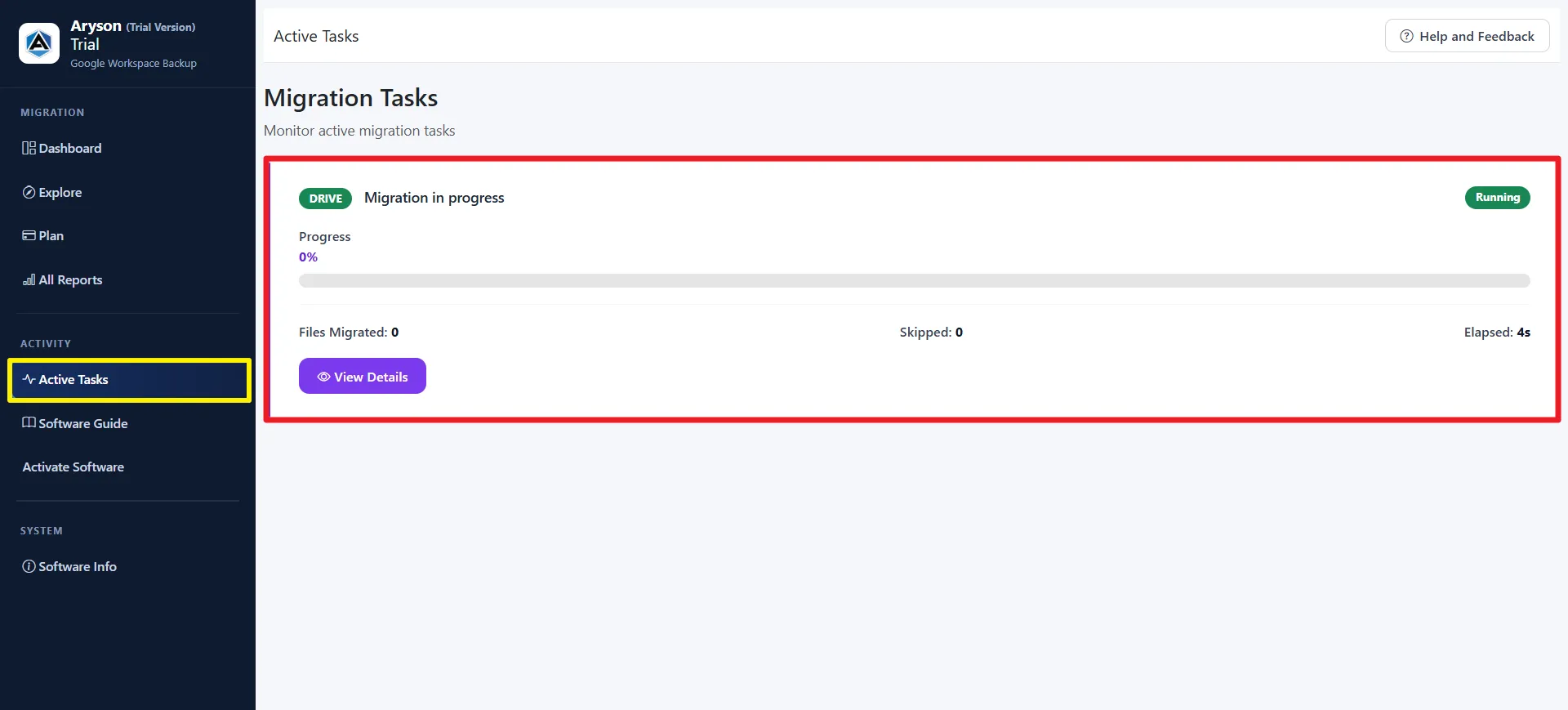
Step 10: Active Tasks / Migration Tasks Panel
- Migration Status: Shows the current migration task and indicates whether it is running.
- Progress: Displays the overall migration percentage through a progress bar.
- Files Migrated: Shows the number of files successfully migrated.
- Skipped Files: Displays the count of files skipped during migration.
- Elapsed Time: Shows how long the migration task has been running.
- View Details: Opens detailed information about the ongoing migration task.
*Redirects the user to the Migration Progress Panel, where they can monitor detailed migration activity and progress*
- Active Tasks: Lets users monitor currently running migration tasks from one place.
- Help and Feedback: Provides access to help resources and feedback options.
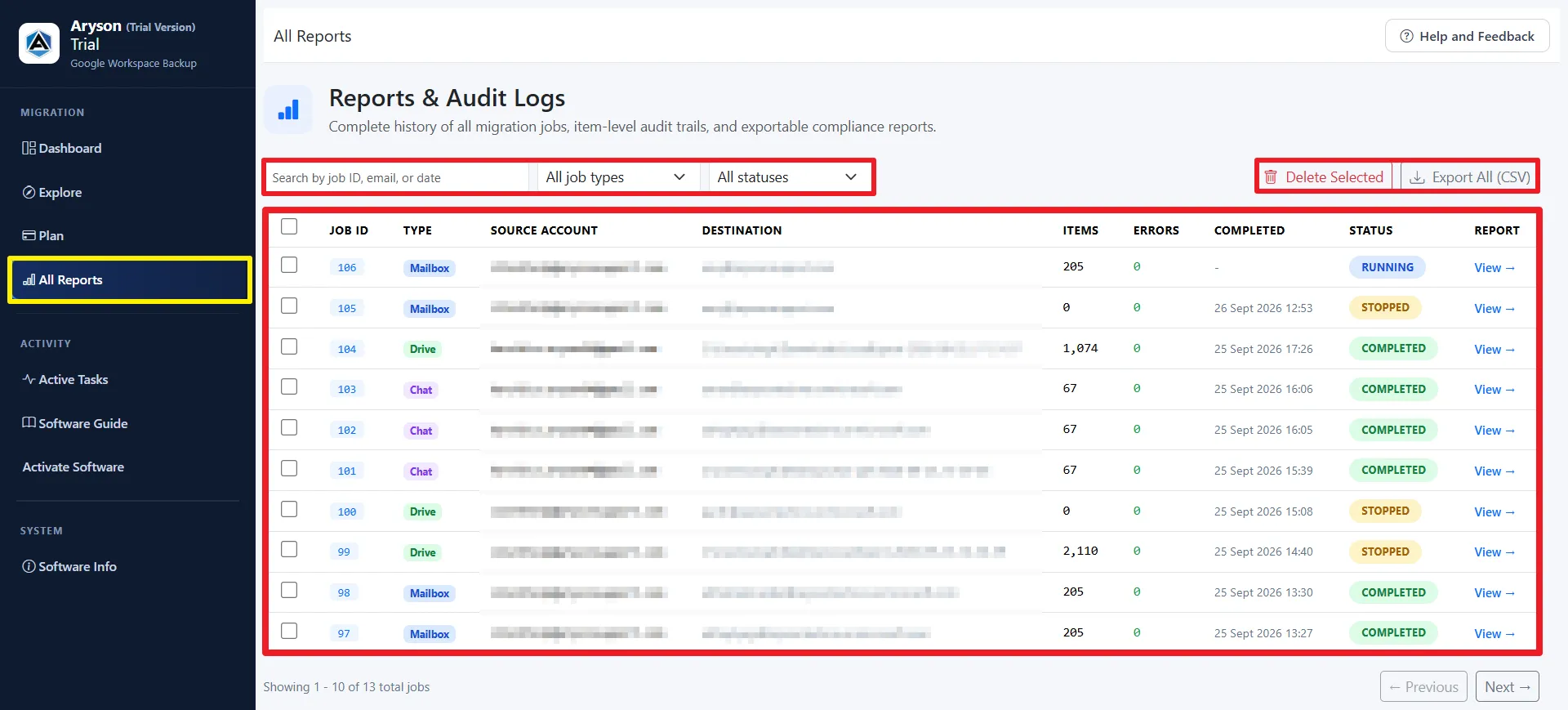
Step 11: The Reports & Audit Logs panel provides a complete record of migration jobs, including job ID, migration type, source account, destination, number of items, errors, completion time, and current status. Users can search and filter reports by job ID, email, date, job type, or status. The panel also allows users to select and delete reports, export all reports in CSV format, view individual reports, and navigate through multiple pages of migration records.
Migrate Google Chats to Microsoft 365
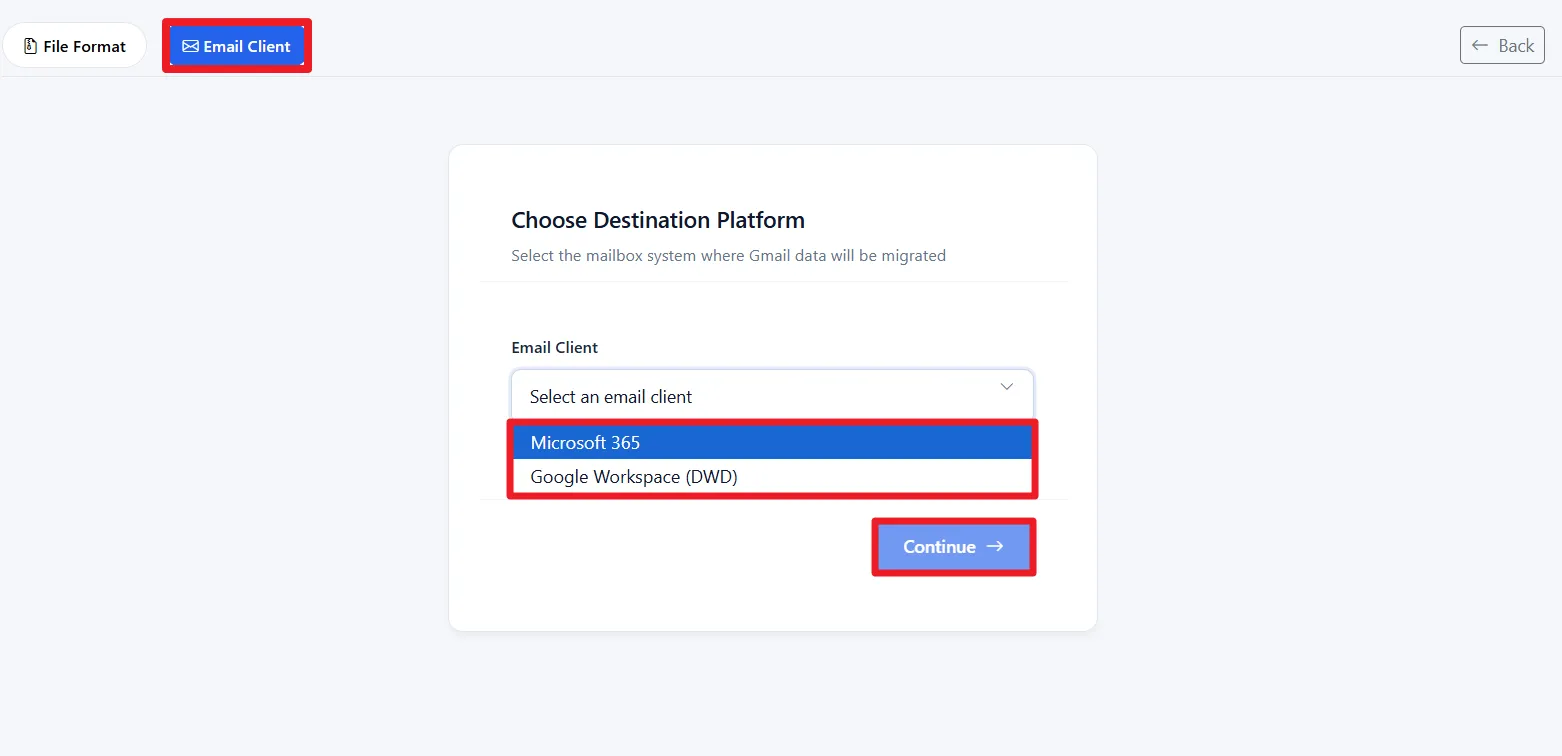
Step 5: Select Microsoft 365 (Teams) as the Destination
- Go to the Email Client section and select Microsoft 365 as the destination platform.
Step 6: Connect the Microsoft 365 Account
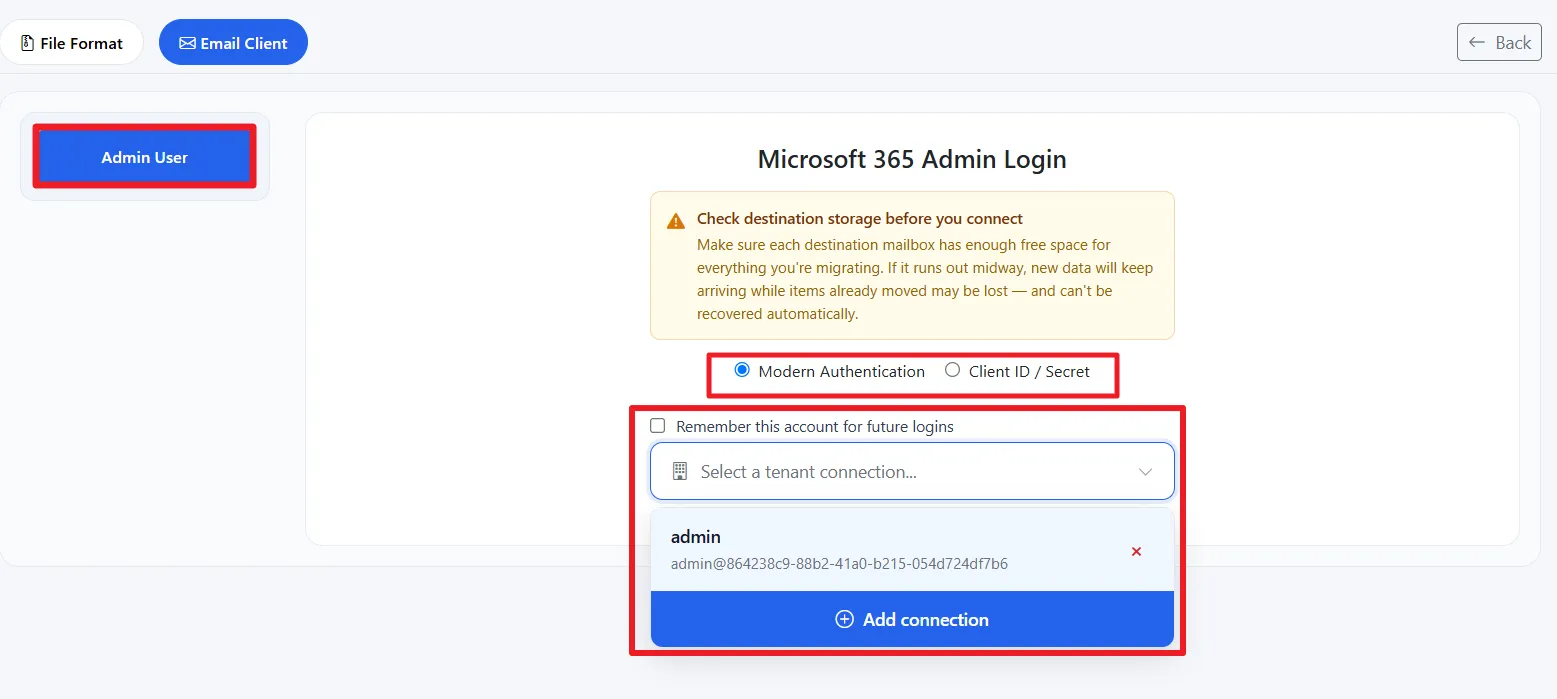
Click on Admin User to switch to the administrative account authentication mode.
- B.1 Modern Authentication:
- Select the Modern Authentication radio button to use Microsoft's standard OAuth sign-in workflow.
- Check ‘Remember this account for future logins’ to store session details securely.
- Click Select a tenant connection... to choose an existing Microsoft 365 tenant profile.
- Authenticate through the Microsoft portal using your admin account credentials.
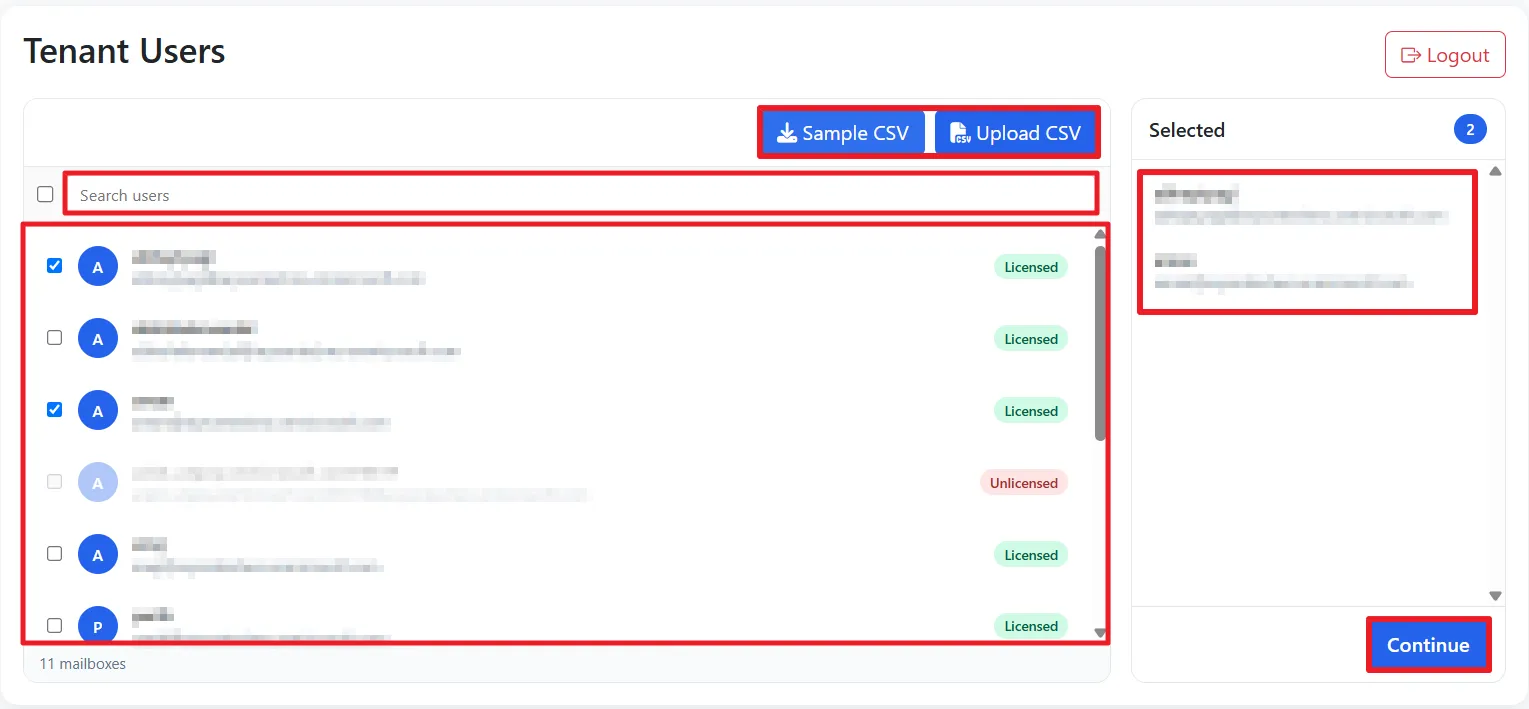
- On the Tenant Users panel, use the Search users bar to quickly filter specific accounts.
- Click Sample CSV to download a pre-formatted template file for bulk user selection.
- Click Upload CSV to import user list mappings directly from a CSV file.
- Select user checkboxes from the list to pick specific target accounts.
- Click Continue to move forward with the selected tenant accounts.
Note: Unlicensed users are not allowed to proceed further with the migration process.
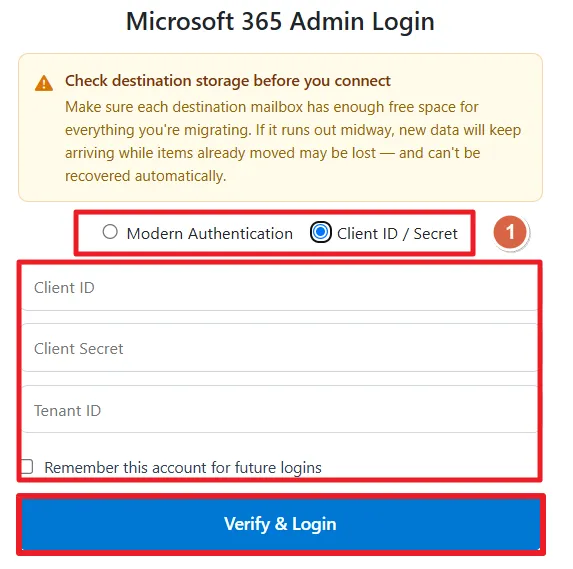
B.2 Client ID / Secret:
- Select the Client ID / Secret radio button to use Azure App registration credentials.
- Enter your Azure Application ID into the Client ID text field.
- Enter your secret value into the Client Secret text field.
- Enter your Azure Active Directory ID into the Tenant ID text field.
- Check “Remember this account for future logins” to save connection settings.
- Click Verify & Login to validate credentials and connect to the Microsoft 365 tenant.
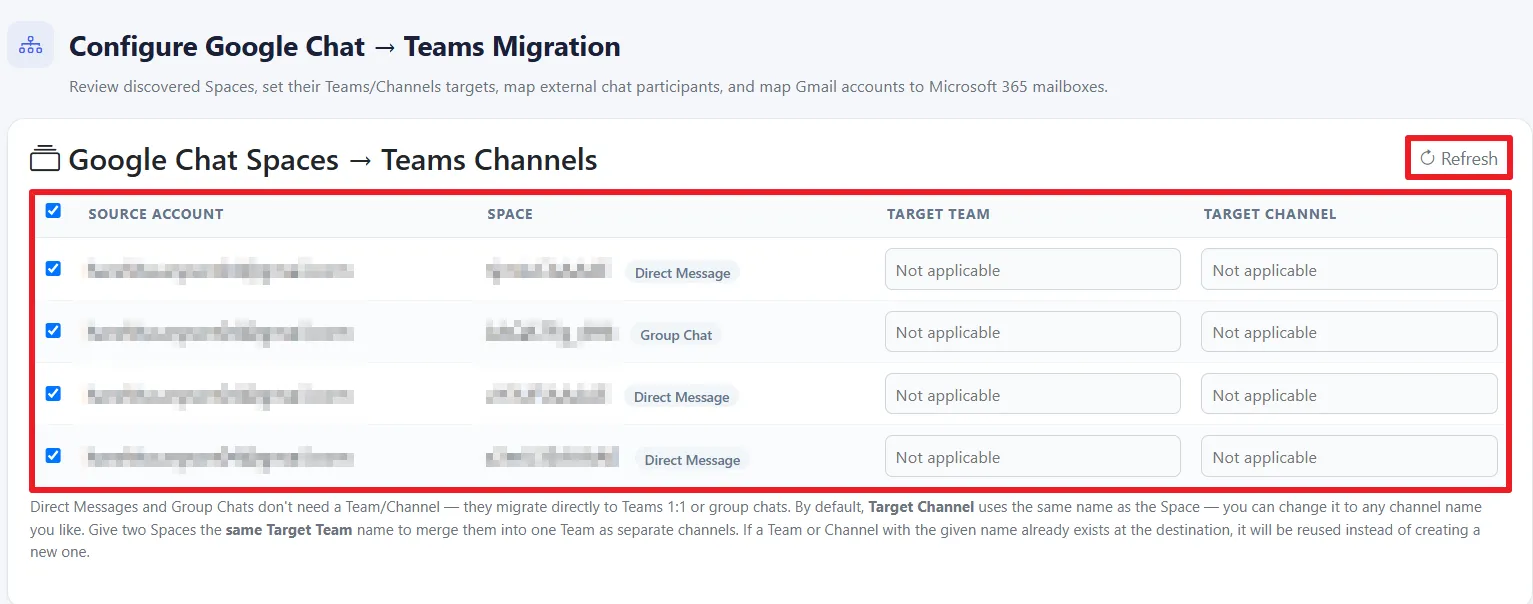
Step 7: Configure Google Chat to Teams Migration
- Select the checkbox next to a source account to include or exclude its spaces from the migration.
- View the discovered source account and its associated space, direct message, or group chat.
- Enter a destination team name in the Target Team field to specify where to migrate the space.
- Enter a destination channel name in the Target Channel field to set the target location within the Team.
- Click Refresh to reload and fetch the latest discovered spaces and channels.
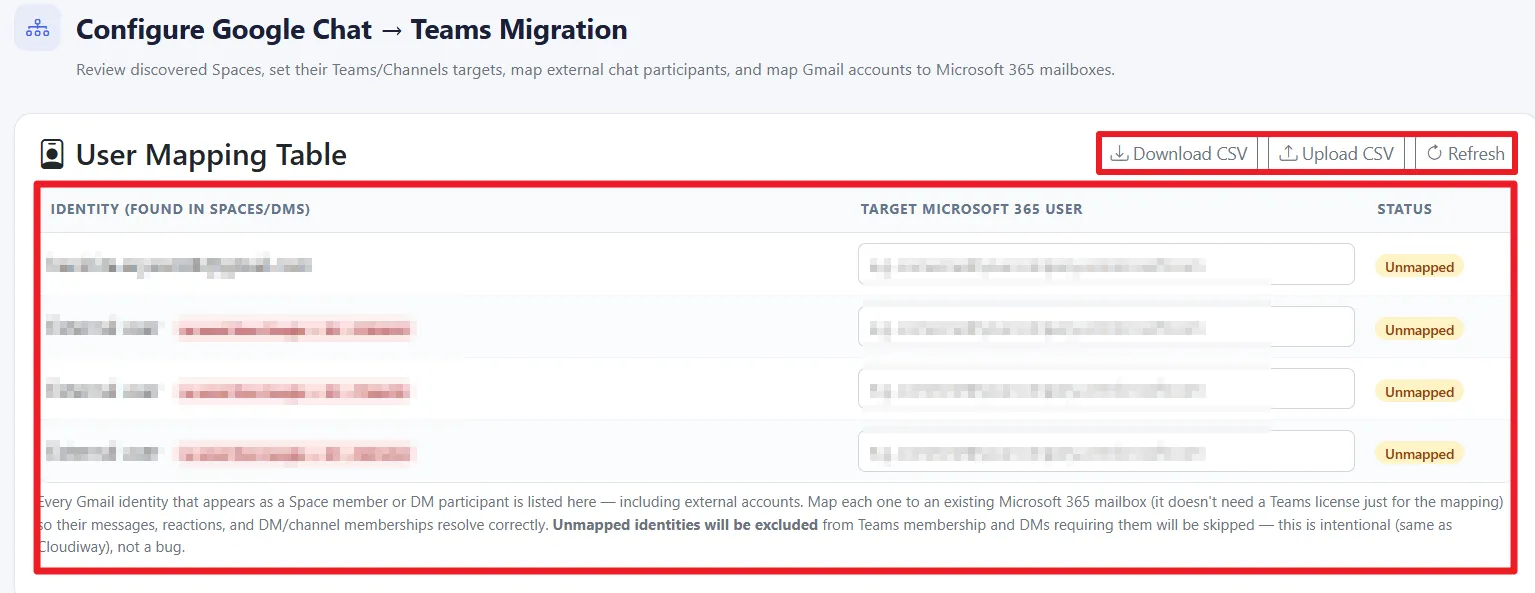
Step 8: User Mapping Table
- Review all discovered Google Chat identities and external chat participants listed under Identity (found in Spaces/DMs).
- Enter the corresponding destination email in the Target Microsoft 365 User field for each listed identity.
- Check the Status column to verify whether an identity is currently mapped or unmapped.
- Alternatively, click Download CSV to export a pre-formatted template of the identity mapping list. Click Upload CSV to bulk import target Microsoft 365 user assignments.
- Click Refresh to update the user mapping table status.
Step 9: Map Mailboxes to From Source to Target Accounts
- Select source and destination checkboxes to pair individual Google and Microsoft 365 accounts manually.
- Click Map Selected to link and confirm the manually selected source and target accounts.
- Click Clear Mapping to erase all established mailbox pairings at once.
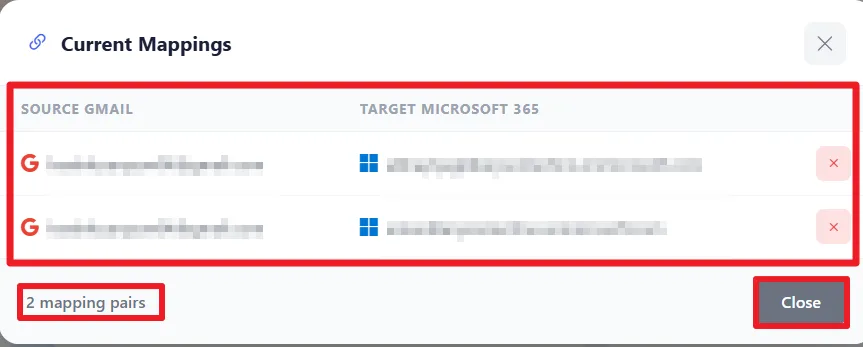
- Click View Mapping to open a modal showing all active source-to-target mapping pairs.
- Click Close to exit the Current Mappings pop-up window.
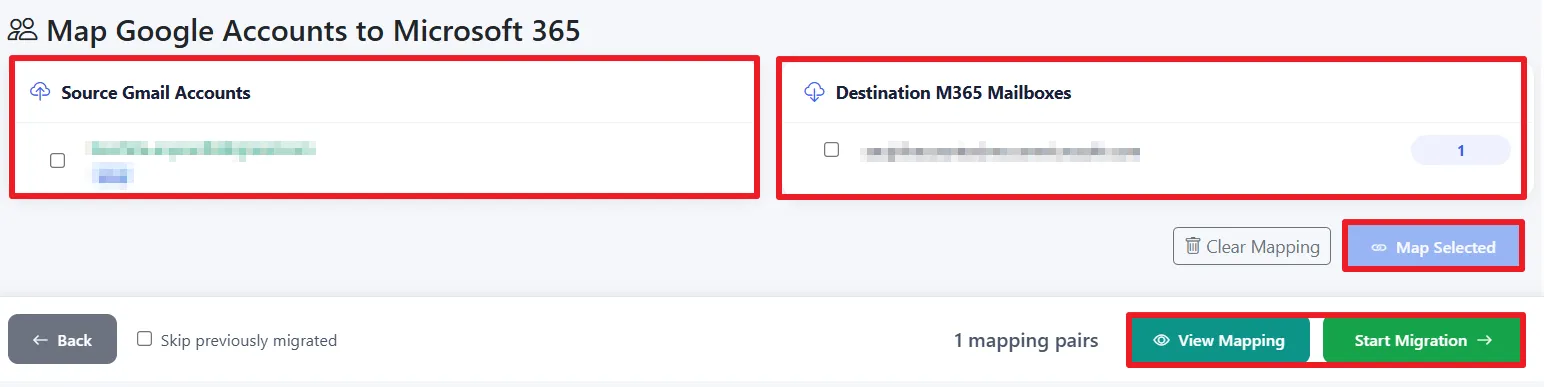
- View the Mapped column count on the right to quickly see how many targets are linked to each destination mailbox.
- Click Back to navigate to the previous configuration screen.
Step 10: You can select the Skip Previously Migrated option to avoid migrating the already migrated chats.
Step 11: Start the Google Chats to Microsoft 365 Migration
After reviewing all settings, click Start Migration to begin transferring Google Chats to the Microsoft 365 destination. The software starts migrating the selected chats data immediately.
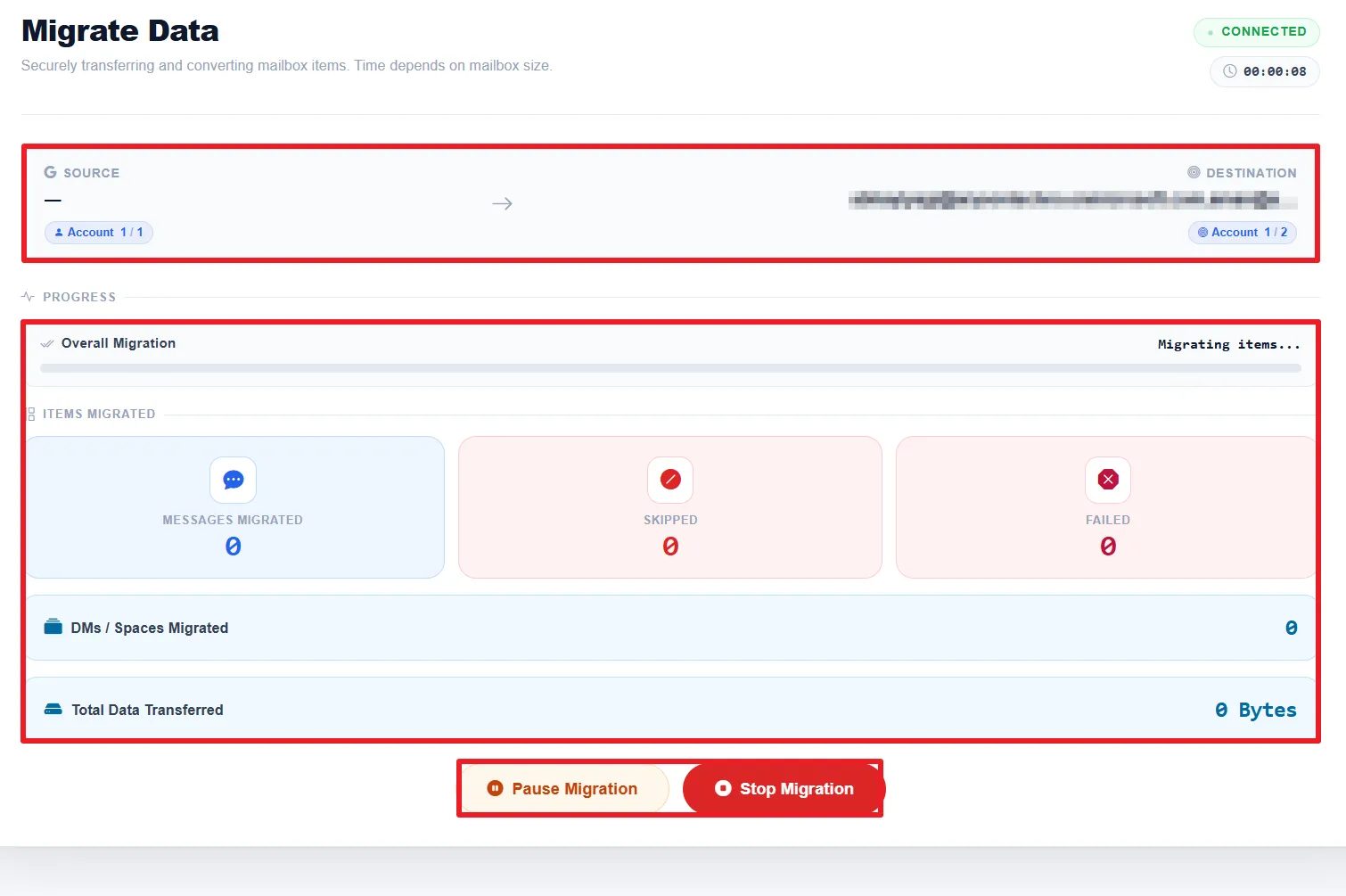
Step 12: Monitor the Migration Progress
Track the real-time migration status, including migrated messages, skipped items, and failed items. The progress bar provides a live overview of the migration process.
You can use the Stop Migration button to halt the migration process and even pause or resume it whenever needed via the Pause Migration button.
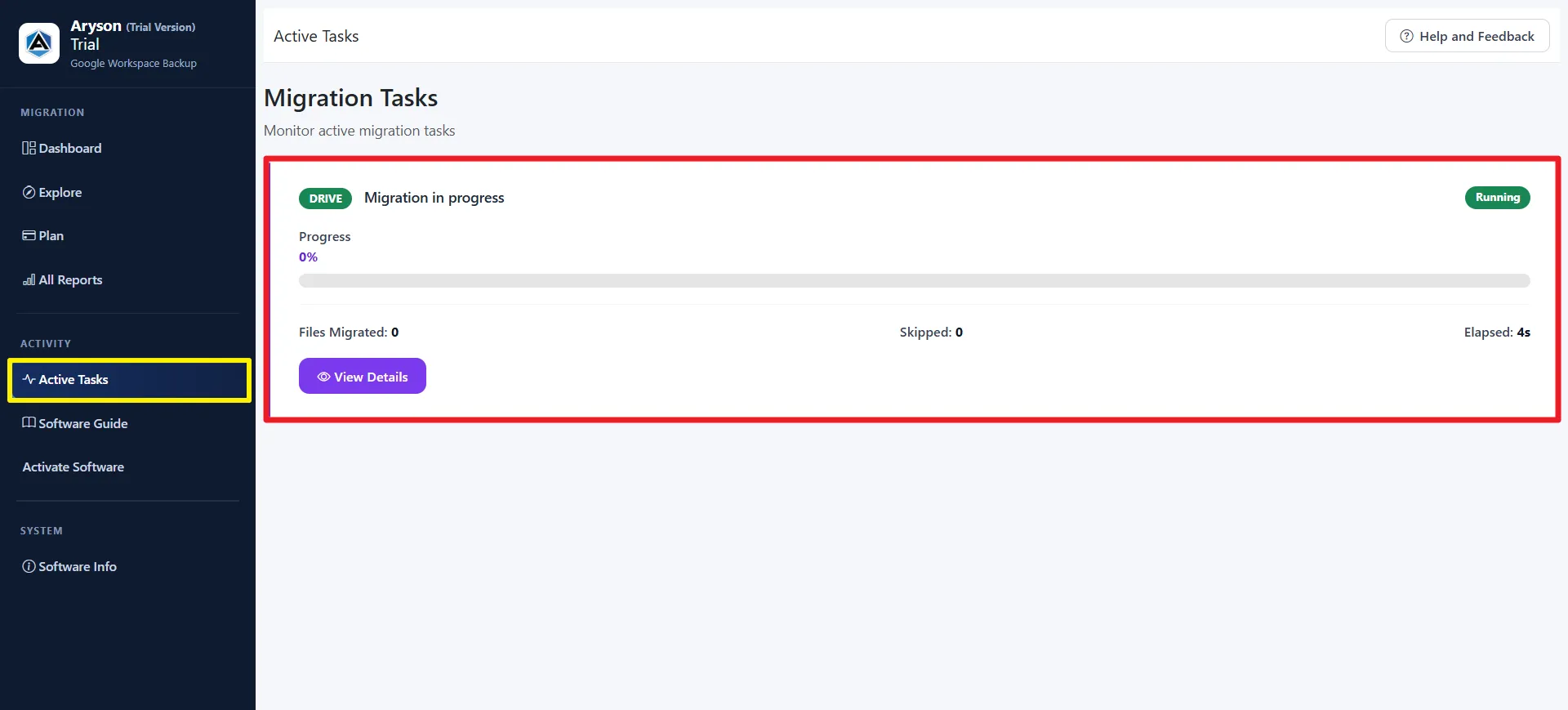
Step 13: Active Tasks / Migration Tasks Panel
- Migration Status: Shows the current migration task and indicates whether it is running.
- Progress: Displays the overall migration percentage through a progress bar.
- Files Migrated: Shows the number of files successfully migrated.
- Skipped Files: Displays the count of files skipped during migration.
- Elapsed Time: Shows how long the migration task has been running.
- View Details: Opens detailed information about the ongoing migration task.
*Redirects the user to the Migration Progress Panel, where they can monitor detailed migration activity and progress*
- Active Tasks: Lets users monitor currently running migration tasks from one place.
- Help and Feedback: Provides access to help resources and feedback options.
Step 14: The Reports & Audit Logs panel provides a complete record of migration jobs, including job ID, migration type, source account, destination, number of items, errors, completion time, and current status. Users can search and filter reports by job ID, email, date, job type, or status. The panel also allows users to select and delete reports, export all reports in CSV format, view individual reports, and navigate through multiple pages of migration records.