-

Written By Rohan Wiese
-
Approved By
Shivam Rathore -
Updated on August 22nd, 2025
Determine Outlook Version in Seconds: 32-bit vs. 64-bit
Fact-checked and reviewed in accordance with our
Editorial Policy
Sometimes, you need to install an Outlook add-in or troubleshoot an error. Maybe you need to upgrade your Microsoft Office package. In those cases, you might be asked: “Is your Outlook 32-bit or 64-bit?” If you have never checked this before, maybe you thought that it’s a complicated process. But it is actually a very simple process.
If you know your Outlook version, it is more than just a technical detail. It affects how well certain tools work, whether add-ins are compatible, and even how your system handles large data files. In this blog, I will walk you through the fastest way to find out your Outlook version in just seconds. Along with detailed steps for every major Outlook release on both Windows and Mac.
Why You Should Check Outlook Version 32-bit or 64-bit
Maybe users think that, so why should they even care if your Outlook is 32-bit or 64-bit? Here are the main reasons:
- Add-in Compatibility: Some older add-ins work only with 32-bit versions. On the other hand, several new versions may require 64-bit.
- Performance with Large Files: 64-bit Outlook can handle larger mailbox files and process more data without crashing.
- Troubleshooting & Support: When contacting Microsoft or your IT team, they often ask for your version before giving instructions.
- Upgrade the Plans: If you know your current versions, it helps when you should decide to switch Outlook version to better performance.
Quick Ways to Determine Outlook Version 32-bit vs 64-bit
There are multiple methods available to find Outlook architecture 32-bit 64-bit. But this process can take less than a minute. In the section below, we’ll cover the simple and fast approaches to determine Outlook version in seconds 32-bit vs 64-bit Windows:
1. Check from the Outlook Application
The easiest way is to directly determine the version through Outlook :
Steps for Outlook 2016, 2019, 2021, and Microsoft 365:
- Open Outlook on your computer.
- Go to the File tab in the top-left corner.
- Select Office Account (or just Account).
- Click on About Outlook.
- A pop-up window will appear showing your Outlook version, along with whether it is 32-bit or 64-bit.
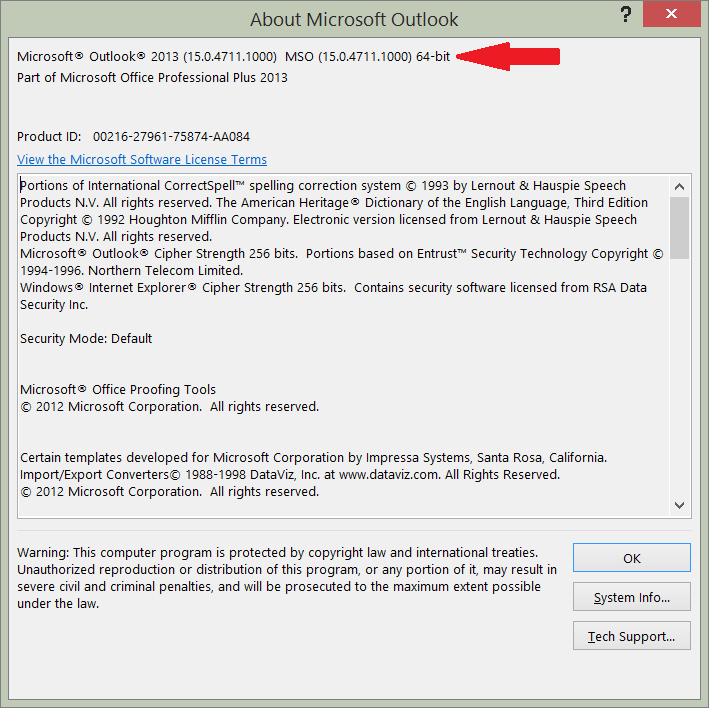
Steps for Outlook 2010 and 2013:
- Firstly, launch Outlook.
- Click on the File tab.
- Select Help (for Outlook 2010) or Office Account (for Outlook 2013).
- Choose About Microsoft Outlook.
- You’ll see the version information with either 32-bit or 64-bit mentioned.
2. Check from the Control Panel of Windows
Another quick method to Outlook version bitness check is via the Control Panel.
- Open the Control Panel on your PC.
- Go to Programs >> Programs and Features.
- Scroll down and locate Microsoft Office in the list.
- Right-click and choose Details/Properties.
- You’ll see whether your Office (including Outlook) is 32-bit or 64-bit.
3. Use Windows Settings on Your System
If you’re on Windows 10 or 11, you can also check using the Settings app.
- Press Windows + I to open Settings.
- Go to Apps >> Installed apps (or Apps & Features).
- Search for Microsoft Office.
- Expand the details, and it will show if the installation is 32-bit or 64-bit.
Also Read: How to Fix Outlook Inbox Repair Tool Not Responding Issue?
Which Version Should You Use: 32-bit or 64-bit?
Are you still unsure which version you should pick? Here is a quick comparison to determine Outlook version 32-bit vs 64-bit with ease:
- 32-bit Outlook:
- The 32-bit Outlook Version works better with the older add-ins.
- Also, this version is recommended for most of the business users.
- Along with that, it is compatible with 32-bit Windows.
- 64-bit Outlook:
- It can handle large mailboxes and big PST/OST files.
- Better for advanced data analysis in Excel and large database connections.
- Moreover, it is recommended for power users dealing with heavy data.
Additional Tips: Usually, Microsoft recommends using the 32-bit version. Until unless you specifically need the advantages of 64-bit.
Also Read: How to Find the Location of ScanPST.exe in Outlook?
Conclusion
Now, it’s easy for the user to determine Outlook version 32-bit vs 64-bit. The above-mentioned steps will save you from compatibility issues and unnecessary troubleshooting later. You can check it directly from Outlook or the Control Panel. Also, you can use Windows Settings to verify it in just a few seconds. Once you know your version, you’ll be able to install add-ins and configure tools. Along with that, you can seek technical help without confusion.
Frequently Asked Questions
Q1. Does my Windows version decide if Outlook is 32-bit or 64-bit?
Ans: No, both of the Outlook versions can run on Windows 64-bit. However, 32-bit Office is installed by default. As an alternative, you have to choose 64-bit manually.
Q2. Can I switch from 32-bit to 64-bit Outlook?
Ans: Yes, you can, but for that, you must uninstall the 32-bit version first and then reinstall Office as 64-bit.
Q3. Are Outlook data files (.PST, .OST) different in 32-bit and 64-bit?
Ans: No, the Outlook data files are the same in the both versions of Outlook. You can open them in any of the versions according to your requirement.
Q4. How long does it take to check the Outlook version?
Ans: If you do it properly, then it will take only a few seconds. Simply, you have to click on the File button>> Office Account>>About Outlook.
About The Author:

Rohan Wiese is a Technical Writer at Aryson Technologies. He is an expert Email Forensic, Cloud Computing, and a passionate nerd with over 10 years of experience in technical content writing. He writes about Cloud Migration, Database Recovery, Email Backup, Windows, Mac, and Tech.
Related Post