Complete Step-by-Step Guide for Aryson OLM Converter
Easily convert OLM files to PST, MBOX, EML, MSG, PDF, CSV, VCF, DOCX, and ICS formats on Windows, Mac, and Linux. This software also migrates OLM files to Office 365, Gmail, G Suite, Thunderbird, Hotmail, IMAP servers, and other email clients. For any issues, you can refer to the Functional & Technical Documentation (FTD) Guide for complete assistance.
- Table of Content
- Software Working Process
- Activation Guide
- Installation & Uninstallation
- User Interface
Software Working Process
Step 1: Download and launch the Aryson OLM Converter Tool on your system.
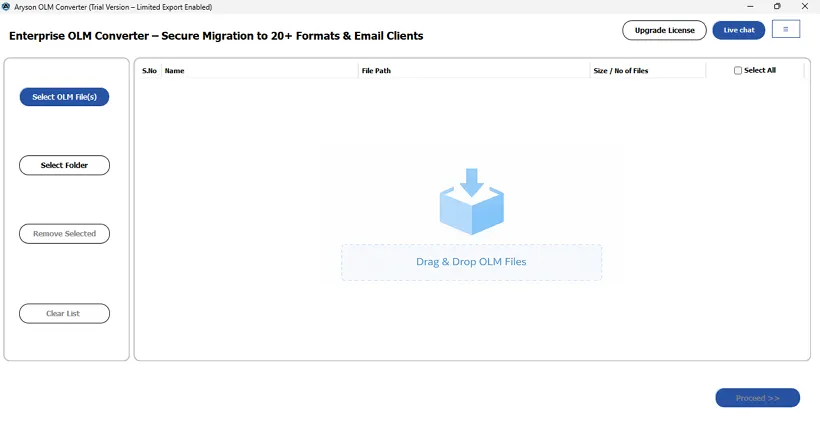
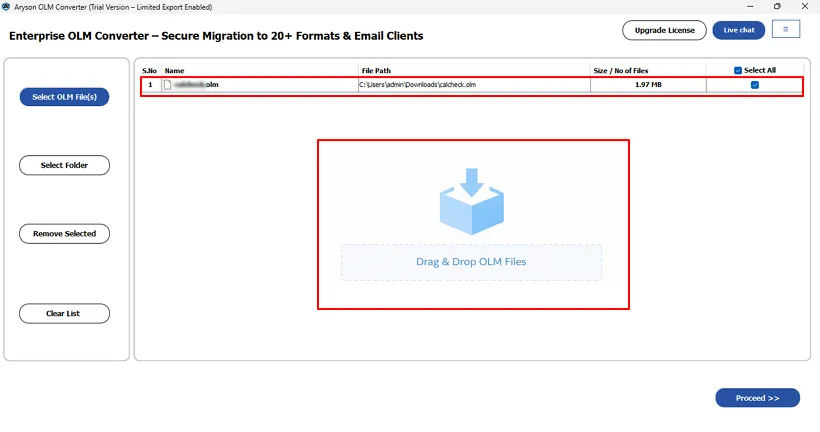
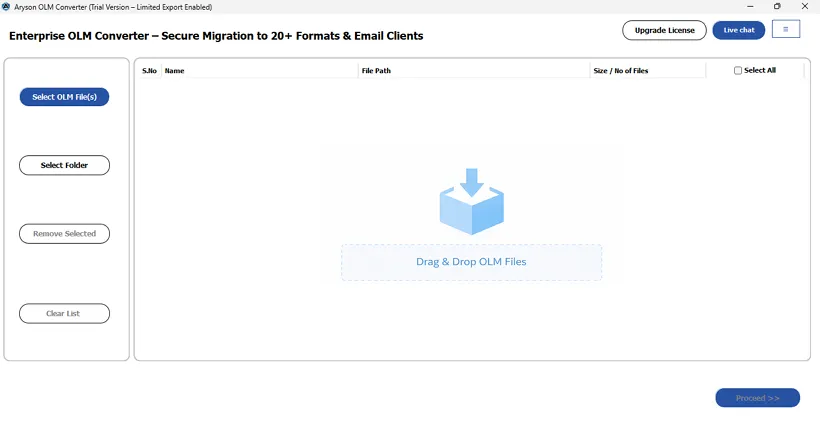
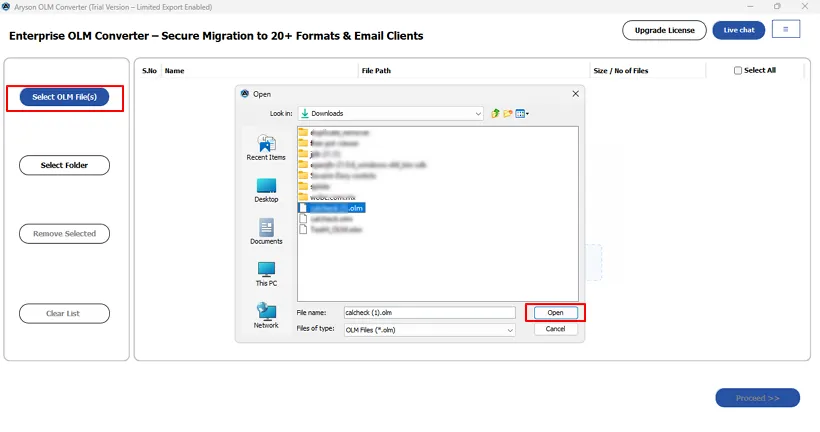
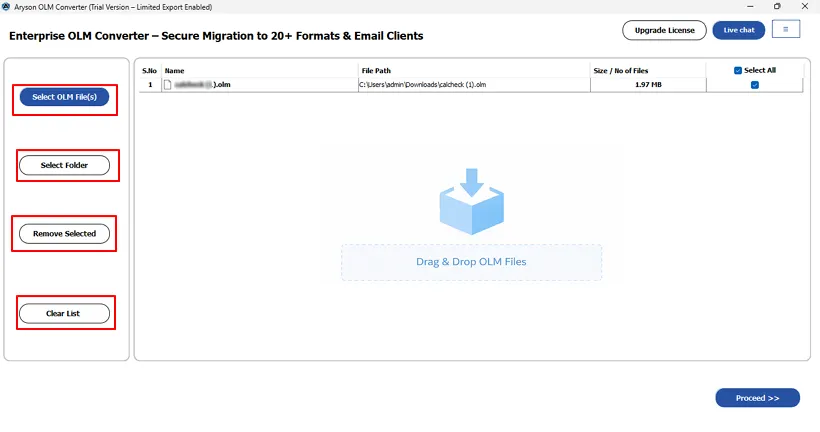
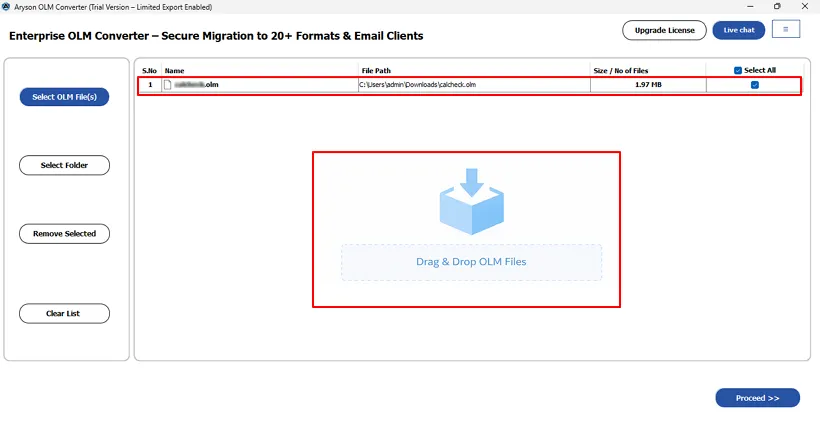
Step 2: Add the required OLM Files
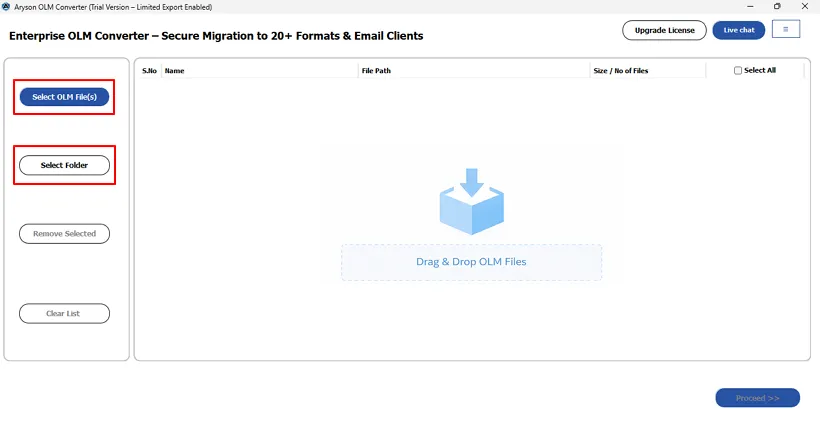
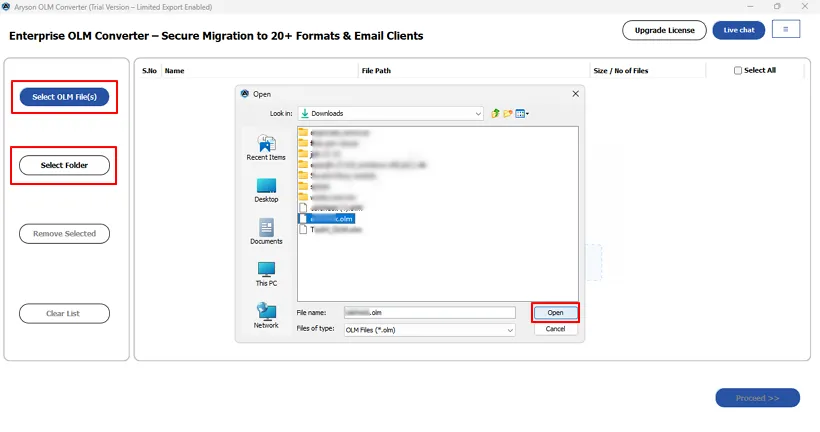
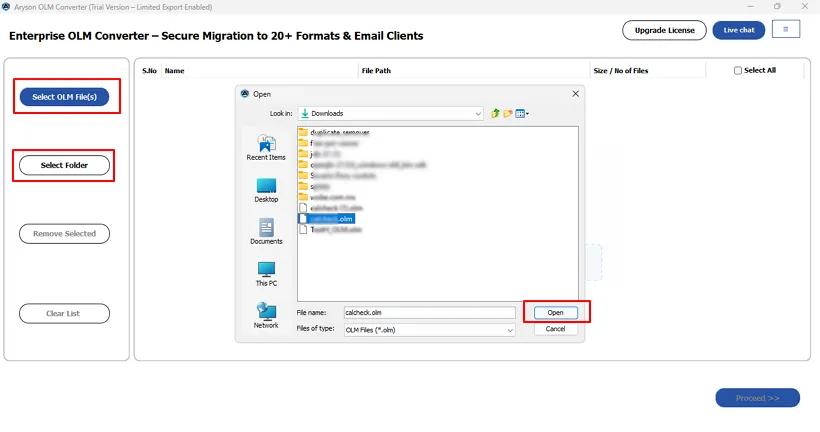
Use the available options to load Outlook for Mac OLM files into the software.
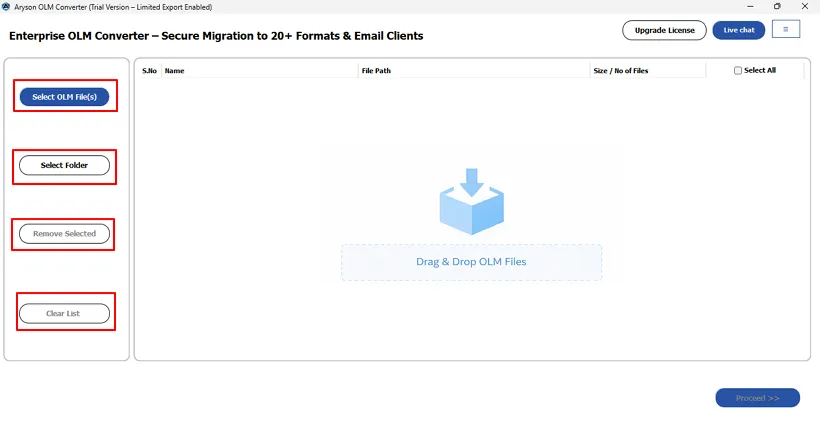
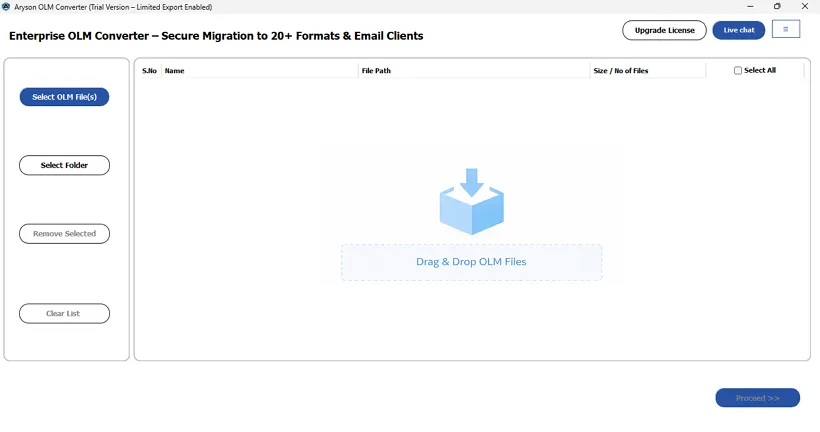
- Select File(s): Browse and add one or multiple OLM files from your system.
- Select Folder: Add an entire folder containing multiple OLM files for batch conversion.
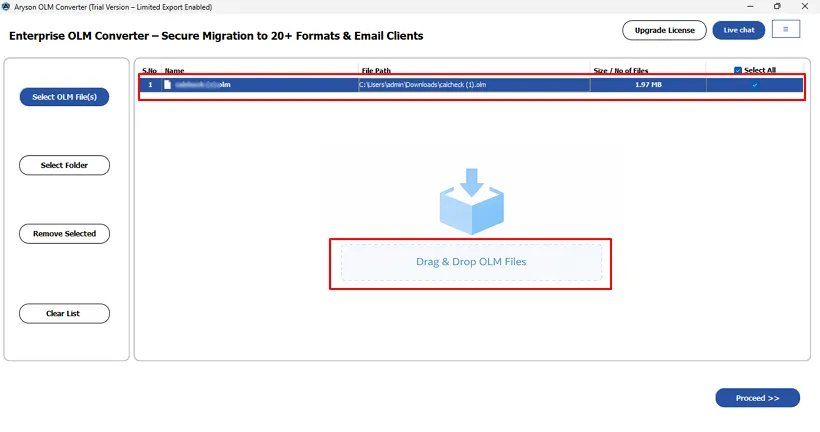
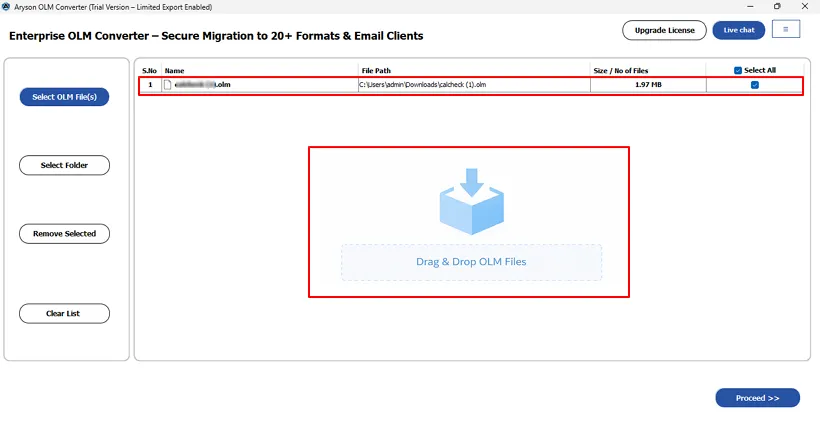
- Drag & Drop OLM Files: Simply drag OLM files into the workspace for quick import.
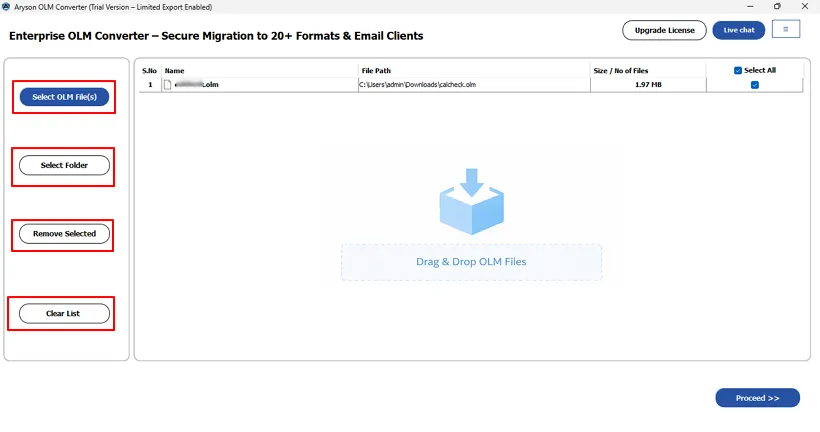
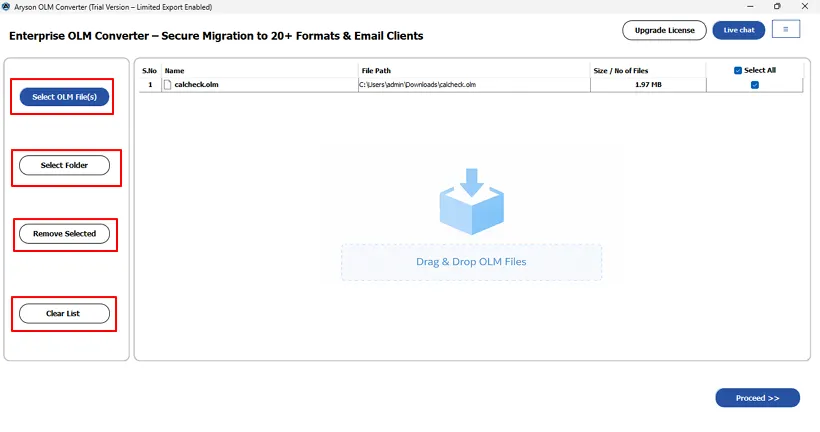
- File Details Grid: Displays the file name, file path, file size, and selection status of added OLM files.
- Select Checkbox: Choose specific OLM files you want to process.
- Remove Selected: Delete only the selected OLM file(s) from the list.
- Clear List: Remove all added OLM files at once and start over.
- Upgrade License: Upgrade from the trial version to unlock full export functionality.
- Live Chat: Contact the support team directly for assistance.
- Proceed Button: Continue to the next step after selecting the required OLM file(s).
Add the desired OLM file(s), verify the details, and click Proceed to preview and convert the data.
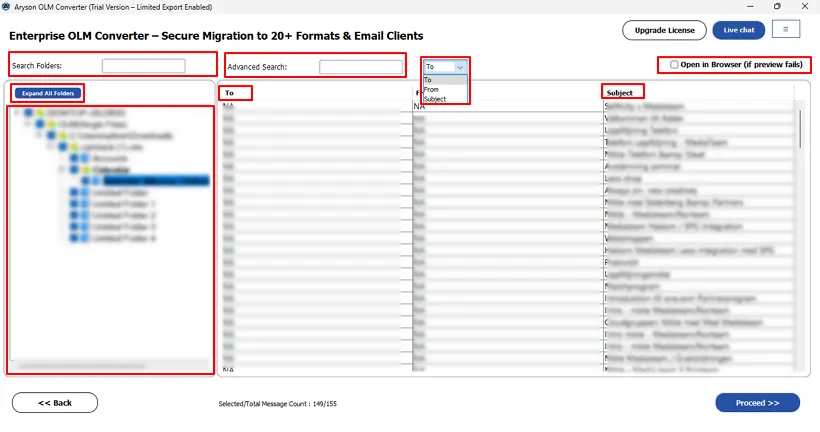
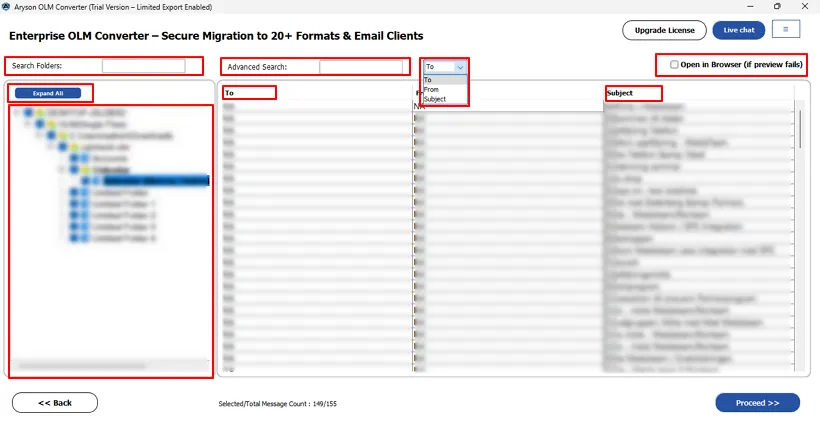
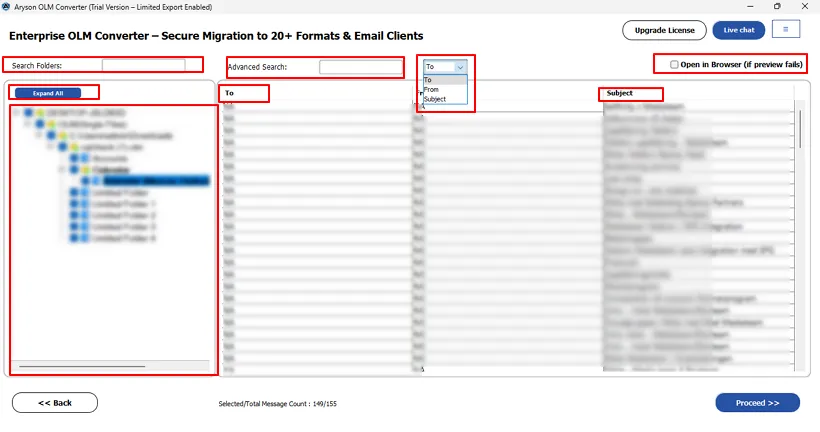
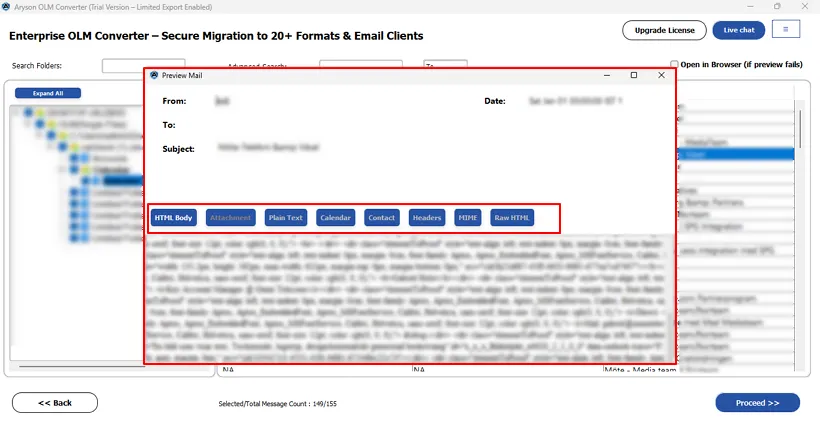
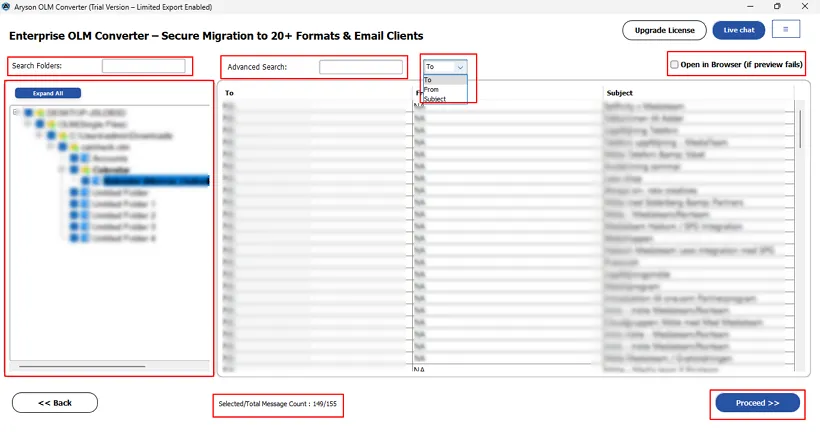
Step 3: Preview & Search OLM Mailbox Data
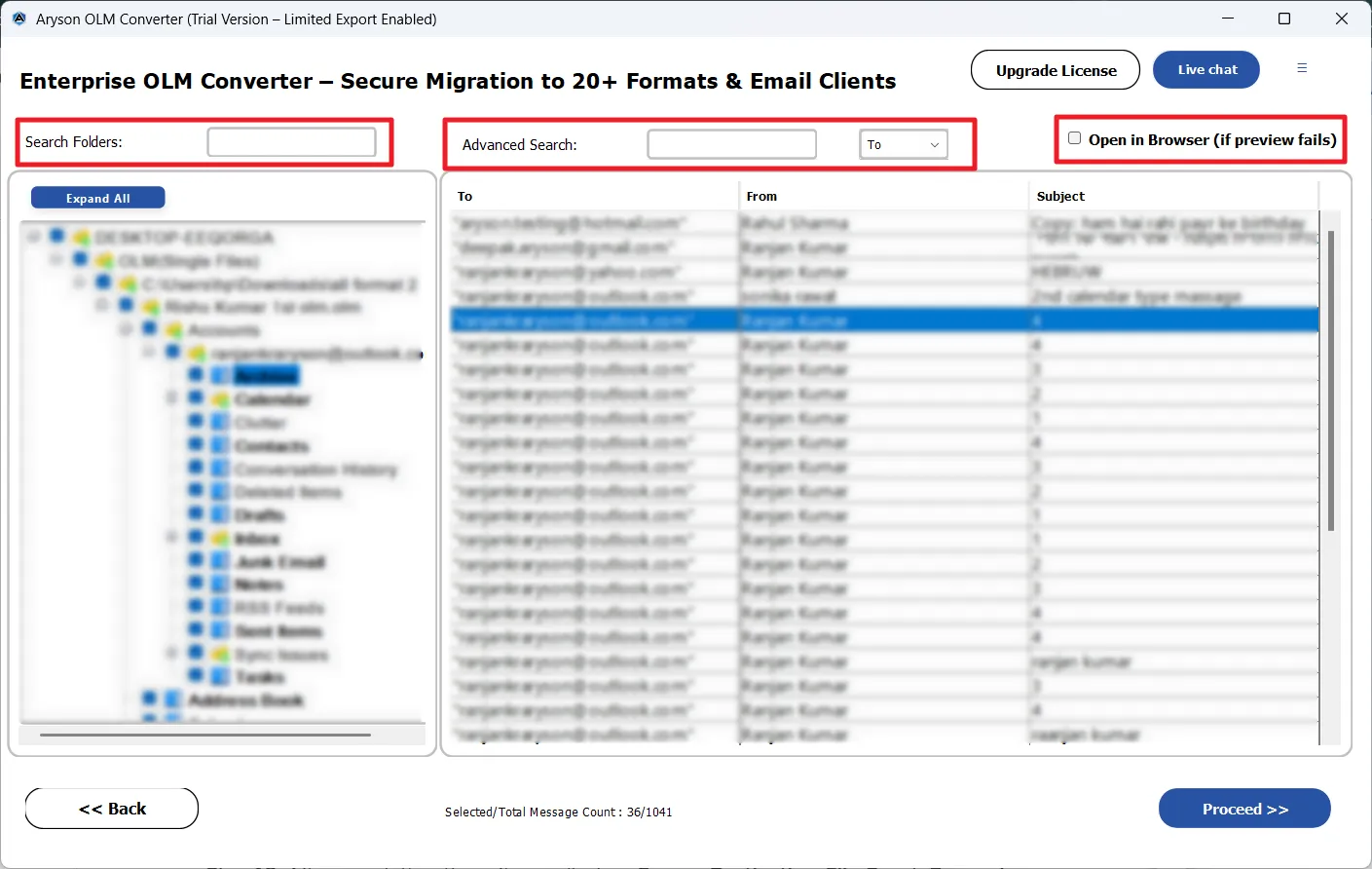
- Browse and expand mailbox folders to view all available emails and items.
- Use Search Folders to quickly locate a specific mailbox folder.
- Double-click the folder to load it into the J-table.
- Apply Advanced Search and select fields like To, From, or Subject to find particular emails.
- Double-click on a particular email to preview it in the advanced preview panel (explained below).
- Enable Open in Browser if the email preview does not load properly within the application.
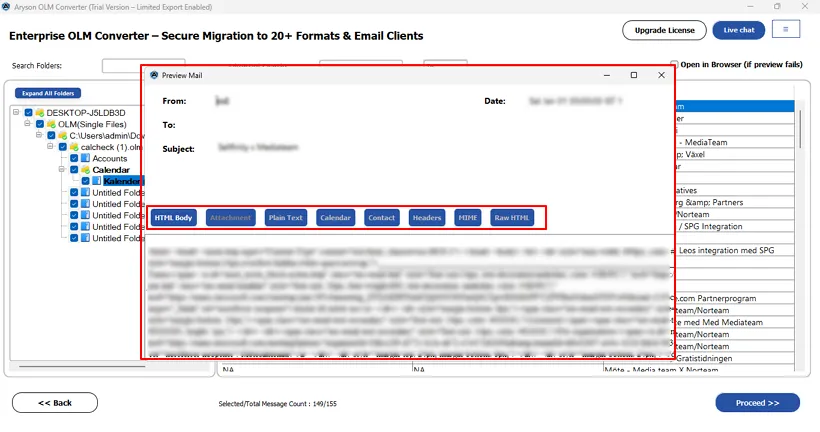
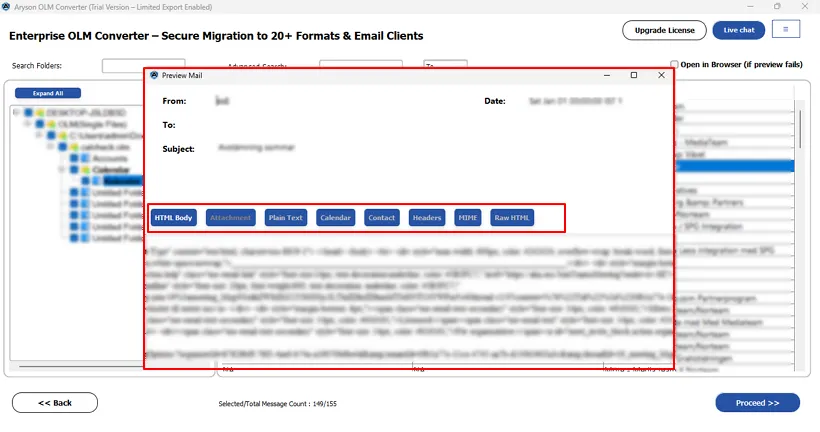
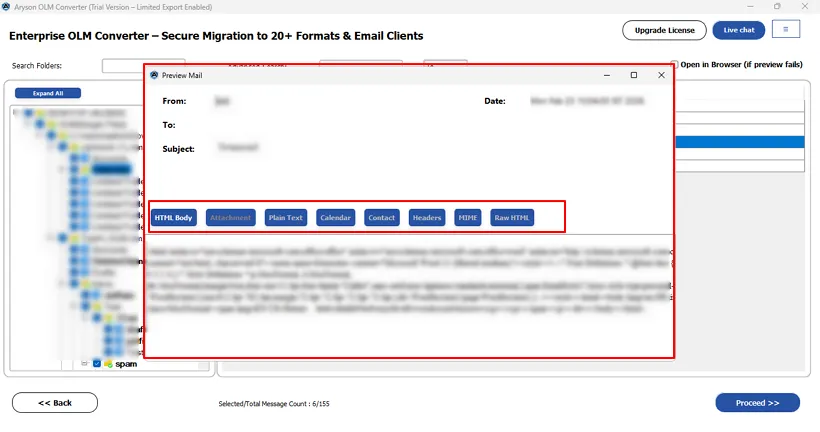
The Advanced Preview Panel displays the following details:
The Date, To, From, and Subject fields of the email. Along with that, the following details are displayed as well.
- HTML Body: View the original email with complete formatting and styling.
- Plain Text: Check the email content in a simple text format.
- Attachments: Preview all files attached to the selected email.
- Calendar: Review event details, including subject, date, time, and location.
- Contacts: View contact information stored in the mailbox.
- Notes: Access and verify saved notes.
- Tasks: Preview task details and related information.
- Headers: Examine technical email properties and routing information.
- MIME: View the MIME structure of the selected message.
- Raw HTML: Inspect the email's source HTML code and formatting structure.
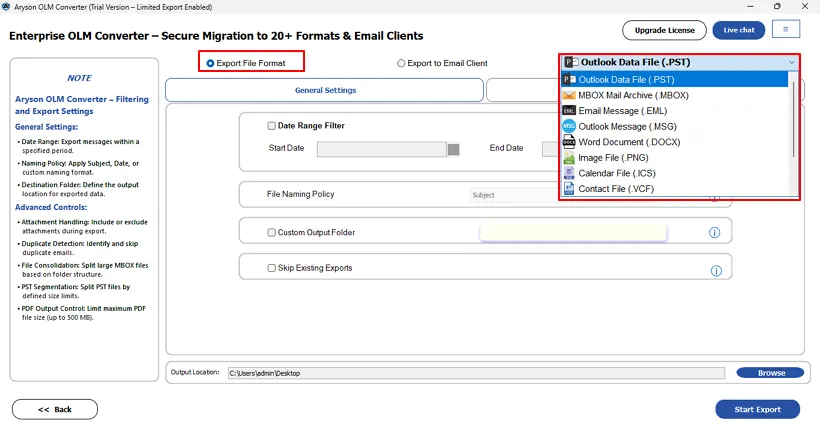
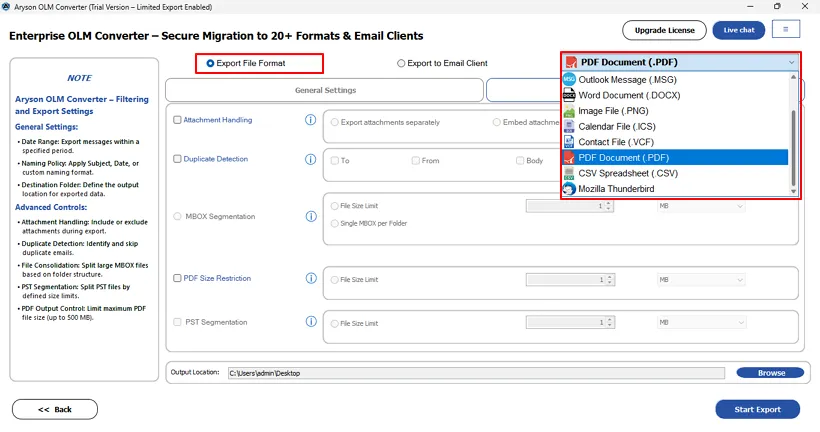
Step 4: Now, mark the Export File Format radio button and select the required file formats as required. The supported output formats are PST, PDF, MBOX, CSV, EML, MSG, DOCX, PNG, ICS, VCF, PDF, CSV, and Mozilla Thunderbird.
Step 5: Apply the Additional Features of the Software
-
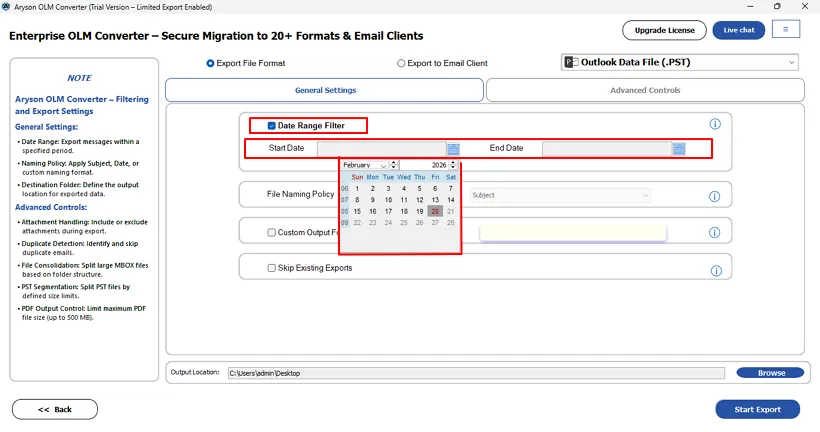
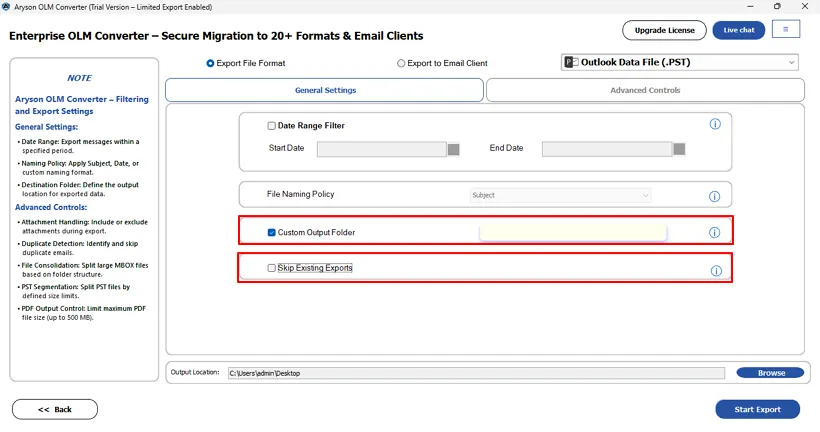
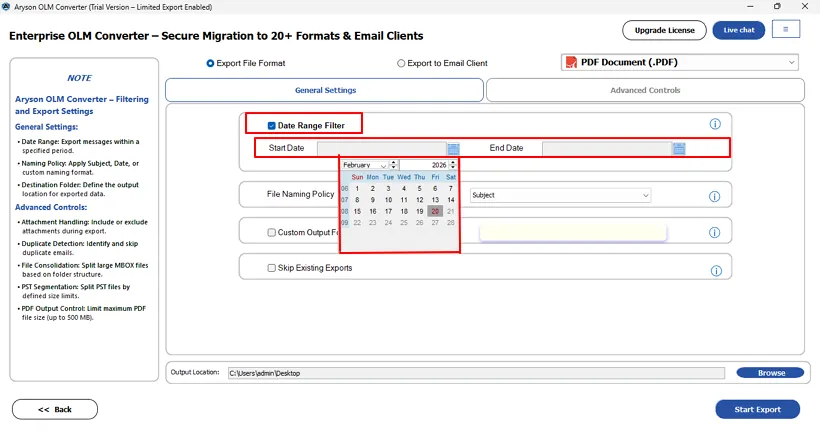
Configure General Export Settings
Choose the desired file format or email client and apply the required export settings before starting the conversion.- Date Range Filter: Export emails within a specific date period.
- Date Range Filter: Export emails within a specific date period.
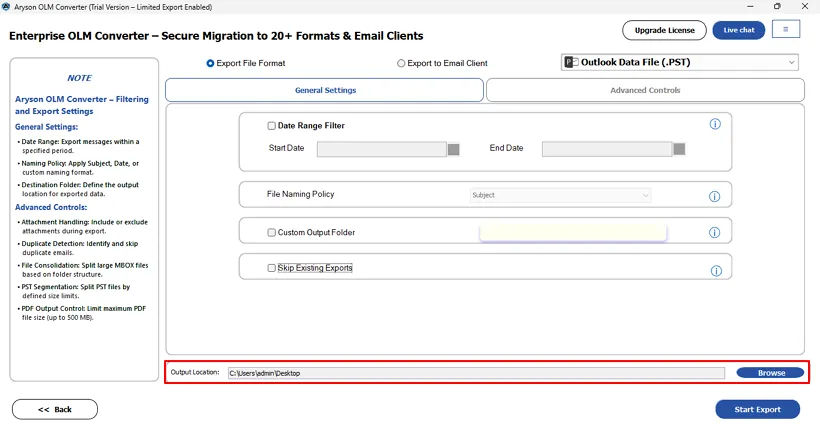
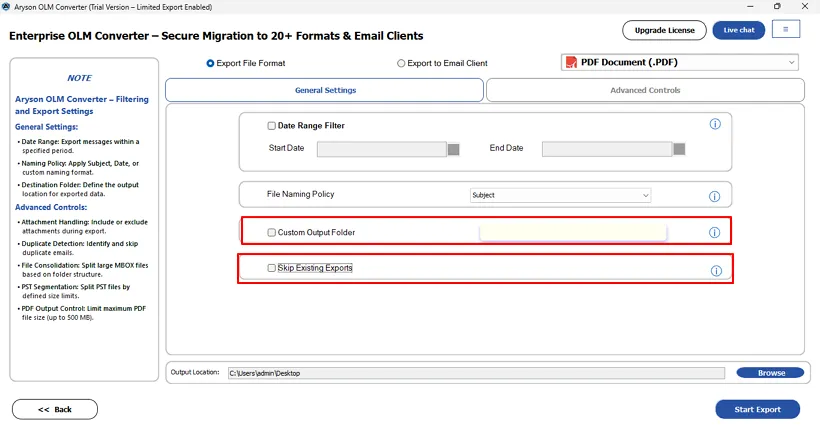
- Custom Output Folder: Select a destination folder for exported data.
- Skip Existing Exports: Prevent re-exporting previously converted items.
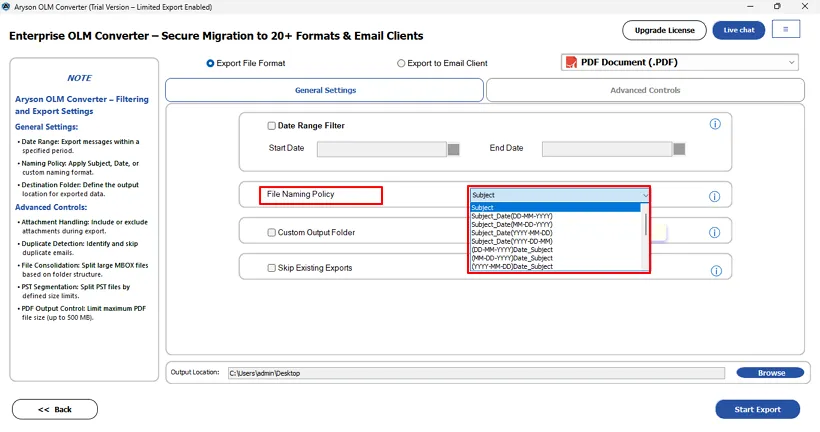
- File Naming Policy: Applies a custom naming convention to exported files using combinations of subject and date formats for organised file management.
-
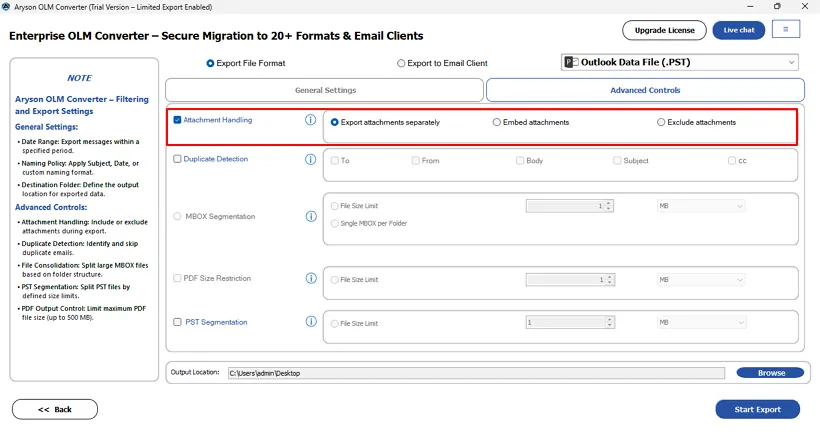
Apply Advanced Export Controls
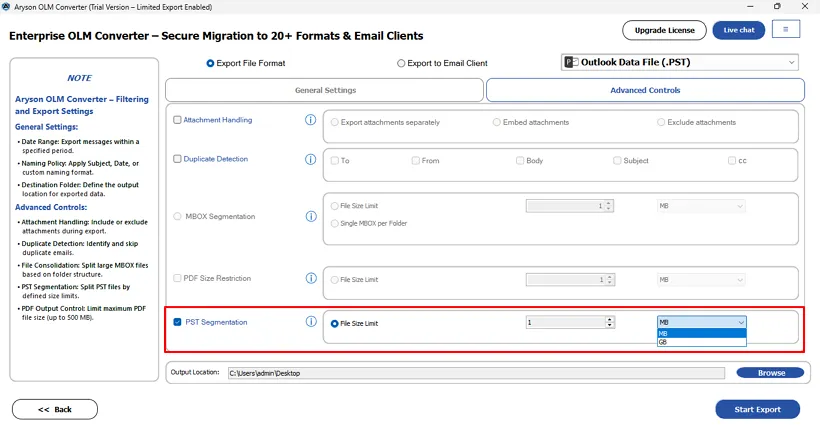
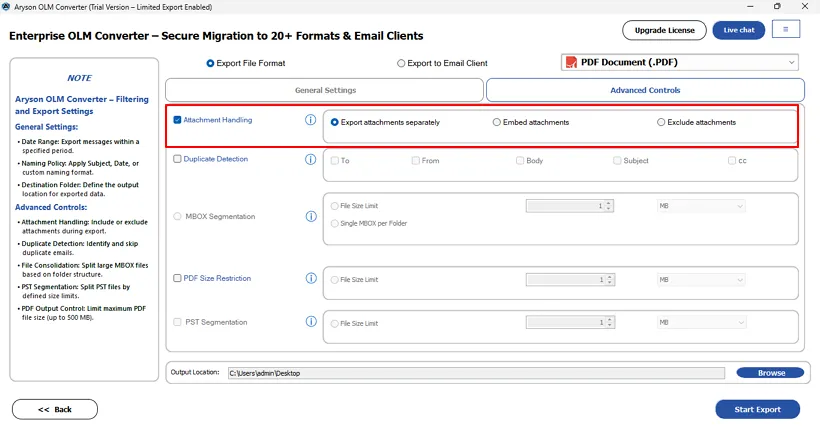
Use advanced options to customize the export process and manage attachments, duplicates, and file size limits.- Attachment Handling: Export attachments separately or exclude them.
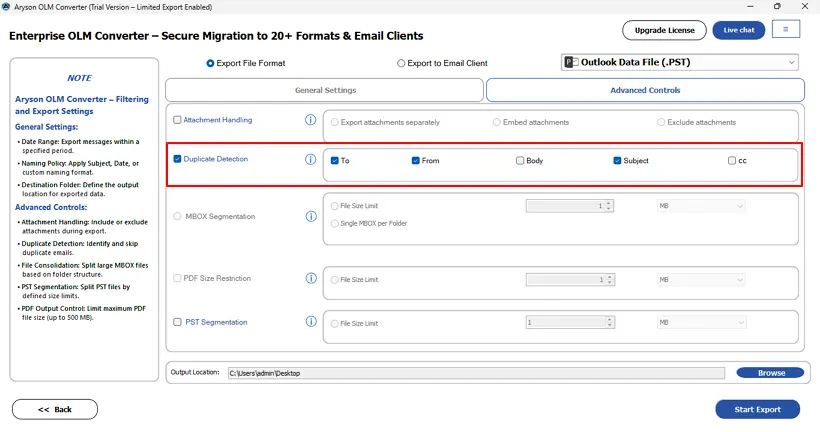
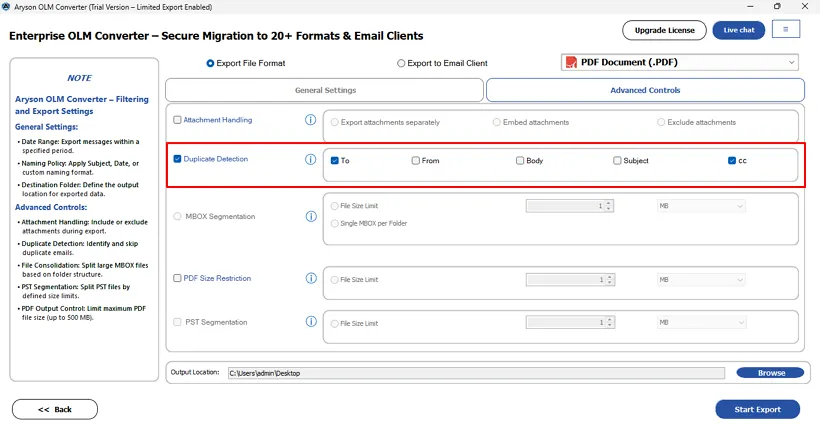
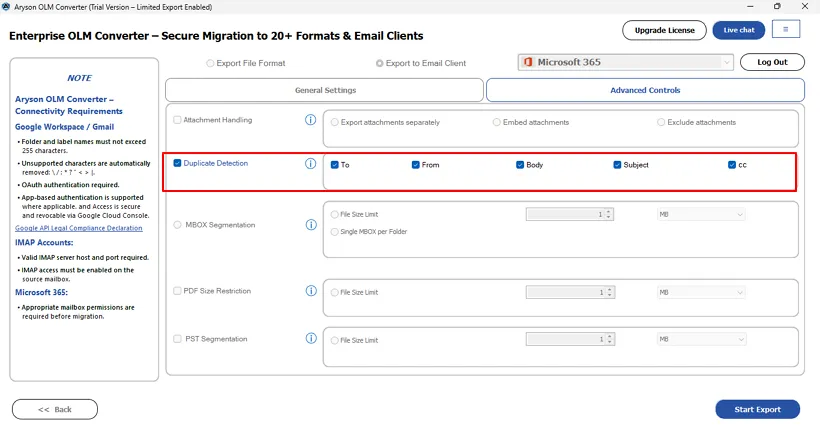
- Duplicate Detection: Identify and skip duplicate emails using fields like To, From, Subject, Body, and CC.
- For PST:
- PST Segmentation: Divide large PST files into smaller parts based on a specified size limit.
- For MBOX:
- MBOX Segmentation: Splits large MBOX files by file size or creates a separate MBOX file for each mailbox folder.
- For PDF:
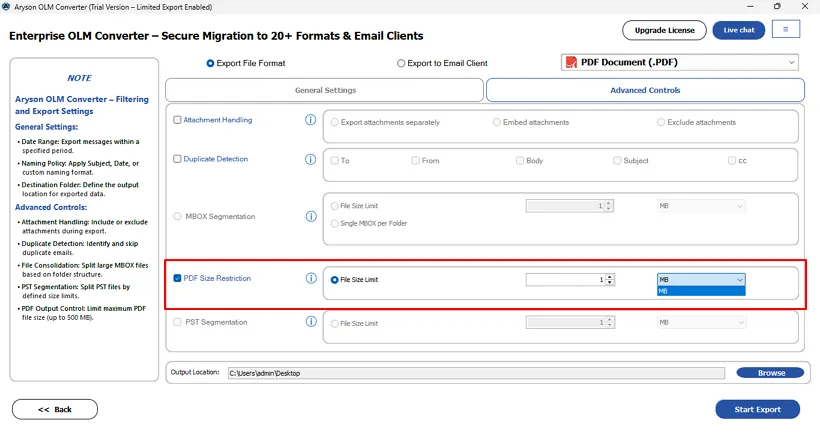
- PDF Size Restriction: Limits the size of exported PDF files by splitting them as per the specified size limit (the maximum size limit that can be specified is 500MB).
- Merge Attachments: Keeps the attachments saved in a written format in PDF pages.
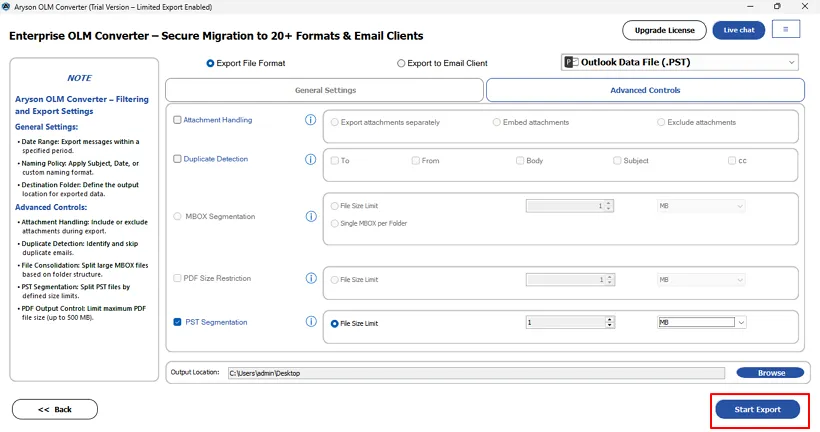
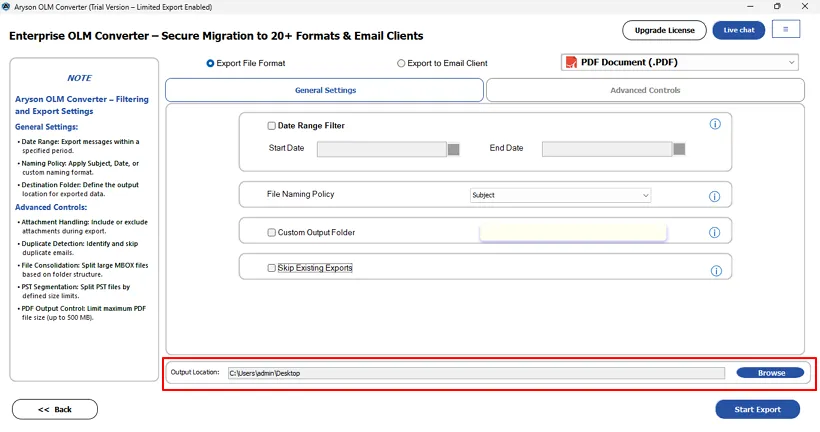
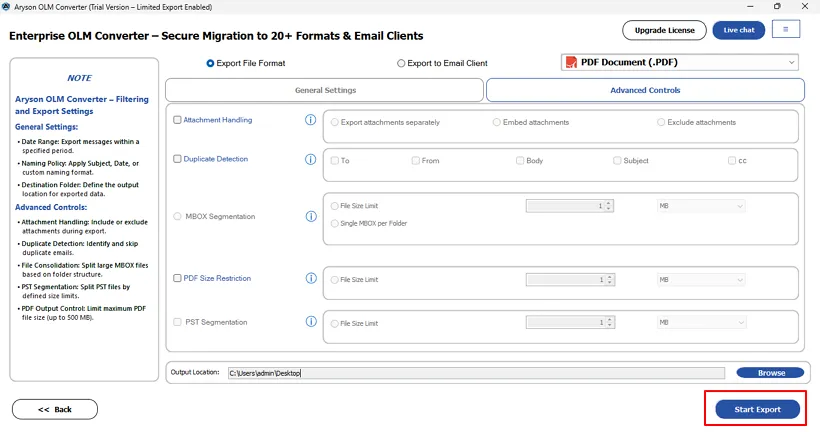
Step 6: Click Browse to browse and choose your preferred saving location, and click the Start Export button to begin conversion.
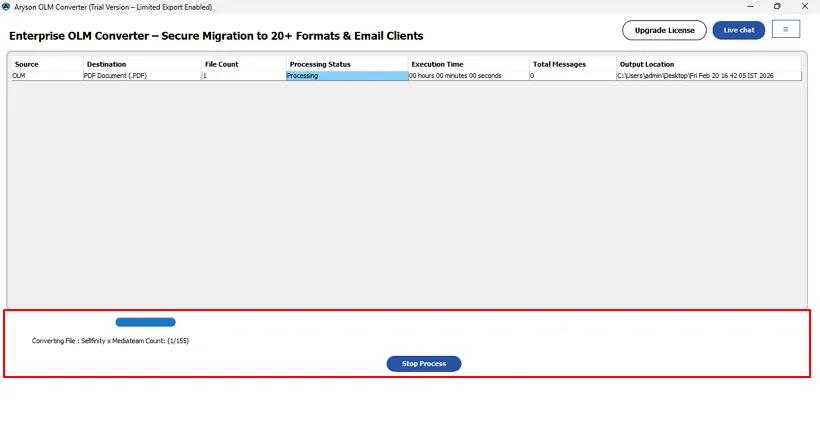
Step 7: Monitor and Complete the Conversion Process
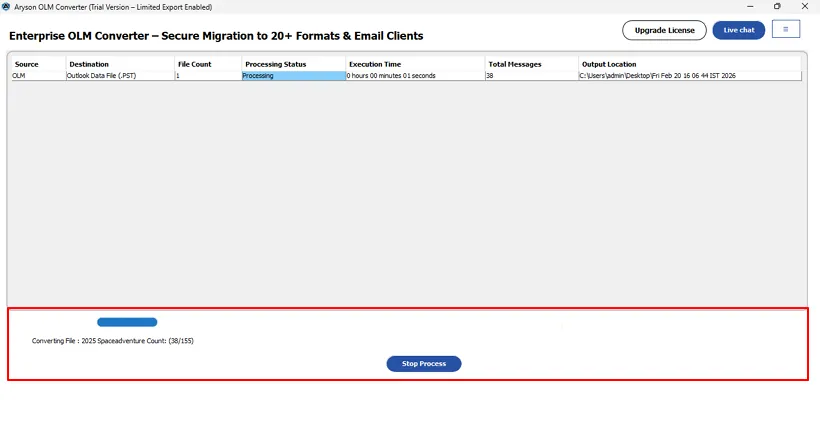
After clicking Start Export, track the migration progress and review the conversion details in real time.
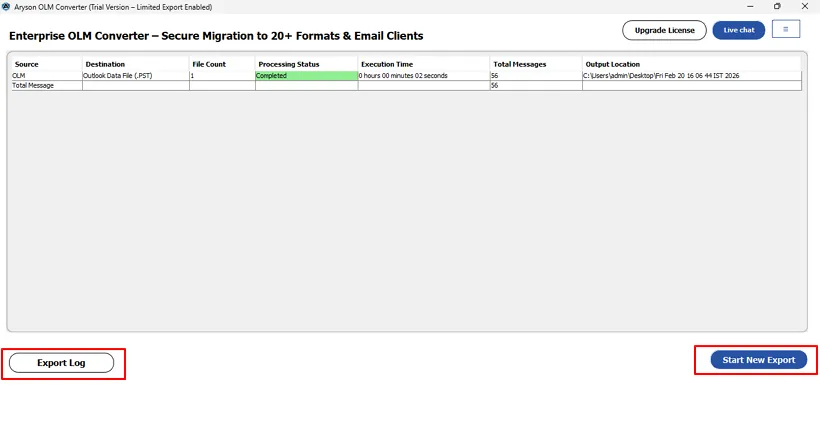
- Source & Destination: View the selected source file and target export location.
- File Count & Total Messages: Monitor the number of processed files and emails.
- Processing Status: Check the current status of the export operation.
- Execution Time: Track the total time taken for the conversion.
- Output Location: Verify where the converted data is being saved.
- Progress Bar: Monitor overall conversion progress in real time.
- Stop Process: Cancel the export operation if required.
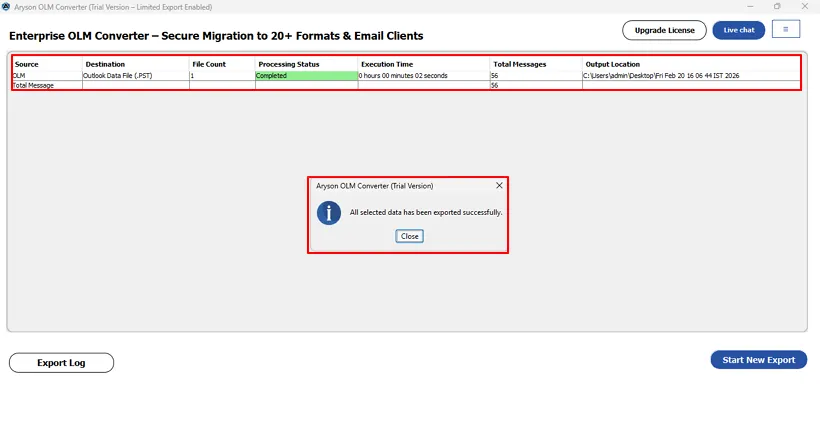
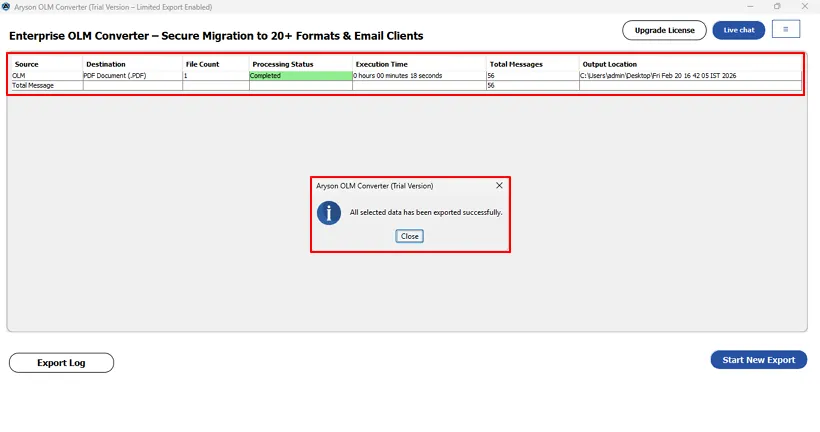
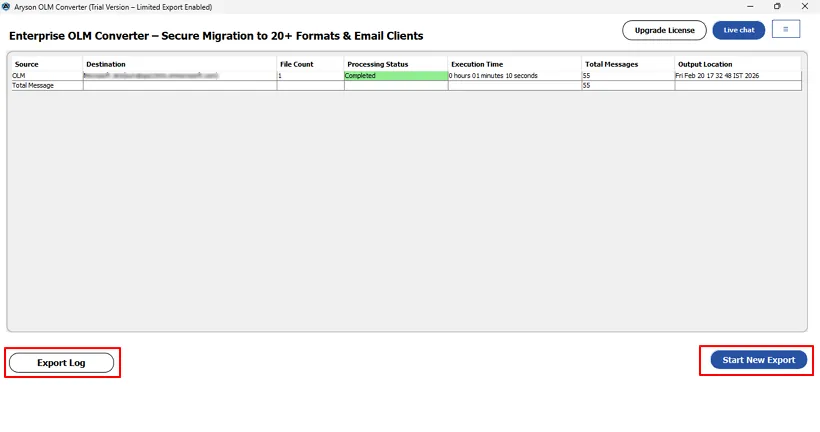
Step 8: Once the conversion completes, the software displays, “All selected data has been exported successfully." You can even use the additional options to proceed further.
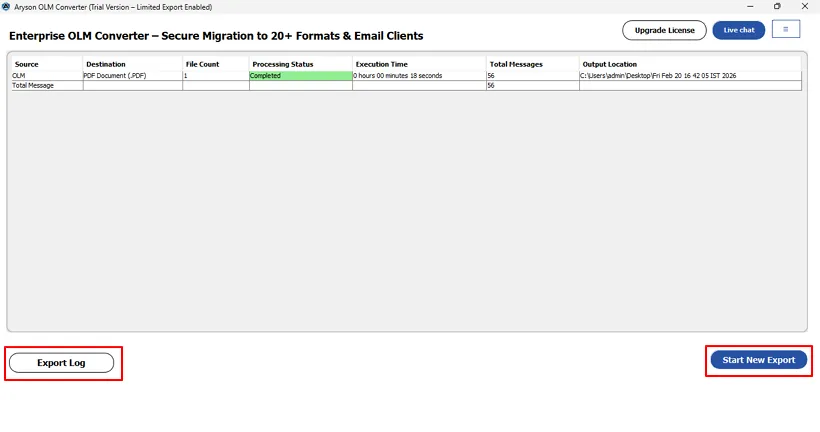
- Export Log: Open the detailed log report to verify the export process and results.
- Start New Export: Begin another OLM conversion or migration task if required.
Step 1: Download and launch the Aryson OLM Converter Tool on your system.
Step 2: Add the required OLM Files
Use the available options to load Outlook for Mac OLM files into the software.
- Select File(s): Browse and add one or multiple OLM files from your system.
- Select Folder: Add an entire folder containing multiple OLM files for batch conversion.
- Drag & Drop OLM Files: Simply drag OLM files into the workspace for quick import.
- File Details Grid: Displays the file name, file path, file size, and selection status of added OLM files.
- Select Checkbox: Choose specific OLM files you want to process.
- Remove Selected: Delete only the selected OLM file(s) from the list.
- Clear List: Remove all added OLM files at once and start over.
- Upgrade License: Upgrade from the trial version to unlock full export functionality.
- Live Chat: Contact the support team directly for assistance.
- Proceed Button: Continue to the next step after selecting the required OLM file(s).
Add the desired OLM file(s), verify the details, and click Proceed to preview and convert the data.
Step 3: Preview & Search OLM Mailbox Data
- Browse and expand mailbox folders to view all available emails and items.
- Use Search Folders to quickly locate a specific mailbox folder.
- Double-click the folder to load it into the J-table.
- Apply Advanced Search and select fields like To, From, or Subject to find particular emails.
- Double-click on a particular email to preview in the advanced preview panel (explained below).
- Enable Open in Browser if the email preview does not load properly within the application.
The Advanced Preview Panel displays the following details:
The Date, To, From, and Subject fields of the email. Along with that, the following details are displayed as well.
- HTML Body: View the original email with complete formatting and styling.
- Plain Text: Check the email content in a simple text format.
- Attachments: Preview all files attached to the selected email.
- Calendar: Review event details, including subject, date, time, and location.
- Contacts: View contact information stored in the mailbox.
- Notes: Access and verify saved notes.
- Tasks: Preview task details and related information.
- Headers: Examine technical email properties and routing information.
- MIME: View the MIME structure of the selected message.
- Raw HTML: Inspect the email's source HTML code and formatting structure.
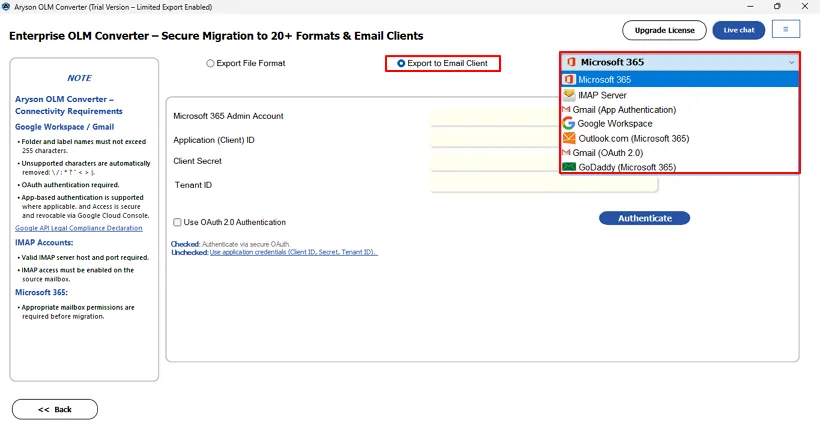
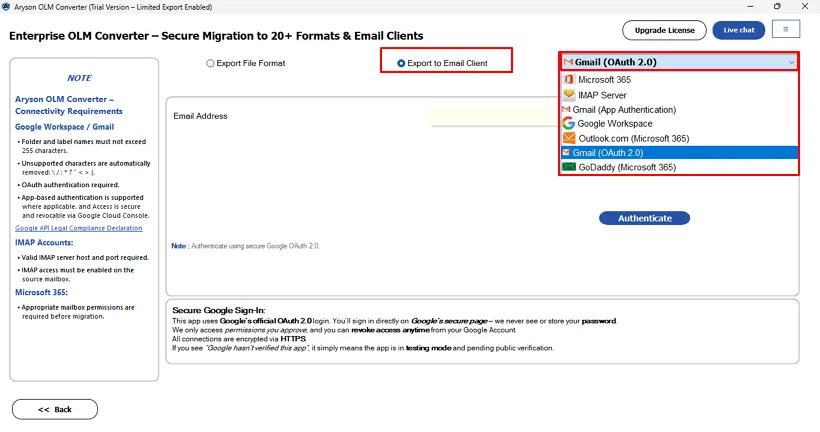
Step 4: Mark the Export to Email Clients radio button and select Microsoft 365 as the destination.
Step 5: Authenticate an active Microsoft 365 account
You may choose the A or B login method to log in to the Microsoft 365 account using valid credentials.
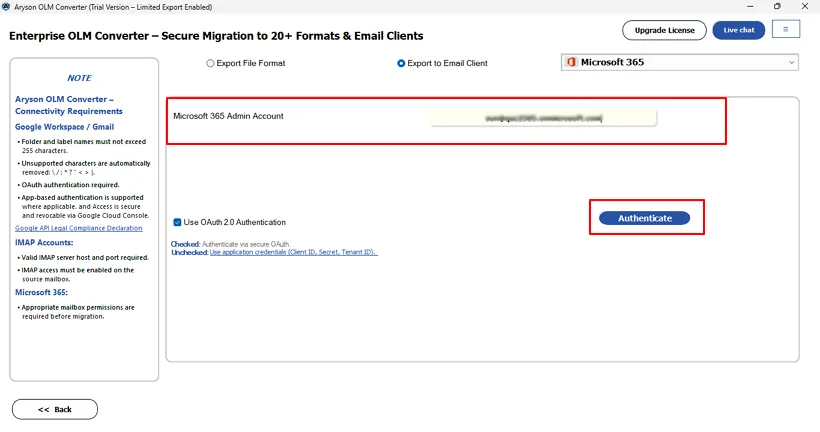
Step 5(A): Use OAuth 2.0 Authentication
- Enter your Microsoft admin account email and click on Authenticate.
-
Select Your Account
- In the Pick an account window, click the Microsoft account you want to use.
- Alternatively, select Use another account if your account is not listed.
-
Enter Password
- Provide your password and click Sign in.
- Provide your password and click Sign in.
-
Approve Multi-Factor Authentication (MFA)
- If prompted, open the Microsoft Authenticator app on your mobile device.
- Approve the sign-in request.
- If a matching number is displayed (e.g., 53), enter that number in the Authenticator app and approve the request.
-
Authentication Successful
- Once verification is completed, a confirmation message will appear: "Authentication complete. You can close the browser and return to the application."
- Close the browser window.
Step 5(B): Use an Application Credential
- First, disable OAuth authentication by unchecking Use OAuth 2.0 Authentication.
-
Enter the following credentials:
- Microsoft 365 Admin Account
- Application (Client) ID
- Client Secret
- Tenant ID
Enter Azure Application Details
Fill in the following information from your Azure app registration:
| Field | Description |
|---|---|
| Microsoft 365 Admin Account | Admin email address |
| Application (Client) ID | Azure App Client ID |
| Client Secret | Secret generated in Azure |
| Tenant ID | Microsoft Entra ID (Azure AD) Tenant ID |
If you choose Application Credentials Authentication (Client ID, Client Secret, and Tenant ID), you must first create an Azure App Registration and assign the required API permissions in Microsoft Entra ID (Azure AD).
For complete instructions on creating the Azure Active Directory application and enabling API permissions, visit:
Create Azure Active Directory and Enable API Permission Guide
In the guide at step 17, you need to add the required API permissions. The image below lists all the API permissions that must be configured for successful authentication and migration.
- After generating the credentials, fill in the required fields and click on Authenticate.
Step 5(B): 1: Choose Mailbox Mapping Mode
- Migrate All Files to Selected Mailbox(es): Transfer all selected OLM files into the same destination Microsoft 365 mailbox(es).
- Map Each File to Specific Mailbox(es): Assign individual OLM files to different Microsoft 365 mailboxes before migration.
- Next: After selecting the preferred mapping mode, click Next to continue with mailbox mapping and migration.
Step 5(B): 1.1: Migrate All Files to Selected Mailbox(es):
Select Destination Microsoft 365 Mailboxes
- Automatic Fetch Users: Retrieve all mailboxes from the authenticated Microsoft 365 tenant automatically.
- CSV Import: Import specific mailbox users using a CSV file.
- Search User: Locate a mailbox quickly using the search option.
- Review User Details: Verify Name, User ID, Mailbox Type, and Validation Status.
- Select Mailboxes: Choose the required destination mailboxes or use Select All.
- Verify Validation: Ensure the selected mailboxes display Allowed status.
- Next: Click Next to proceed with mailbox mapping and migration.
Note:
- Allowed indicates a licensed and valid mailbox, while Denied indicates a non-licensed or invalid mailbox.
- Mailbox types may include User Mailbox and Shared Mailbox.
- Only mailboxes with Allowed status can be selected as migration destinations.
Import Users via CSV
- Enable CSV import and download the sample CSV template.
- Enter mailbox details in the required format and save the file.
- Click Import CSV and browse to the updated CSV file.
- Review the imported users and verify their validation status.
- Select the required mailboxes and click Next to continue.
Step 5(B): 1.2: Map Each File to Specific Mailbox(es):
- Review Loaded Folders: Verify your retrieved OLM folders under the Source Folder column and ensure all mailboxes are loaded successfully.
-
Map Target Mailboxes: Click the -- Select Target Mailboxes -- dropdown next to each OLM folder to map its destination.
- Select the corresponding target Microsoft 365 mailbox from the mailbox list.
- Use the Search Users option to quickly find destination mailboxes.
- Verify the UPN and mailbox type before mapping.
- Check licensed mailboxes to ensure they are ready for migration.
- Click Select All to map multiple mailboxes at once.
- Review the mailbox summary (All, Licensed, Unlicensed) for validation.
- Click Apply to save the mappings and proceed with migration.
- Filter Selection: Use the checkboxes on the right (or toggle Select All ) to exclude any folders you do not want to migrate.
- CSV Import (Optional): Click the CSV Import button to upload a mapping file if you are migrating multiple users' profiles at once.
- Save and Migrate: Click Save Mapping & Start >> to lock in your folder configuration and begin the migration process.
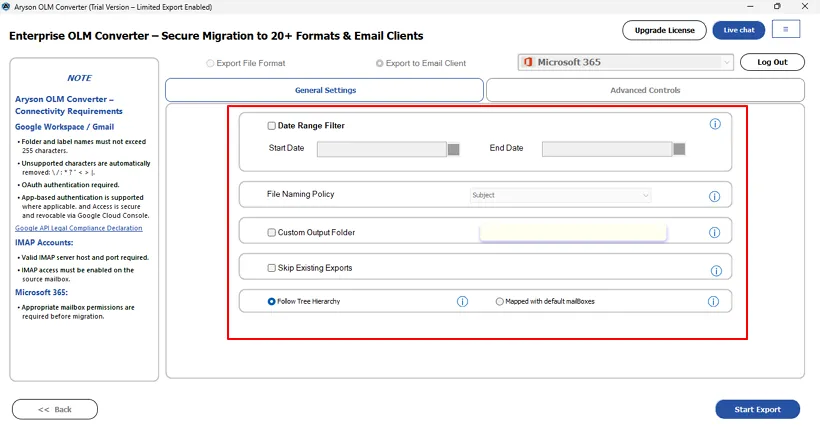
Step 6: Return to the Application & Configure Migration Settings & Filters
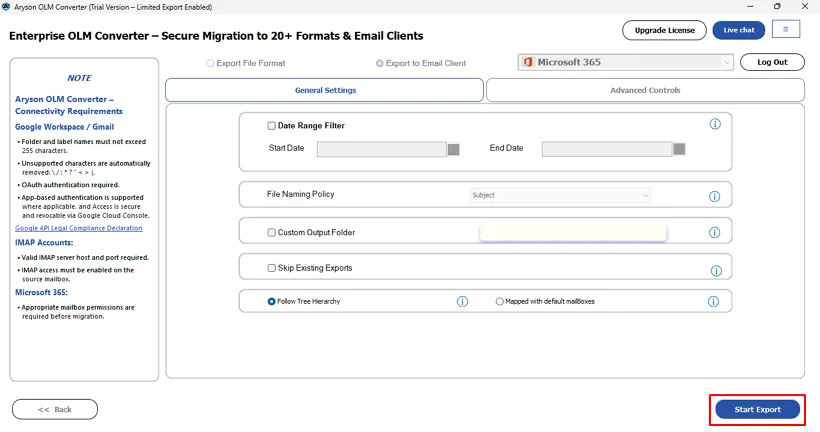
- Date Range Filter: Enable and specify a Start Date and End Date to migrate only emails within a particular time period.
- Custom Output Folder: Select a specific destination folder to store migrated data instead of the default location.
- Skip Existing Exports: Exclude previously migrated items to prevent duplicates and reduce migration time.
- Follow Tree Hierarchy: Maintain the original mailbox folder structure throughout the migration process.
- Map with Default Mailboxes: Automatically map source default folders to their corresponding default folders in the target mailbox.
Step 7: Configure Advanced Migration Filters
- Attachment Handling: Enable this option to manage email attachments during migration. Choose to exclude attachments based on migration requirements.
- Duplicate Detection: Enable duplicate filtering to prevent redundant email migration. Compare items using attributes such as To, From, Subject, Body, and CC fields for accurate duplicate identification.
Step 8: Click Start Export to begin the OLM to Office 365 migration conversion process.
Step 9: Monitor and Complete the OLM to Office 365 Migration
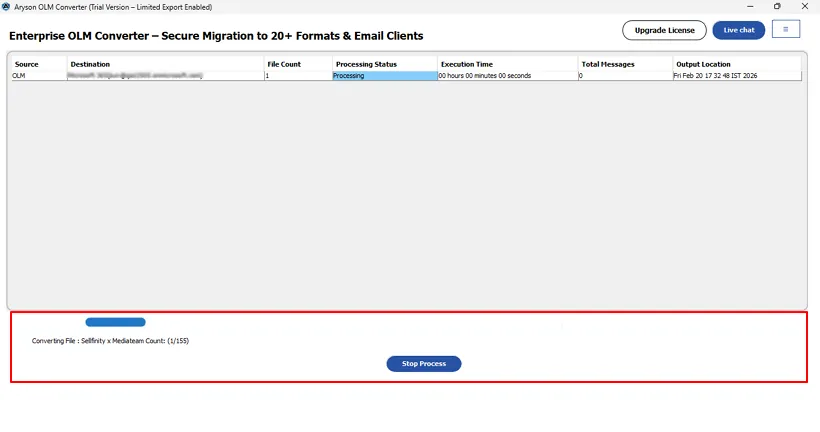
After clicking Start Export, monitor the mailbox transfer progress and review migration statistics in real time.
- Source OLM File: Verify the selected OLM mailbox being migrated.
- Target Microsoft 365 Account: Confirm the destination Office 365 mailbox.
- Mailbox Items Processed: Track migrated emails, contacts, calendars, tasks, and notes.
- Migration Status: View the current status of the mailbox migration process.
- Execution Time: Monitor the total time taken for migration.
- Data Transfer Progress: Check the amount of mailbox data migrated.
- Progress Bar: Follow the overall migration progress in real time.
- Stop Migration: Pause or cancel the migration process if required.
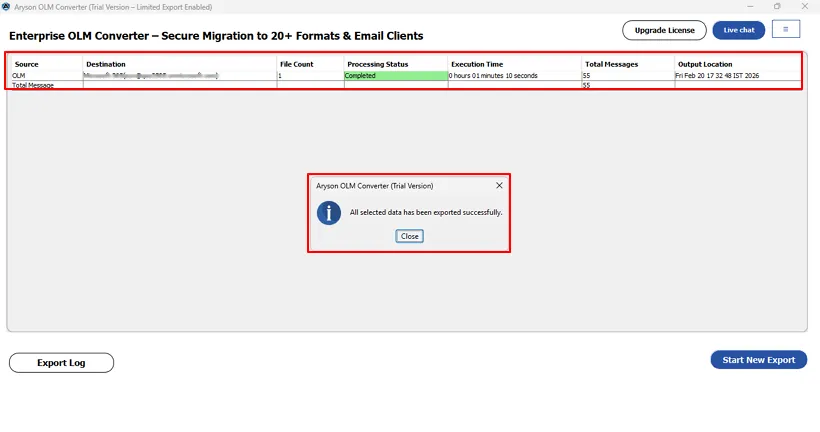
Step 10: Once the conversion completes, the software displays, “All selected data has been exported successfully." You can even use the additional options to proceed further.
- Export Log: Open the detailed log report to verify the export process and results.
- Start New Export: Begin another OLM conversion or migration task if required.
Step 1: Download and launch the Aryson OLM Converter Tool on your system.
Step 2: Add the required OLM Files
Use the available options to load Outlook for Mac OLM files into the software.
- Select File(s): Browse and add one or multiple OLM files from your system.
- Select Folder: Add an entire folder containing multiple OLM files for batch conversion.
- Drag & Drop OLM Files: Simply drag OLM files into the workspace for quick import.
- File Details Grid: Displays the file name, file path, file size, and selection status of added OLM files.
- Select Checkbox: Choose specific OLM files you want to process.
- Remove Selected: Delete only the selected OLM file(s) from the list.
- Clear List: Remove all added OLM files at once and start over.
- Upgrade License: Upgrade from the trial version to unlock full export functionality.
- Live Chat: Contact the support team directly for assistance.
- Proceed Button: Continue to the next step after selecting the required OLM file(s).
Add the desired OLM file(s), verify the details, and click Proceed to preview and convert the data.
Step 3: Preview & Search OLM Mailbox Data
- Browse and expand mailbox folders to view all available emails and items.
- Use Search Folders to quickly locate a specific mailbox folder.
- Double-click the folder to load it into the J-table.
- Apply Advanced Search and select fields like To, From, or Subject to find particular emails.
- Double-click on a particular email to preview in the advanced preview panel (explained below).
- Enable Open in Browser if the email preview does not load properly within the application.
The Advanced Preview Panel displays the following details:
The Date, To, From, and Subject fields of the email. Along with that, the following details are displayed as well.
- HTML Body: View the original email with complete formatting and styling.
- Plain Text: Check the email content in a simple text format.
- Attachments: Preview all files attached to the selected email.
- Calendar: Review event details, including subject, date, time, and location.
- Contacts: View contact information stored in the mailbox.
- Notes: Access and verify saved notes.
- Tasks: Preview task details and related information.
- Headers: Examine technical email properties and routing information.
- MIME: View the MIME structure of the selected message.
- Raw HTML: Inspect the email's source HTML code and formatting structure.
Step 4: Mark the Export to Email Clients radio button and select IMAP as the destination.
Step 5: Configure IMAP Server and Authenticate/p>
- Enter the destination Email Address.
- Provide the App Password or mailbox password.
- Specify the IMAP Server Host and IMAP Port Number.
-
Click on Server List option to fetch supported IMAP server details automatically.
- Select the IMAP host as desired or search for a specific one and click Continue.
- Select the IMAP host as desired or search for a specific one and click Continue.
- Enable Show Credentials to verify the entered password.
- Click Authenticate to validate the mailbox connection and proceed with the migration.
Step 6: Apply the Additional Features of the Software
-
Configure General Export Settings
- Date Range Filter: Migrate emails within a specific date range.
- Custom Output Folder: Specify a folder to save migration logs and reports.
- Skip Existing Exports: Avoid migrating items that already exist in the destination mailbox.
-
Configure Advanced Migration Controls
- Attachment Handling: Exclude attachments during the migration.
- Duplicate Detection: Skip duplicate emails based on To, From, Subject, Body, and CC fields.
Step 7: Click on the Start Export button to begin the OLM to IMAP migration.

Step 8: Monitor and Complete the OLM to IMAP Migration
After clicking Start Export, monitor the mailbox migration progress and review transfer statistics in real time.
- Source OLM File: Verify the selected OLM mailbox being migrated.
- Target IMAP Account: Confirm the destination IMAP mailbox details.
- Mailbox Items Processed: Track migrated emails and mailbox folders.
- Migration Status: View the current status of the migration process.
- Execution Time: Monitor the total time taken for migration.
- Total Messages: Check the volume of mailbox data transferred.
- Output location: The location where the emails are migrated.
- Progress Bar: Follow the overall migration progress in real time.
- Stop Migration: Pause or cancel the migration process if required.
Step 9:Once the conversion is complete, the software displays, “All selected data has been exported successfully." You can even use the additional options to proceed further.
- Export Log: Open the detailed log report to verify the export process and results.
- Start New Export: Begin another OLM conversion or migration task if required.
Step 1: Download and launch the Aryson OLM Converter Tool on your system.
Step 2: Add the required OLM Files
Use the available options to load Outlook for Mac OLM files into the software.
- Select File(s): Browse and add one or multiple OLM files from your system.
- Select Folder: Add an entire folder containing multiple OLM files for batch conversion.
- Drag & Drop OLM Files: Simply drag OLM files into the workspace for quick import.
- File Details Grid: Displays the file name, file path, file size, and selection status of added OLM files.
- Select Checkbox: Choose specific OLM files you want to process.
- Remove Selected: Delete only the selected OLM file(s) from the list.
- Clear List: Remove all added OLM files at once and start over.
- Upgrade License: Upgrade from the trial version to unlock full export functionality.
- Live Chat: Contact the support team directly for assistance.
- Proceed Button: Continue to the next step after selecting the required OLM file(s).
Add the desired OLM file(s), verify the details, and click Proceed to preview and convert the data.
Step 3: Preview & Search OLM Mailbox Data
- Browse and expand mailbox folders to view all available emails and items.
- Use Search Folders to quickly locate a specific mailbox folder.
- Double-click the folder to load it into the J-table.
- Apply Advanced Search and select fields like To, From, or Subject to find particular emails.
- Double-click on a particular email to preview in the advanced preview panel (explained below).
- Enable Open in Browser if the email preview does not load properly within the application.
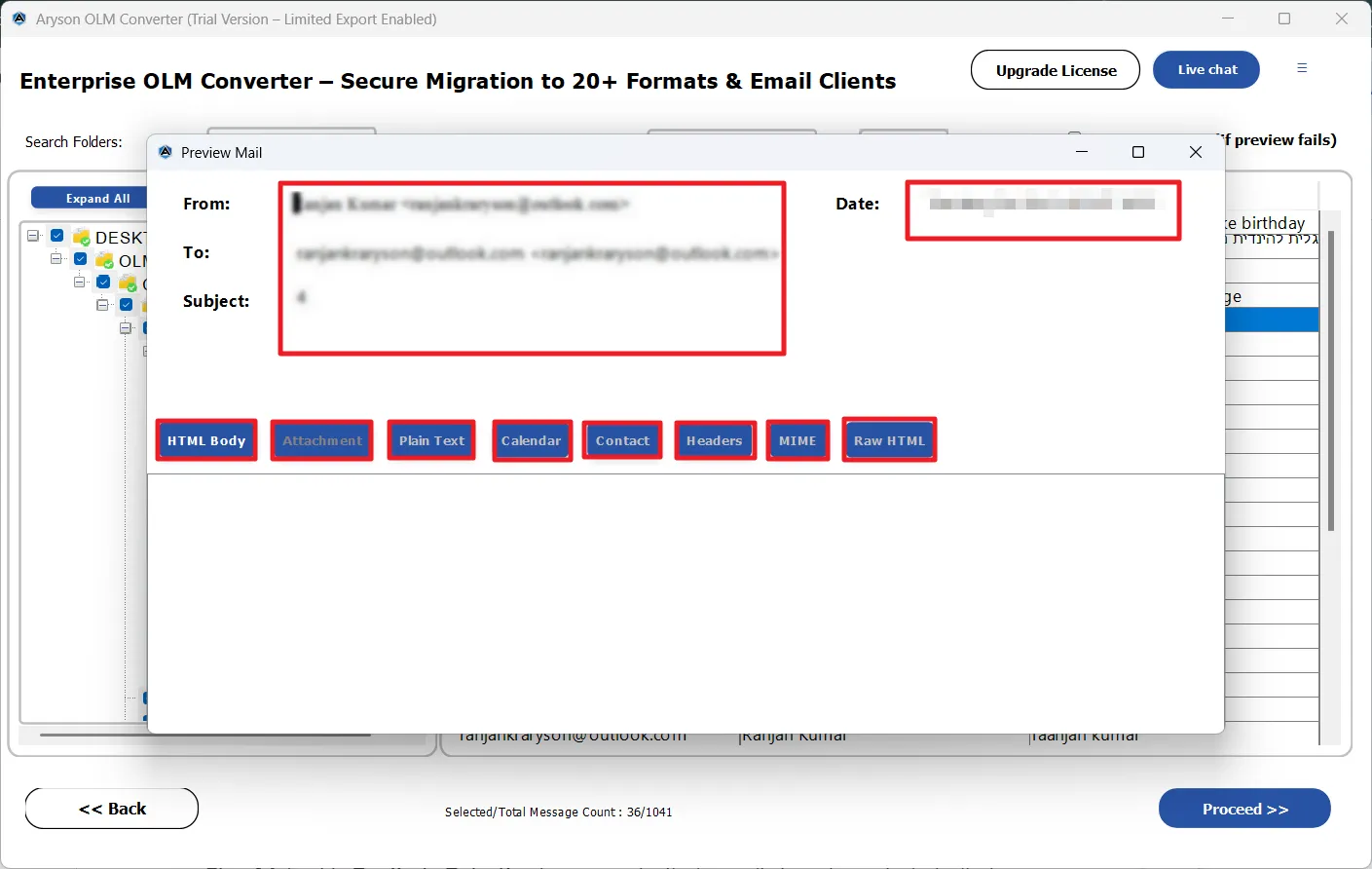
The Advanced Preview Panel displays the following details:
The Date, To, From, and Subject fields of the email. Along with that, the following details are displayed as well.
- HTML Body: View the original email with complete formatting and styling.
- Plain Text: Check the email content in a simple text format.
- Attachments: Preview all files attached to the selected email.
- Calendar: Review event details, including subject, date, time, and location.
- Contacts: View contact information stored in the mailbox.
- Notes: Access and verify saved notes.
- Tasks: Preview task details and related information.
- Headers: Examine technical email properties and routing information.
- MIME: View the MIME structure of the selected message.
- Raw HTML: Inspect the email's source HTML code and formatting structure.
For personal Gmail accounts:
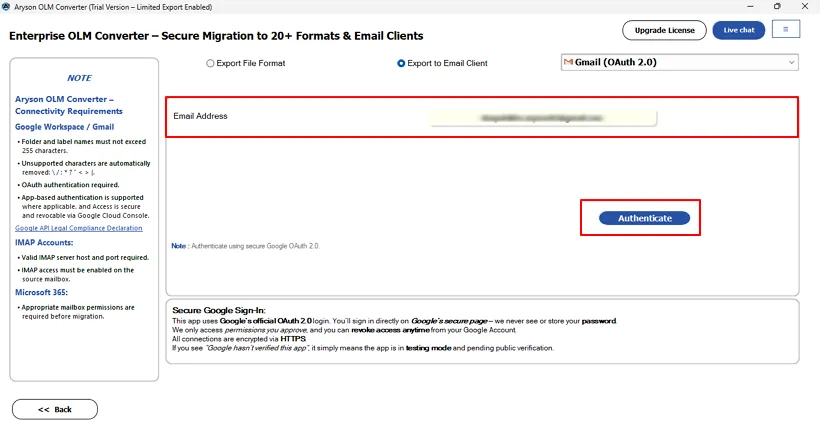
Step 4: Select Gmail app authentication or OAuth 2.0 under the Export to Email Client option.
Step 5: Authenticate your Gmail Account
Step 5.1.1: For Gmail App Authentication:
- Enter the target Gmail email address, OAuth client ID, and OAuth client secret. You can create a Google Client ID and Client Secret Using the Google Developers Console
- Click Authenticate to securely authorize the Gmail account and proceed with the migration.
Note: Make sure to first log in to your Gmail account in the browser to securely authenticate. Otherwise, the migration process will not continue.
Step 5.1.2: For Gmail OAuth 2.0:
- Enter the Gmail email address and click on the Authenticate button.
Step 5.2: Select the required Gmail account as per the requirement or click on the Use another account option to add another account.
Step 5.3: Click Continue if you agree to OLM Converter’s privacy policy and proceed further.
Step 5.4: After authentication, the browser window displays "Received verification code. You may close this window."
For Business or Enterprise Mailboxes:
Step 4: Select Google Workspace under the Export to Email Clients drop-down list.
Step 5: Log in via the workspace admin account and JSON key and click Authenticate. You can generate a JSON file with the help of the detailed guide.
Step 6: Map OLM Files to Google Workspace User Accounts
Associate the selected OLM file with the corresponding Google Workspace mailbox before starting the migration.
- Select the imported OLM file from the mapping list.
-
Click Select Directory Users and choose the target Google Workspace user account.

- Search or select the required User ID to map and click Apply.
- Search or select the required User ID to map and click Apply.
-
Alternatively, you can import a CSV file for bulk user mapping.
- Click on the Sample CSV button to save a demo CSV file.
- Afterwards, click on the Import CSV button to import the saved CSV file.
- Click ok and click on Select CSV users.
- Select the required user IDs of the users and click Apply.
Step 6: Configure Migration Settings
-
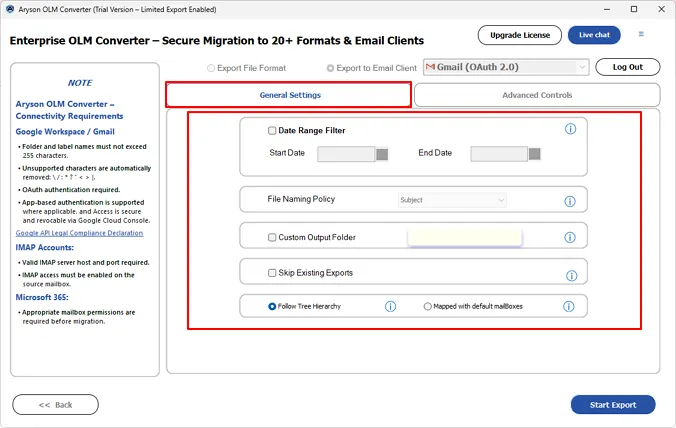
Apply the General Filters:
- Date Range Filter: Migrate emails within a specified start and end date range.
- Custom Output Folder: Specify a location to store migration logs and reports.
- Skip Existing Exports: Prevent duplicate migration of items already present in the destination account.
- Follow Tree Hierarchy: Preserve the original mailbox folder structure during migration.
- Mapped with Default Mailboxes: Automatically map source default folders to Gmail's default mailbox folders.
-
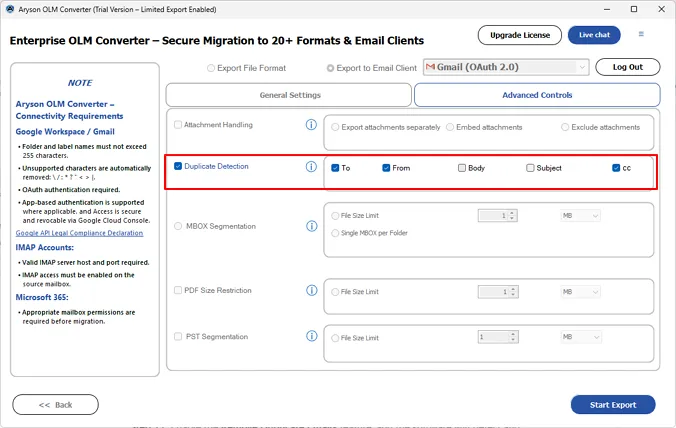
Apply the Advanced Filters:
- Attachment Handling: Exclude attachments during the migration.
- Duplicate Detection: Identify and skip duplicate emails based on fields such as To, From, Subject, Body, and CC.
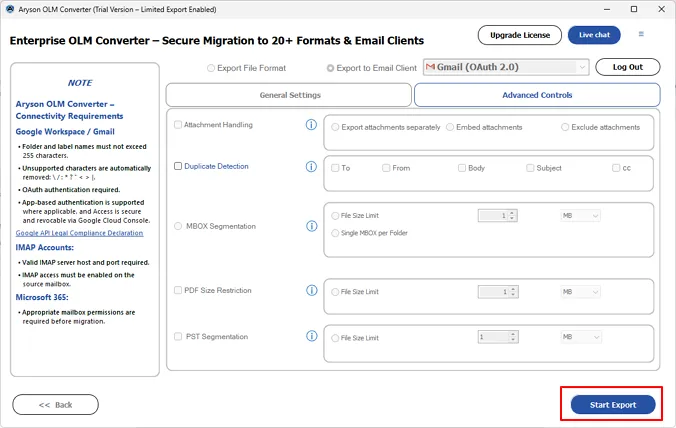
Step 7: Click on the Start Export button to begin the OLM to Google Workspace/Gmail migration.
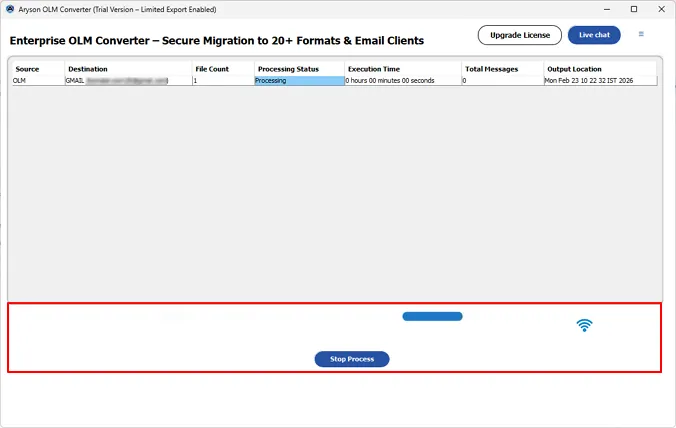
Step 8: Monitor and Complete the OLM to Google Workspace/Gmail Migration
After clicking Start Export, monitor the migration progress and review transfer statistics in real time.
- Source OLM File: Verify the selected OLM mailbox being migrated.
- Target Google Workspace Account: Confirm the destination Google Workspace user mailbox.
- Mailbox Items Processed: Track migrated emails and mailbox folders.
- Migration Status: View the current status of the migration process.
- Execution Time: Monitor the total time taken for migration.
- Total Messages: Check the number of emails migrated successfully.
- Target Mailbox: Verify the Google Workspace mailbox receiving the migrated data.
- Progress Bar: Follow the overall migration progress in real time.
- Stop Migration: Pause or cancel the migration process if required.
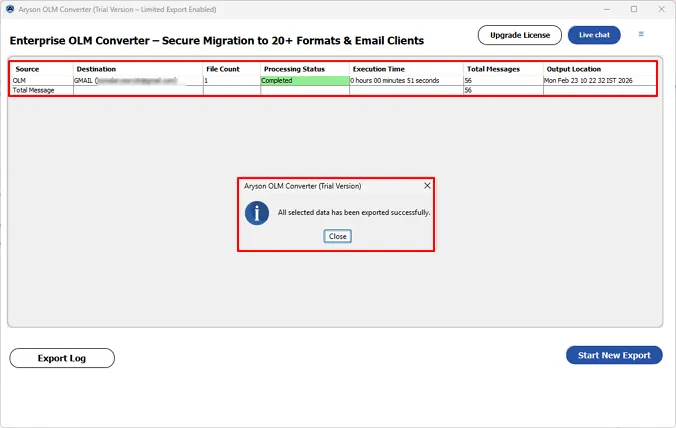
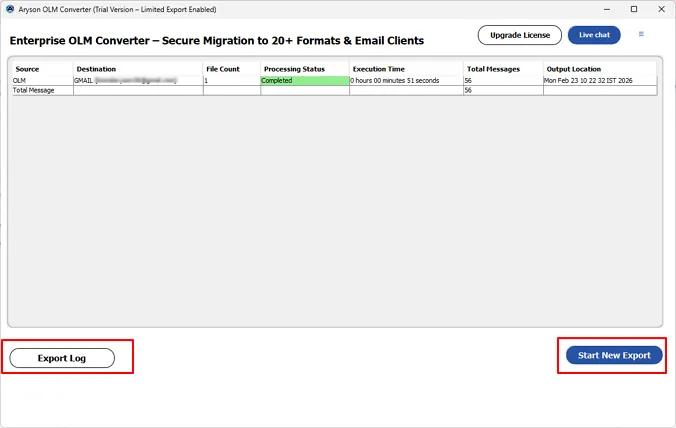
Step 9: Once the conversion completes, the software displays, “All selected data has been exported successfully." You can even use the additional options to proceed further.
- Export Log: Open the detailed log report to verify the export process and results.
- Start New Export: Begin another OLM conversion or migration task if required.
Activation Guide
Activate the Software
Installation & Uninstallation
Installation & Uninstallation of Software
User Interface
User Interface
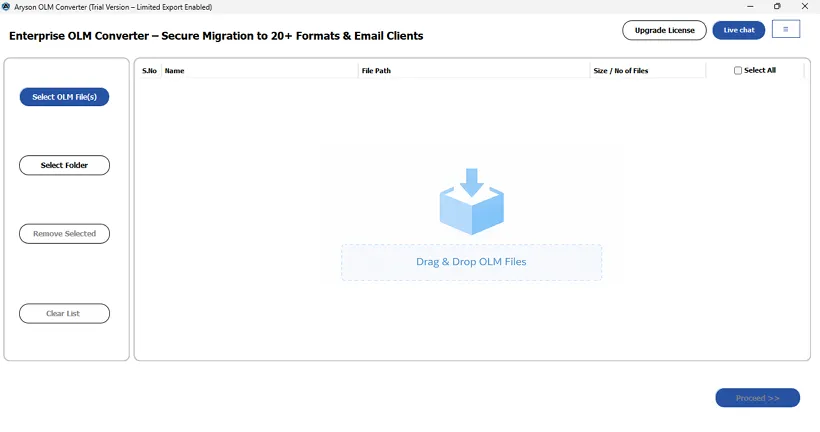
After downloading the Aryson OLM Converter Tool, you will find the welcome screen as played below.